

Kaveri | CBSE | Bharat Our Land Question Answer | NCERT Solutions For Class 9 English Literature Chapter 2 | Kaveri | Class IX | Best Guide 2026. It is required for Grade 9 students to build a strong foundation in the subject, and NCERT Solutions For Class 9 English Literature Chapter 2. Understanding the chapter thoroughly helps students grasp key concepts, improve comprehension, and perform well in exams.
In this article, Kaveri | CBSE | Bharat Our Land Poem Questions and Answers | NCERT Solutions For Class 9 English Literature Chapter 2 | Class IX | Best Guide 2026 by Subramania Bharati, we (ThinkSphereEdu.com) provide a detailed Bharat Our Land Summary to make learning easier and more effective. Whether you are a student looking for well-explained solutions or a parent guiding your child, this guide will be a helpful resource for mastering the chapter with confidence.
- Bharat Our Land Poem Summary in English:
- Bharat Our Land Poem Summary in Hindi:
- Bharat Our Land Poem Summary in Bengali:
- Reflect and Respond: (Bharat Our Land Question Answer) Page – 23
- Check Your Understanding: (Bharat Our Land Question Answer) Page – 25
- Critical Reflection: (Bharat Our Land Question Answer) Page – 28
- Vocabulary in Context: (Bharat Our Land Question Answer) Page – 29
- Listen and Respond: (Bharat Our Land Question Answer) Page – 30
- Speaking Activity: (Bharat Our Land Poem Questions And Answers) Page – 31
- Writing Task: (Bharat Our Land Poem Questions And Answers) Page – 31
CBSE | Kaveri | Bharat Our Land Question Answer Solved | Class 9 | English Literature | Must Read
Bharat Our Land Poem Summary in English:
The poet describes India as an exceptional country which has no equivalent among the countries of the world. The poet proudly describes the mighty Himalayas and the river Ganga as special gifts of this land.
He also talks about the rich spiritual and cultural heritage of India. The sacred Upanishads were written here, which contain great wisdom and knowledge. The poet describes this land as having received continuous blessings which brought it courageous warriors and wise sages together with beautiful music.
The poet shows us that India served as the birthplace of important spiritual beliefs. The knowledge of Brahma-knowledge which reveals life’s truth developed in this area while Lord Buddha delivered his teachings throughout this region.
The poet declares that India maintains an ancient and exceptional historical past. The country stands out as unmatched because of its natural beauty and cultural heritage and its wisdom traditions and spiritual practices. The golden land should receive praise from everyone according to him because he wants people to feel proud about it.
Bharat Our Land Poem Summary in Hindi:
कवि भारत को एक ऐसा खास देश बताते हैं जिसका दुनिया के देशों में कोई मुकाबला नहीं है। कवि गर्व से ताकतवर हिमालय और गंगा नदी को इस ज़मीन का खास तोहफ़ा बताते हैं।
वह भारत की समृद्ध आध्यात्मिक और सांस्कृतिक विरासत के बारे में भी बात करते हैं। पवित्र उपनिषद यहीं लिखे गए थे, जिनमें बहुत ज्ञान और समझ है। कवि बताते हैं कि इस ज़मीन को लगातार आशीर्वाद मिला जिससे यहाँ बहादुर योद्धा और बुद्धिमान ऋषि-मुनि और सुंदर संगीत मिले।
कवि हमें दिखाते हैं कि भारत ज़रूरी आध्यात्मिक मान्यताओं की जन्मभूमि रहा है। जीवन की सच्चाई बताने वाला ब्रह्म-ज्ञान इसी इलाके में विकसित हुआ, जबकि भगवान बुद्ध ने इस पूरे इलाके में अपनी शिक्षाएँ दीं।
कवि कहते हैं कि भारत का एक पुराना और खास इतिहास रहा है। यह देश अपनी प्राकृतिक सुंदरता और सांस्कृतिक विरासत और अपनी ज्ञान परंपराओं और आध्यात्मिक कामों की वजह से बेमिसाल है। उनके अनुसार, इस सुनहरी ज़मीन की सभी को तारीफ़ करनी चाहिए क्योंकि वह चाहते हैं कि लोग इस पर गर्व महसूस करें।
Bharat Our Land Poem Summary in Bengali:
কবি ভারতকে একটি ব্যতিক্রমী দেশ হিসেবে বর্ণনা করেছেন যার পৃথিবীর অন্য দেশগুলোর মধ্যে কোন তুলনা নেই। কবি গর্বের সাথে মহান হিমালয় এবং গঙ্গা নদীকে এই ভূমির বিশেষ উপহার হিসেবে বর্ণনা করেছেন।
তিনি ভারতের সমৃদ্ধ আধ্যাত্মিক ও সাংস্কৃতিক ঐতিহ্য সম্পর্কেও কথা বলেছেন। পবিত্র উপনিষদ এখানে রচিত হয়েছে, যেখানে মহান জ্ঞান ও জ্ঞান রয়েছে। কবি এই ভূমিকে অবিরাম আশীর্বাদ লাভ করেছে বলে বর্ণনা করেছেন যা এটিকে সাহসী যোদ্ধা এবং জ্ঞানী ঋষিদের সুন্দর সঙ্গীতের সাথে একত্রিত করেছে।
কবি আমাদের দেখান যে ভারত গুরুত্বপূর্ণ আধ্যাত্মিক বিশ্বাসের জন্মস্থান হিসেবে কাজ করেছে। ব্রহ্ম জ্ঞান – যা জীবনের সত্য প্রকাশ করে এই অঞ্চলে বিকশিত হয়েছিল যখন ভগবান বুদ্ধ এই অঞ্চল জুড়ে তাঁর শিক্ষা প্রদান করেছিলেন।
কবি ঘোষণা করেন যে ভারত একটি প্রাচীন এবং ব্যতিক্রমী ঐতিহাসিক অতীত বজায় রেখেছে। দেশটি তার প্রাকৃতিক সৌন্দর্য এবং সাংস্কৃতিক ঐতিহ্য এবং তার জ্ঞানের ঐতিহ্য এবং আধ্যাত্মিক অনুশীলনের কারণে অতুলনীয়। তার মতে, সোনালী ভূমির সকলের কাছ থেকে প্রশংসা পাওয়া উচিত কারণ তিনি চান মানুষ এটি নিয়ে গর্বিত হোক।
Bharat Our Land Question Answer | Exam Preparation | 2026-27
Reflect and Respond: (Bharat Our Land Question Answer) Page – 23
I. Recall the lines of the National Anthem and complete the table given below with the names of the states, mountain ranges, and rivers mentioned in it.
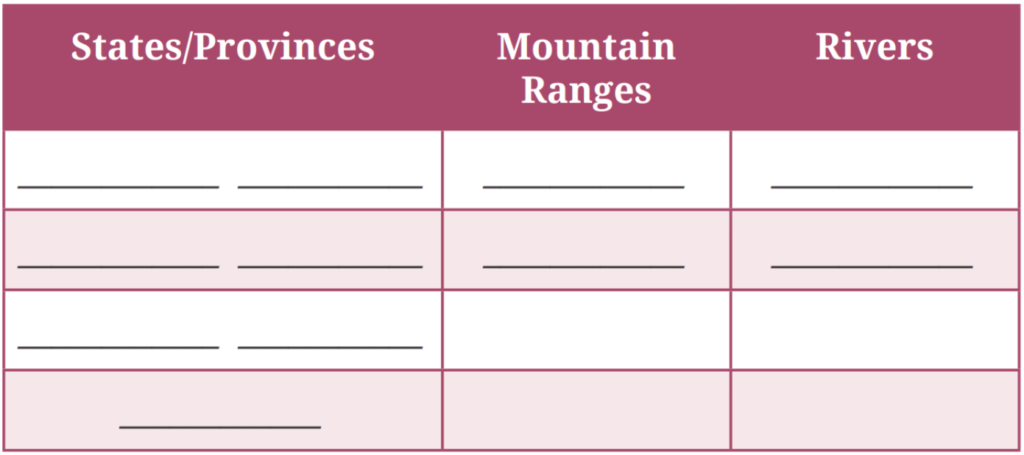
Answer: The lines are
“Punjab Sindh Gujarat Maratha
Dravida Utkala Banga
Vindhya Himachala
Yamuna Ganga”
Here the states, mountain ranges and rivers are:
- States/Provinces: Punjab, Sindh, Gujarat, Maratha, Dravida, Utkala, Banga
- Mountain Ranges: Vindhya, Himachala (Himalayan region)
- Rivers: Yamuna, Ganga
| States\Provinces | Mountain Ranges | Rivers |
|---|---|---|
| Punjab, Sindh | Vindhya | Yamuna |
| Gujarat, Maratha | Himachala (Himalaya) | Ganga |
| Dravida | ||
| Utkala, Banga |
II. Work in pairs. Discuss what the words ‘जय हे’ (Jaya he) in the last two lines of the National Anthem convey Share your answer with your classmates and teacher.
Answer: The words “जय हे” (Jaya he) in the last two lines of the National Anthem express praise, victory, and respect for the nation. These words show our deep love and pride for India. By saying “Jaya he,” we celebrate the greatness of our country and honour the guiding spirit that protects and unites the people of India. It also expresses a wish for the continued success and glory of the nation.
III. Read the underlined words in the given lines of the poem. Choose the odd one out that does not correspond with the meaning of the underlined word.
- She’s peerless, let’s praise her! (valuable, incomparable, unmatched)
- Many a sage has sanctified this land. (blessed, purified, applauded)
- And here all auspicious things are found. (fortunate, fantastic, favourable)
- Of hoary antiquity is Bharat. (ancient times, recent past, time immemorial)
Answer:
- Peerless -> valuable
- Sanctified -> applauded
- Auspicious -> fantastic
- Hoary antiquity -> recent past
Check Your Understanding: (Bharat Our Land Question Answer) Page – 25
I. Fill in the blanks by choosing appropriate words from the box given below to complete the summary of the poem.
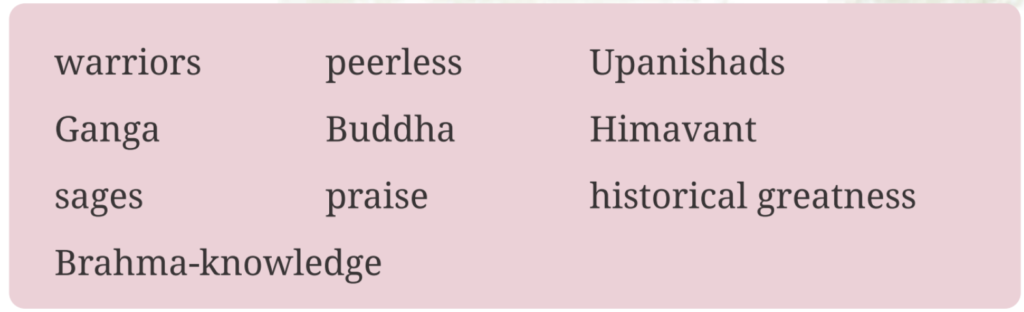
The poem is a tribute to India, celebrating its natural beauty, spiritual heritage, and 1. ______. The poet praises the 2. _________, describing it as mighty and unparalleled. The 3. _________ is depicted as generous and graceful, while the 4. ________ are honoured as sacred and unmatched. The poem highlights the contributions of 5. ______ and 6. _________ who have enriched the land with their bravery and wisdom. It also acknowledges the presence of 7. ________ and the teachings of 8. ________, highlighting India’s deep-rooted spiritual and philosophical traditions. The poet repeatedly asserts that India is 9. _________, urging everyone to 10. _______ her.
Answer: The poem is a tribute to India, celebrating its natural beauty, spiritual heritage, and historical greatness. The poet praises the Himavant, describing it as mighty and unparalleled. The Ganga is depicted as generous and graceful, while the Upanishads are honoured as sacred and unmatched. The poem highlights the contributions of warriors and sages who have enriched the land with their bravery and wisdom. It also acknowledges the presence of Brahma-knowledge and the teachings of Buddha, highlighting India’s deep-rooted spiritual and philosophical traditions. The poet repeatedly asserts that India is peerless, urging everyone to praise her.
II. Complete the following features about the poem.
- The impact on the readers (mood): _____________
- The poet’s attitude (tone): ____________
- The rhyme scheme: _______________
- Examples of personification: ____________
Answer:
- The mood of the poem is patriotic and inspiring. It makes readers feel proud of India and its rich heritage.
- The tone of the poem is admiring and proud, as the poet praises the greatness and uniqueness of India.
- The rhyme scheme of the poem is ABAB.
- The generous Ganga is ours”, “This sunny golden land is ours – she’s peerless”
III. What is the impact of the refrain, ‘she’s peerless, let’s Praise her!’?
Answer: The refrain emphasizes the greatness and uniqueness of India. By repeating this line, the poet reminds readers again and again that India has no equal in the world. It also creates a strong feeling of pride and encourages people to admire, respect, and praise their motherland. The repetition makes the message of the poem more powerful and memorable.
IV. Complete the following sentence appropriately.
India is metaphorically described as ‘this sunny golden land,’ suggesting that it is ____________.
Answer: India is metaphorically described as “this sunny golden land,” suggesting that it is bright, prosperous, beautiful, and full of richness and hope.
IV. The poet uses symbolism. Match the symbols in Column 1 to what they suggest in Column 2.
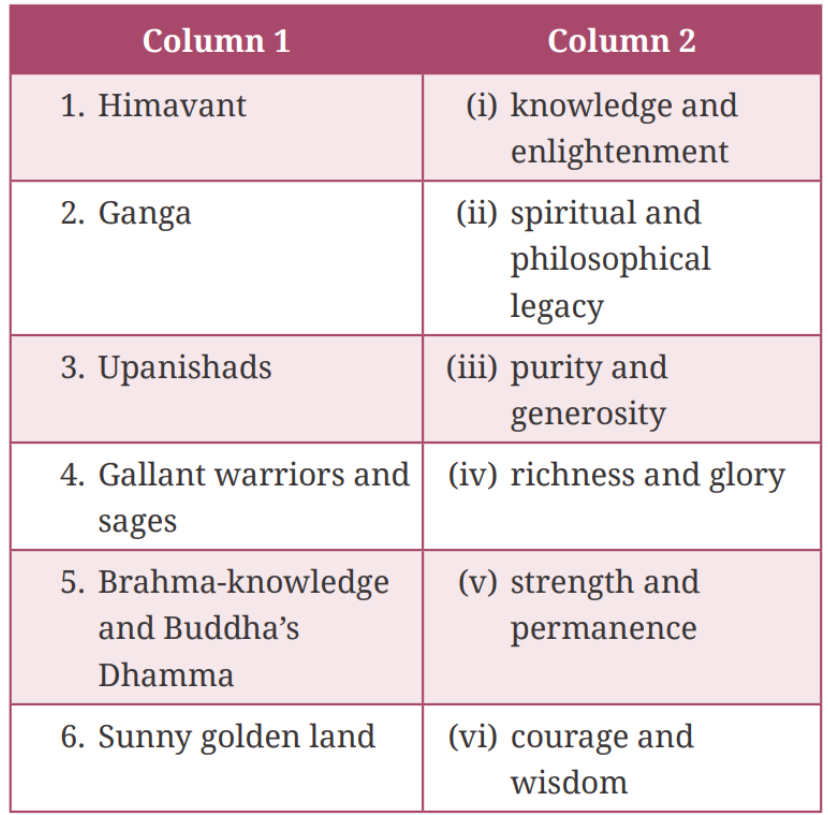
Answer:
| Column 1 | Column 2 |
|---|---|
| 1. Himavant | (v) strength and permanence |
| 2. Ganga | (iii) purity and generosity |
| 3. Upanishads | (ii) spiritual and philosophical legacy |
| 4. Gallant warriors and sages | (vi) courage and wisdom |
| 5. Brahma-knowledge and Buddha’s Dhamma | (i) knowledge and enlightenment |
| 6. Sunny golden land | (iv) richness and glory |
VI. The poet uses imagery (descriptive language to create vivid mental pictures that appeal to the senses). Give any two examples from the poem.
Answer:
- “The mighty Himavant is ours.” – This line creates a strong picture of the huge and powerful Himalayan mountains.
- “This sunny golden land is ours.” – This line gives a bright and beautiful image of India as a shining and rich land.
VII. What is the impact of the use of hyphens in the first stanza? Select the options that are true.
| 1. Creates deliberate pauses to reinforce the sense of admiration and pride |
| 2. Emphasises the contrast between India’s strengths and weaknesses |
| 3. Lends to the lyrical quality giving it a measured, chant-like rhythm |
| 4. Suggests hesitation or uncertainty in the poet’s claims about India |
| 5. Presents a key element of India’s greatness before the hyphen and makes a strong assertion about its uniqueness after the hyphen |
Answer: The correct options are
| 1. Creates deliberate pauses to reinforce the sense of admiration and pride |
| 3. Lends to the lyrical quality giving it a measured, chant-like rhythm |
| 5. Presents a key element of India’s greatness before the hyphen and makes a strong assertion about its uniqueness after the hyphen |
Critical Reflection: (Bharat Our Land Question Answer) Page – 28
I. Read the extract given below and answer the questions that follow.
The mighty Himavant is ours-
there’s no equal anywhere on earth.
The generous Ganga is ours-
which other river can match her grace?
The sacred Upanishads are ours-
what scriptures else to name with them?
1. Complete the sentence.
The word ‘mighty’ refers to the __________ of the Himavant.
Answer: The word ‘mighty’ refers to the strength and greatness of the Himavant.
2. Choose the correct option to complete the sentence given below.
The question mark at the end of the fourth and sixth line of the extract is used to ______.
- show doubt and uncertainty
- emphasise a point
- highlight confusion and hesitation
- reveal inquiry and curiosity
Answer: The question mark at the end of the fourth and sixth line is used to emphasise a point.
3. The poet uses the word ‘generous’ to describe the Ganga. Why?
Answer: The poet calls the Ganga generous because it gives water and life to people, helps in farming, and supports many living beings along its banks.
4. Why has the movement of the river been described as graceful?
Answer: The movement of the river is described as graceful because it flows smoothly and beautifully across the land.
4. Fill in the blank with the correct option from the words given in the brackets.
The poet is implying that the Upanishads are _________(unmatched/abundant) in their wisdom and spiritual depth.
Answer: The poet is implying that the Upanishads are unmatched in their wisdom and spiritual depth.
II. Answer the following questions.
1. How does the poem reflect a strong connection to cultural identity and heritage?
Answer: The poem shows India’s cultural identity by mentioning the Himalayas, the Ganga, the Upanishads, brave warriors, and wise sages. These symbols represent India’s rich culture, history, and spiritual traditions.
2. What can you infer about the poet’s attitude towards India from the repeated phrase ‘she’s peerless, let’s praise her!’?
Answer: The repeated phrase shows that the poet feels deep pride and admiration for India. He believes that India is unique and has no equal in the world.
3. What does the line ‘many a sage has sanctified this land’ suggest about India’s spiritual heritage?
Answer: This line suggests that many holy men and wise sages lived and taught in India. Their presence made the land spiritually rich and sacred.
4. How does the poet connect warriors and music to India’s greatness?
Answer: The poet says that India has produced brave warriors who protected the land and beautiful music that shows its rich cultural tradition. Both bravery and art add to the greatness of the country.
5. How does this poem foster a sense of national pride?
Answer: The poem praises India’s natural beauty, history, culture, and spiritual knowledge. By highlighting these great qualities, it makes readers feel proud of their country.
Vocabulary in Context: (Bharat Our Land Question Answer) Page – 29
I. Complete the table by choosing words from the poem.
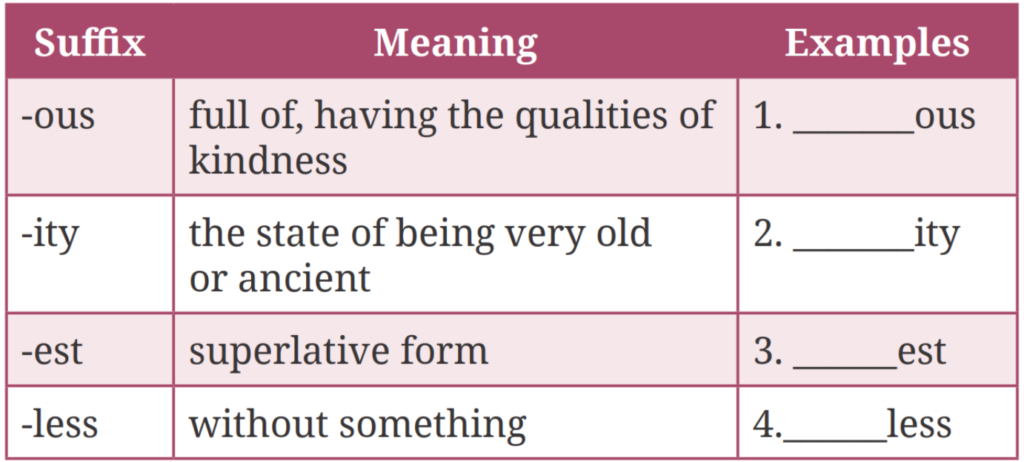
Answer:
- ______ous -> generous
- ______ity -> antiquity
- ______est -> divinest
- ______less -> peerless
II. Complete the following table by adding a different suffix to form new words. Also, create a sentence using the created word. One example has been done for you.
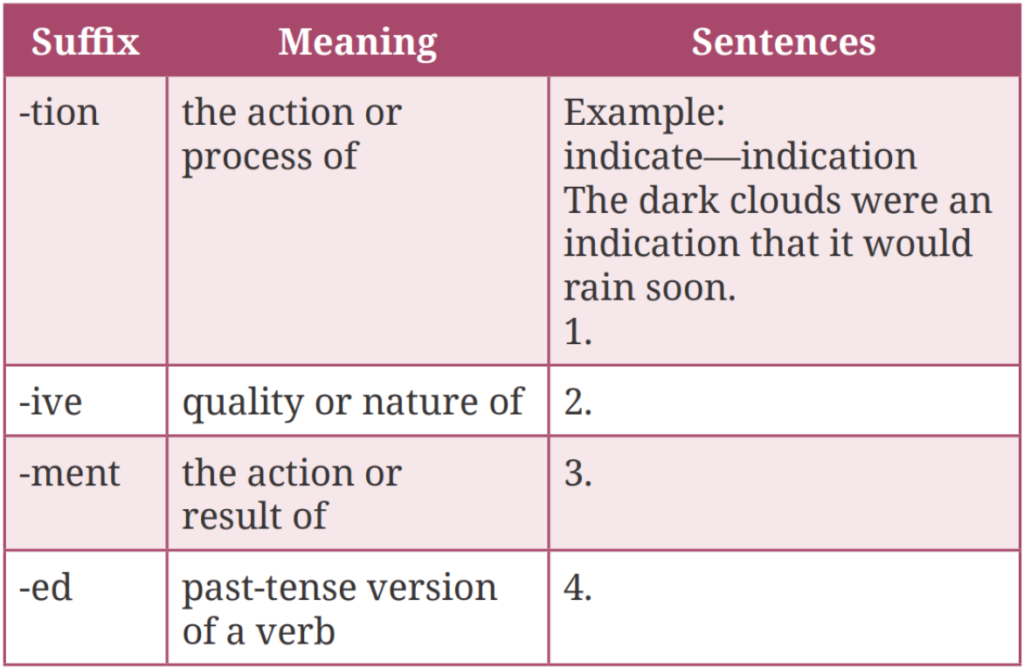
Answer:
- create -> creative ( Sentence: She is a very creative student.)
- achieve -> achievement ( Sentence: Winning the prize was a great achievement for him. )
- bless -> blessed ( Sentence: The land was blessed by many wise sages. )
Listen and Respond: (Bharat Our Land Question Answer) Page – 30
I. You will listen to four people talk about the places they like to travel to. As you listen, write the speaker number for the two pictures given. (Transcript for teacher on page 260)
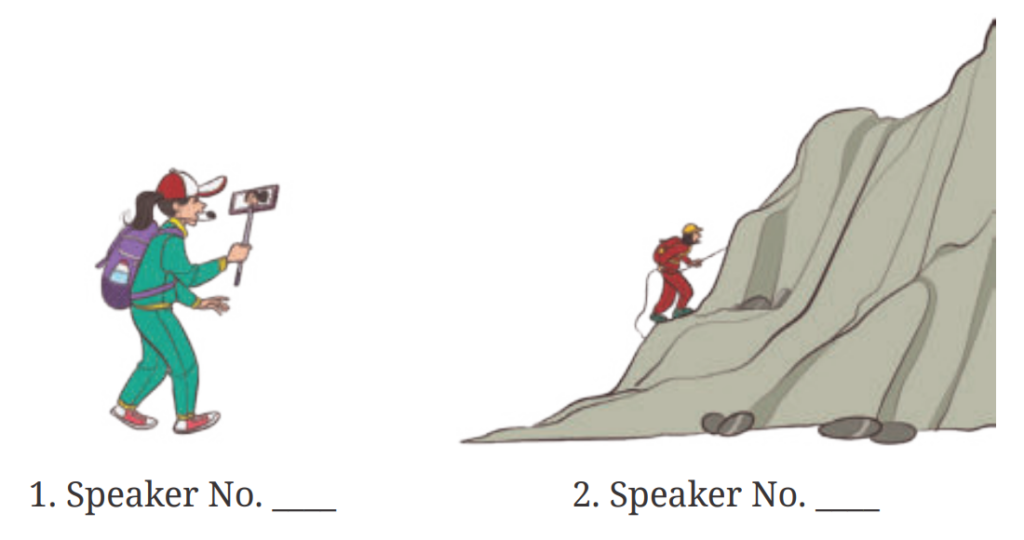
Answer:
- Speaker No. 4
- Speaker No. 2
II. You will once again listen to the four speakers. As you listen, match the given statements to the speaker. There are two statements that you do not need. (Transcript for teacher on page 260)
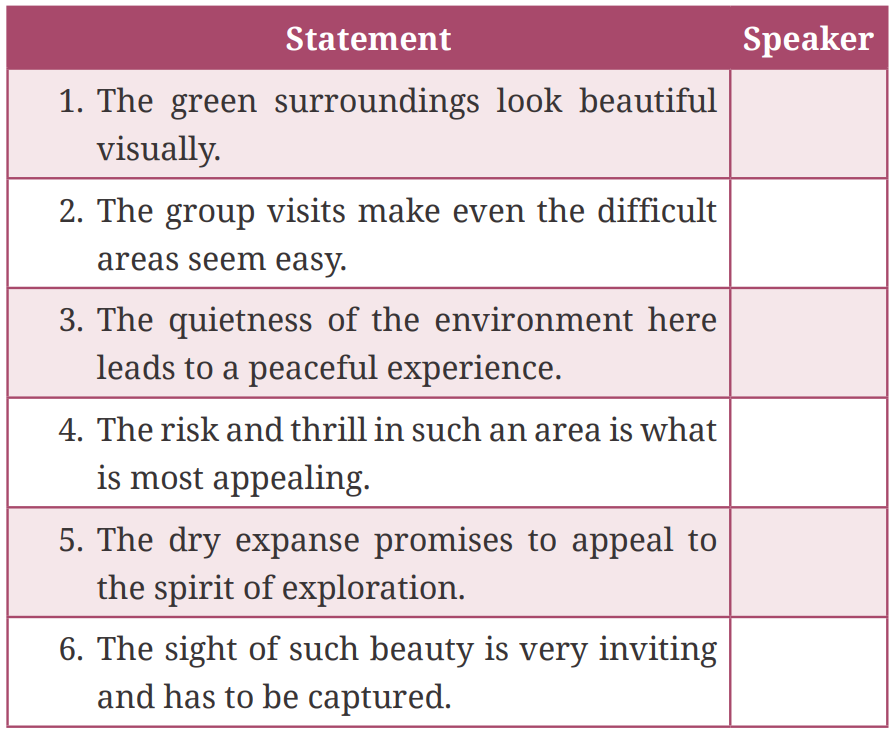
Answer:
| Statement | Speaker |
|---|---|
| The green surroundings look beautiful visually. | Speaker 4 |
| The group visits make even the difficult areas seem easy. | Not needed |
| The quietness of the environment here leads to a peaceful experience. | Speaker 1 |
| The risk and thrill in such an area is what is most appealing. | Speaker 2 |
| The dry expanse promises to appeal to the spirit of exploration. | Not needed |
| The sight of such beauty is very inviting and has to be captured. | Speaker 3 |
Speaking Activity: (Bharat Our Land Poem Questions And Answers) Page – 31
I. In pairs, take turns to speak about the aspects of your village/town/city that you feel are an asset. It could be about geographical, cultural, traditional features, or even its history.

Answer:
I live in a small village in Paschim Medinipur. One of the biggest assets of my village is its natural beauty. There are green fields all around, and the air is fresh and peaceful. Most of the people here are farmers and they live a simple life. The people of the village are very friendly and always help each other in times of need. We celebrate festivals like Durga Puja, Saraswati Puja, and Kali Puja with great enthusiasm. Our village also has some old temples that show its traditional and cultural values. Because of these things, I feel proud of my village.
Writing Task: (Bharat Our Land Poem Questions And Answers) Page – 31
I. Write a paragraph about a place that you have visited which has stayed in your memory. Remember to mention the following:
- Why did you go there?
- Who did you travel with?
- How did you prepare for the travel?
- Where did you stay?
- What activities did you do there?
Answer:
Last year I visited Puri in Odisha, and the trip has stayed in my memory for a long time. I went there mainly to see the famous Jagannath Temple and to spend some time near the sea. I travelled with my family, and we were all very excited about the journey. Before leaving, we packed our clothes, booked our train tickets, and planned our trip properly. We stayed in a small hotel near the sea beach. During our visit, we went to the temple, walked along the beach, enjoyed the sea waves, and watched the beautiful sunrise in the morning. It was a very enjoyable trip, and I still remember the peaceful and happy moments we spent there.
These NCERT solutions for Chapter 2 are really helpful for understanding the text, and I found a similar breakdown of the key themes on https://pvid.app. It’s good to have multiple resources when studying!
Thank you for your thoughtful feedback! 😊
We’re really glad to hear that the NCERT solutions helped you understand the chapter better. You’re absolutely right—exploring multiple resources can make learning even more effective and clear.
We appreciate you sharing another helpful platform as well! Thanks for your support, and keep visiting for more useful study content. 📚✨