
Kaveri | CBSE | How I Taught My Grandmother To Read Question Answer Solutions | Class IX | Best Guide 2026. It is required for Grade 9 students to build a strong foundation in the subject, and NCERT Solutions For Class 9 English Literature Chapter 1. Understanding the chapter thoroughly helps students grasp key concepts, improve comprehension, and perform well in exams.
In this article, Kaveri | CBSE | How I Taught My Grandmother To Read Question Answer Solutions | Class IX | Best Guide 2026 by Sudha Murty, we (ThinkSphereEdu.com) provide a detailed How I Taught My Grandmother To Read Summary to make learning easier and more effective. Whether you are a student looking for well-explained solutions or a parent guiding your child, this guide will be a helpful resource for mastering the chapter with confidence.
- How I Taught My Grandmother To Read Summary in English:
- How I Taught My Grandmother To Read Summary in Bengali:
- Reflect and Respond: (how i taught my grandmother to read pdf)
- Check Your Understanding: (How I Taught My Grandmother To Read Question Answer)
- Check Your Understanding: (How I Taught My Grandmother To Read Question Answer) Page-9
- Critical Reflection: (How I Taught My Grandmother To Read Question Answer) Page-10
- Vocabulary and Structures in Context: (How I Taught My Grandmother To Read Question Answer) Page-10
- Listen And Respond: (How I Taught My Grandmother To Read Question Answer) Page-17
- Writing Task: (How I Taught My Grandmother To Read Question Answer) Page-19
- Learning Beyond the Text: (How I Taught My Grandmother To Read Question Answer) Page-20
CBSE | Kaveri | How I Taught My Grandmother To Read Question Answer Solved | Class 9 | English Literature | Must Read
How I Taught My Grandmother To Read Summary in English:
The story is written by Sudha Murty. It describes a touching incident from her childhood and shows that there is no age limit for learning.
When the author was about twelve years old, she lived with her grandparents in a village in north Karnataka. At that time, the transport system was poor, so newspapers and magazines arrived late. The family eagerly waited for the weekly Kannada magazine Karmaveera, which carried a popular serial novel called “Kashi Yatre” written by Triveni.
The author’s grandmother, Krishtakka, had never gone to school and could not read. Every week the author would read the new episode of the story to her grandmother. The grandmother listened very carefully and enjoyed the story a lot. She especially liked the character of the old lady who wanted to go to Kashi (Varanasi) but finally gave her savings to help a poor orphan girl get married. The grandmother felt a deep connection with the story.
One day, the author went to another village for a wedding and stayed there for a week. During that time the next issue of the magazine arrived. The author’s grandmother tried to read it but she could not understand anything because she was illiterate. She felt very helpless and dependent.
That night, the grandmother told the author about her sadness. She decided that she wanted to learn to read and write Kannada so that she would never depend on anyone again. She set a goal to learn the alphabet before the Dassara festival. At first the author laughed at her because she was sixty-two years old, but the grandmother was determined.
From the next day, the author started teaching her grandmother. The grandmother worked very hard and practiced reading and writing every day. When the Dassara festival arrived, the author gifted her grandmother the novel “Kashi Yatre.” The grandmother successfully read the title of the book herself.
As a sign of respect, the grandmother touched the author’s feet, saying that she was not touching her granddaughter’s feet but the feet of her teacher. The author felt very proud and touched. She realized that learning has no age limit and teachers should always be respected.
How I Taught My Grandmother To Read Summary in Bengali:
গল্পটি লিখেছেন সুধা মূর্তি। এতে তার শৈশবের একটি মর্মস্পর্শী ঘটনা বর্ণনা করা হয়েছে এবং দেখানো হয়েছে যে শেখার জন্য কোনও বয়সের সীমা নেই।
লেখিকা যখন প্রায় বারো বছর বয়সী ছিলেন, তখন তিনি উত্তর কর্ণাটকের একটি গ্রামে তার দাদা-দাদির সাথে থাকতেন। সেই সময় পরিবহন ব্যবস্থা খারাপ ছিল, তাই সংবাদপত্র এবং ম্যাগাজিনগুলি দেরিতে আসত। পরিবারটি সাপ্তাহিক কন্নড় ম্যাগাজিন কর্মবীরের জন্য অধীর আগ্রহে অপেক্ষা করত, যেখানে ত্রিবেণীর লেখা “কাশী যাত্রা” নামে একটি জনপ্রিয় ধারাবাহিক উপন্যাস প্রকাশিত হত।
লেখিকার দাদি, কৃষ্টাক্কা, কখনও স্কুলে যাননি এবং পড়তে পারতেন না। প্রতি সপ্তাহে লেখক তার দাদির কাছে গল্পের নতুন পর্বটি পড়তেন। দাদি খুব মনোযোগ সহকারে শুনতেন এবং গল্পটি খুব উপভোগ করতেন। তিনি বিশেষ করে বৃদ্ধা মহিলার চরিত্রটি পছন্দ করেছিলেন যিনি কাশী (বারাণসী) যেতে চেয়েছিলেন কিন্তু অবশেষে একটি দরিদ্র অনাথ মেয়ের বিয়েতে সাহায্য করার জন্য তার জমানো অর্থ দান করেছিলেন। দাদি গল্পের সাথে গভীর সংযোগ অনুভব করেছিলেন।
একদিন, লেখক একটি বিয়ের জন্য অন্য গ্রামে গিয়েছিলেন এবং সেখানে এক সপ্তাহ ছিলেন। সেই সময়ের মধ্যে ম্যাগাজিনের পরবর্তী সংখ্যাটি এসেছিল। লেখকের ঠাকুমা এটি পড়ার চেষ্টা করেছিলেন কিন্তু তিনি কিছুই বুঝতে পারেননি কারণ তিনি নিরক্ষর ছিলেন। তিনি খুব অসহায় এবং নির্ভরশীল বোধ করেছিলেন।
সেই রাতে, ঠাকুমা লেখককে তার দুঃখের কথা বলেছিলেন। তিনি সিদ্ধান্ত নিয়েছিলেন যে তিনি কন্নড় পড়তে এবং লিখতে শিখতে চান যাতে তিনি আর কখনও কারও উপর নির্ভর না করেন। তিনি দশরা উৎসবের আগে বর্ণমালা শেখার লক্ষ্য স্থির করেছিলেন। প্রথমে লেখক তাকে নিয়ে হেসেছিলেন কারণ তার বয়স বাষট্টি বছর ছিল, কিন্তু ঠাকুমা দৃঢ়প্রতিজ্ঞ ছিলেন।
পরের দিন থেকে, লেখক তার ঠাকুমাকে পড়াতে শুরু করেছিলেন। ঠাকুমা খুব কঠোর পরিশ্রম করেছিলেন এবং প্রতিদিন পড়া এবং লেখার অনুশীলন করেছিলেন। যখন দশরা উৎসব এসেছিল, তখন লেখক তার ঠাকুমাকে “কাশী যাত্রা” উপন্যাসটি উপহার দিয়েছিলেন। ঠাকুমা নিজেই বইটির শিরোনামটি সফলভাবে পড়েছিলেন।
শ্রদ্ধার নিদর্শন হিসেবে, ঠাকুমা লেখকের পা স্পর্শ করেছিলেন, বলেছিলেন যে তিনি তার নাতনীর পা স্পর্শ করছেন না বরং তার শিক্ষকের পা স্পর্শ করছেন। লেখক খুব গর্বিত এবং স্পর্শিত বোধ করেছিলেন। তিনি বুঝতে পেরেছিলেন যে শেখার কোনও বয়সসীমা নেই এবং শিক্ষকদের সর্বদা সম্মান করা উচিত।
How I Taught My Grandmother To Read Questions And Answers | Exam Preparation
Reflect and Respond: (how i taught my grandmother to read pdf)
I. Complete the given word web.
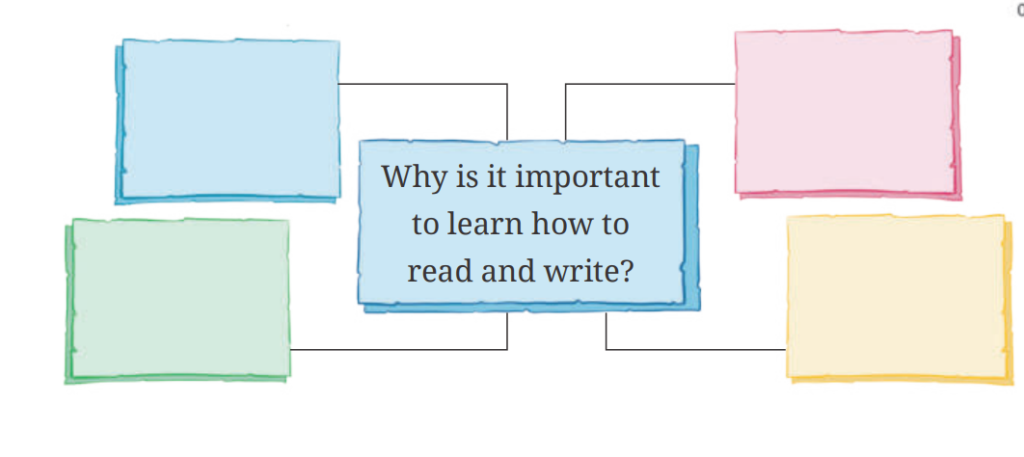
Answer:
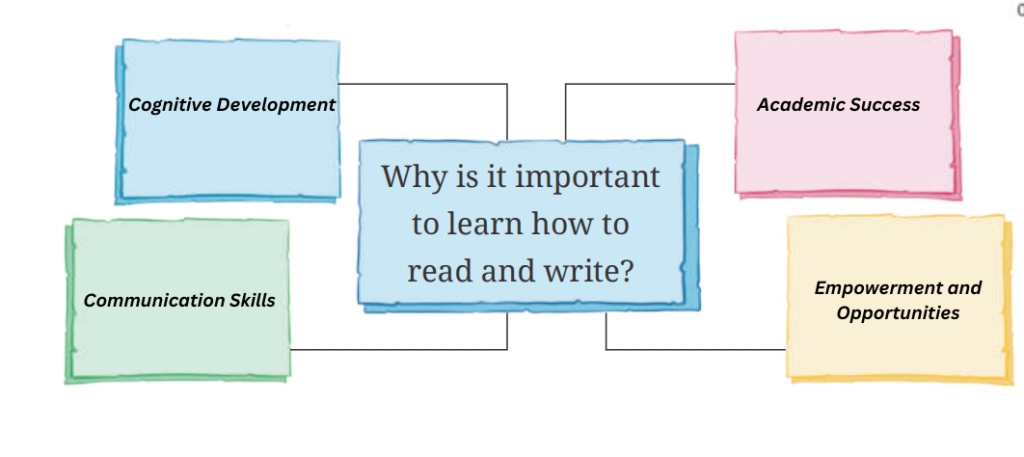
II. Read the questions given below and share your answers with your classmates and teacher.
1. Which language(s) do your grandparents or elderly relatives speak?
Answer: My grandparents speak Bengali and can also understand a little Hindi.
2. How do they spend their time? How do you spend time with them?
Answer: My grandparents usually spend their time praying, watching television, talking with neighbours, and telling stories about their past. I spend time with them by talking, listening to their stories, and sometimes helping them with small tasks.
3. What is your favourite experience with them?
Answer: My favourite experience with them is listening to their interesting stories about their childhood and old village life.
4. What is something that the elderly in your family cannot do easily but enjoy watching you do?
Answer: The elderly in my family cannot use smartphones and the internet easily, but they enjoy watching me use them and show them photos or videos.
III. Read the following passage. Match the highlighted words with their meanings given in the box below.
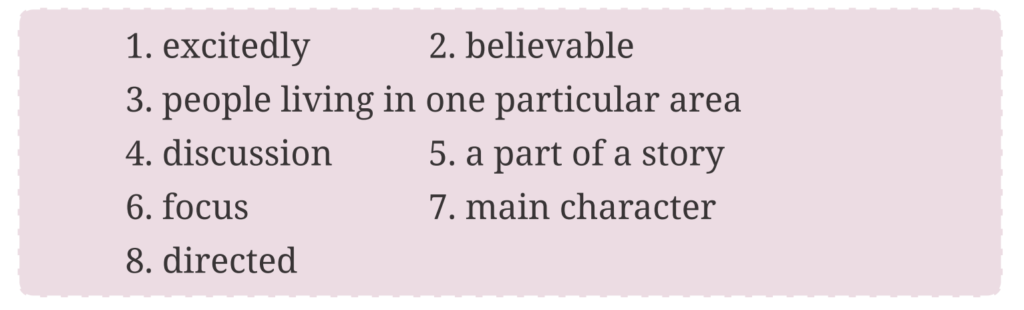
Answer: From the passage How I Taught My Grandmother to Read, the highlighted words match these meanings:
- excitedly -> eagerly
- believable -> convincing
- people living in one particular area -> neighbours
- discussion -> debate
- a part of a story -> episode
- focus -> concentration
- main character -> protagonist
- directed -> guided
Check Your Understanding: (How I Taught My Grandmother To Read Question Answer)
I. Complete the cause and effect table given below based on Part I of the story. Share your answers with your classmates and teacher.
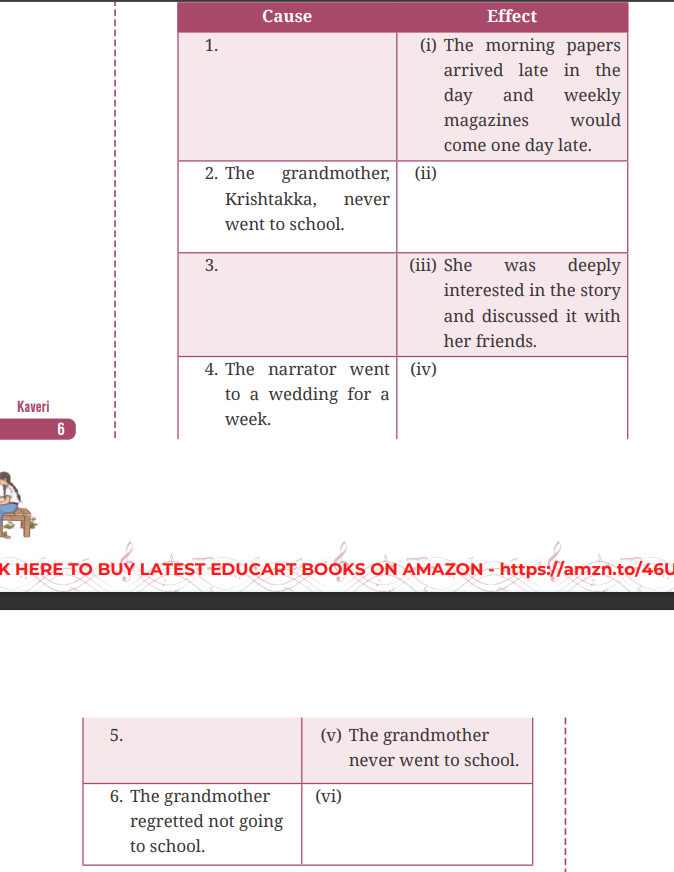
Answer:
| Cause | Effect |
|---|---|
| 1. The transport system in the village was not very good. | (i) The morning papers arrived late in the day and weekly magazines would come one day late. |
| 2. The grandmother, Krishtakka, never went to school. | (ii) She could not read or write and depended on the narrator to read the story to her. |
| 3. The narrator used to read the serial story “Kashi Yatre” to her grandmother every week. | (iii) She was deeply interested in the story and discussed it with her friends. |
| 4. The narrator went to a wedding for a week. | (iv) The grandmother could not read the new episode of the story and felt very sad and helpless. |
| 5. In those days people did not think education was necessary for girls. | (v) The grandmother never went to school. |
| 6. The grandmother regretted not going to school. | (vi) She decided to learn the Kannada alphabet and become independent. |
II. Do you think the narrator expected to see her grandmother in tears when she returned to the village? If yes, why? If no, why not?
Answer: No, the narrator did not expect to see her grandmother in tears. She was surprised because she had never seen her grandmother cry even in difficult situations. She later understood that her grandmother was sad because she could not read the new episode of the story when the narrator was away.
III. How might the narrator help her grandmother to fulfill her desire to learn to read and write?
Answer: The narrator could help her grandmother by teaching her the Kannada alphabet. She could guide her in reading, writing, and practicing regularly. With patience and hard work, the grandmother could gradually learn to read and write by herself.
Check Your Understanding: (How I Taught My Grandmother To Read Question Answer) Page-9
I. State whether the following sentences are true or false. Share your answers with your classmates and teacher.
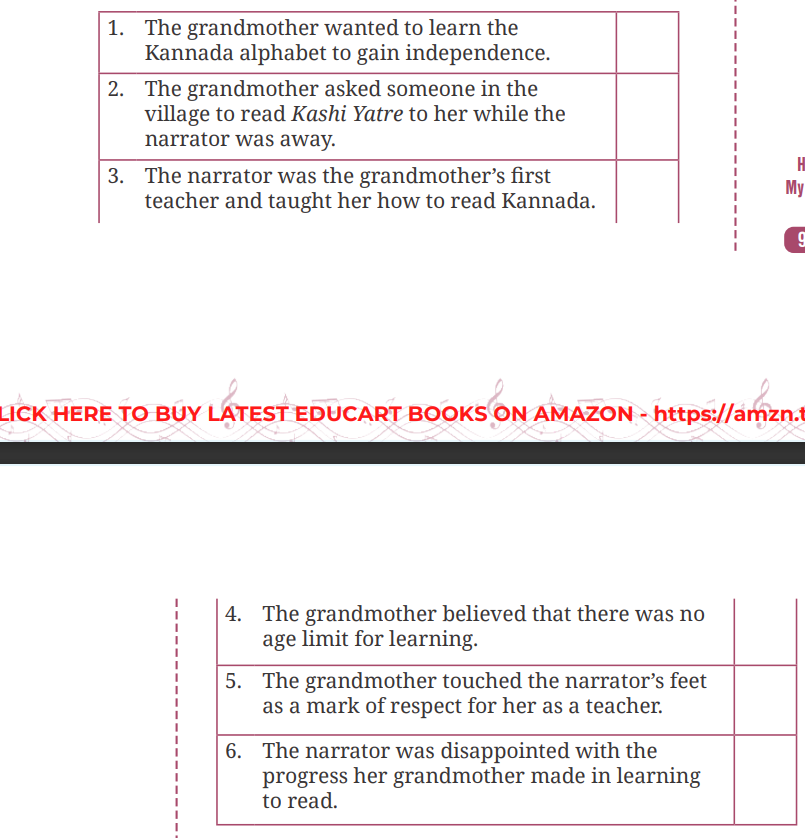
Answer:
- The grandmother wanted to learn the Kannada alphabet to gain independence. – [ Ture ]
- The grandmother asked someone in the village to read Kashi Yatre to her while the narrator was away. – [ False ]
- The narrator was the grandmother’s first teacher and taught her how to read Kannada. – [ Ture ]
- The grandmother believed that there was no age limit for learning. – [ Ture ]
- The grandmother touched the narrator’s feet as a mark of respect for her as a teacher. – [ Ture ]
- The narrator was disappointed with the progress her grandmother made in learning to read. – [ False ]
Critical Reflection: (How I Taught My Grandmother To Read Question Answer) Page-10
I. Read the extracts given below and answer the questions that follow:
1. When I came back to my village, I saw my grandmother in tears. I was surprised, for I had never seen her cry even in the most difficult situations. What had happened? I was worried. ‘Avva, is everything all right? Are you okay?’
I used to call her Avva, which means mother in the Kannada spoken in north Karnataka. She nodded but did not reply. I did not understand and forgot about it. In the night, after dinner, we were sleeping in the open terrace of our house. It was a summer night and there was a full moon. Avva came and sat next to me. Her affectionate hands touched my forehead.
(i) Complete the following sentence with the appropriate option.
The phrase ‘never seen her cry in the most difficult situations’ tells us that the grandmother was _______
- strong-willed
- understanding
- considerate
- bold
Answer: Strong-willed
(ii) Complete the following with the correct option from those given in the brackets.
Grandmother did not reply when the narrator asked if she was alright because she might have been too _______ (emotional/tired) to respond.
Answer: emotional
(iii) Identify the clue from the extract that indicates a rural setting with traditional customs.
Answer: “After dinner, we were sleeping in the open terrace of our house.”
(iv) Which lines of the extract establish a tender atmosphere?
Answer: “Her affectionate hands touched my forehead.”
(v) Which of the following aspect is NOT emphasised in the given extract?
- the emotional turmoil of the grandmother
- the affeectionate bond between the narrator and her grandmother
- the grandmother’s regret over her lack of education
- the narrator’s concern for her grandmothe
Answer: the grandmother’s regret over her lack of education.
2. ‘I have decided I want to learn the Kannada alphabet from tomorrow onwards. I will work very hard. I will keep Saraswati Puja day during Dassara as the deadline. That day I should be able to read a novel on
my own. I want to be independent.’
I saw the determination on her face. Yet I laughed at her. ‘Avva, at this age of sixty-two you want to learn
the alphabet? All your hair is grey, your hands are wrinkled, you wear spectacles and you work so much in the kitchen…’ Childishly I made fun of the old lady. But she just smiled.
‘For a good cause if you are determined, you can overcome any obstacle. I will work harder than anybody but I will do it. For learning there is no age bar.’
(i) What does the grandmother’s statement, “I want to be independent,” reveal about her character?
- She wanted to be literate.
- She desires self-sufficiency.
- She wants to prove her intelligence to others.
- She feels pressured by society to learn.
Answer: She desires self-sufficiency.
(ii) Fill in the blank with the appropriate option from those given in brackets.
The grandmother’s determination shows that learning has no _______. (age limit/gender bias/cultural barriers)
Answer: age limit
(iii) Complete the following with a suitable reason.
The narrator laughs at her grandmother’s decision to learn the alphabet at the age of sixty-two because _______________.
Answer: She thought her grandmother was too old to start learning.
(iv) List any two qualities displayed by the grandmother.
Answer: Determination and hardworking nature.
(v) How can we say that the narrator is making assumption about her grandmother?
Answer: The narrator assumes that her grandmother cannot learn because she is old, without knowing her strong determination and willingness to learn.
II. Answer the following questions. (How I Taught My Grandmother To Read Question Answer)
1. Why do you think the grandmother felt embarrassed to ask someone else to read to her
while the narrator was away?
Answer: The grandmother felt embarrassed because she could not read even at the age of sixty-two. She felt ashamed to tell others that she was illiterate and did not want to depend on anyone else to read the story for her.
2. Why does the narrator initially laugh at her grandmother’s determination to learn at the age of sixty-two?
Answer: The narrator laughs because she thinks her grandmother is too old to start learning the alphabet. She believes that learning at such an old age is difficult.
3. What significance does the story of Kashi Yatre have in both the grandmother’s life and the story?
Answer: The story Kashi Yatre is very important to the grandmother because she enjoys listening to it every week. When she cannot read the next episode by herself, she feels helpless. This inspires her to learn to read so that she can enjoy the story independently.
4. What does the grandmother’s desire to learn the Kannada alphabet reflect about her?
Answer: It shows that the grandmother is determined and hardworking. She wants to become independent and prove that learning can happen at any age.
5. What lessons can we infer from the grandmother’s action of touching the narrator’s feet?
Answer: It teaches us that teachers should always be respected, no matter their age. It also shows the grandmother’s humility and respect for knowledge.
6. What does the following line tell us about the broader theme of the story?
‘For a good cause if you are determined, you can overcome any obstacle.’
Answer: This line shows that strong determination can help a person achieve any goal. It also highlights that learning is possible at any age if a person is willing to work hard.
7. How effectively does the story highlight the value of education in supporting personal independence?
Answer: The story clearly shows that education helps a person become independent. The grandmother feels helpless when she cannot read the magazine, but after learning the alphabet she can read by herself and feels confident and independent.
Vocabulary and Structures in Context: (How I Taught My Grandmother To Read Question Answer) Page-10
I. The expression ‘hide and seek’ is used in the text. This is called a binomial.
Binomials are expressions consisting of two words, usually linked by a conjunction like ‘and’ or ‘or’,
that are commonly used together in a fixed order. For example: odds and ends, right or wrong.
Match the binomials in Column 1 with their meanings in Column 2. You may refer to a dictionary
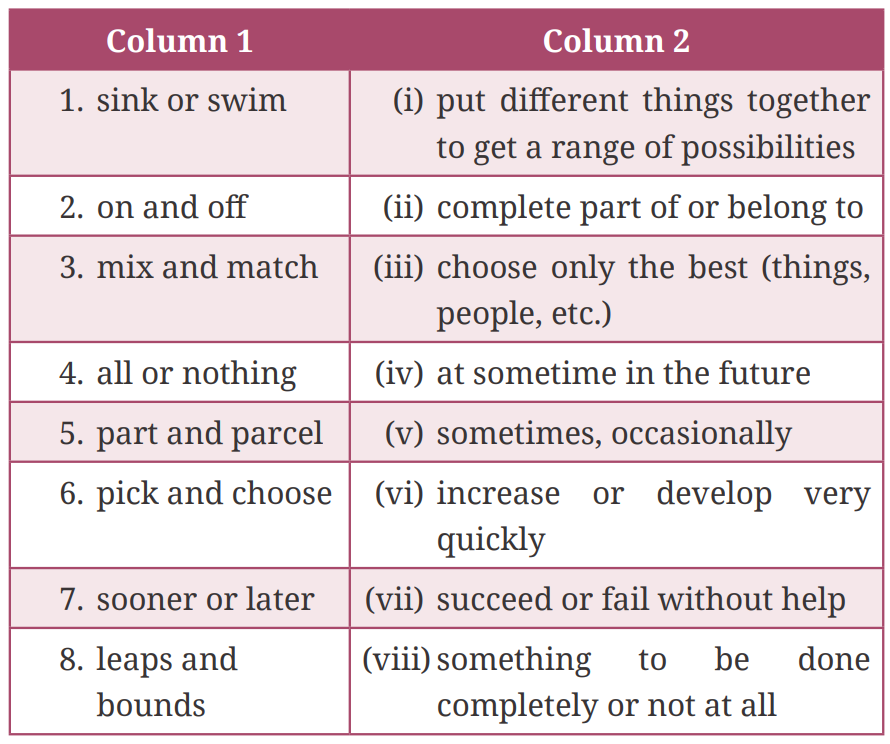
Answer:
| Column 1 | Column 2 |
|---|---|
| 1. sink or swim | (vii) succeed or fail without help |
| 2. on and off | (v) sometimes, occasionally |
| 3. mix and match | (i) put different things together to get a range of possibilities |
| 4. all or nothing | (viii) something to be done completely or not at all |
| 5. part and parcel | (ii) complete part of or belong to |
| 6. pick and choose | (iii) choose only the best (things, people, etc.) |
| 7. sooner or later | (iv) at sometime in the future |
| 8. leaps and bounds | (vi) increase or develop very quickly |
II. Read the following words from the text given in the box below.

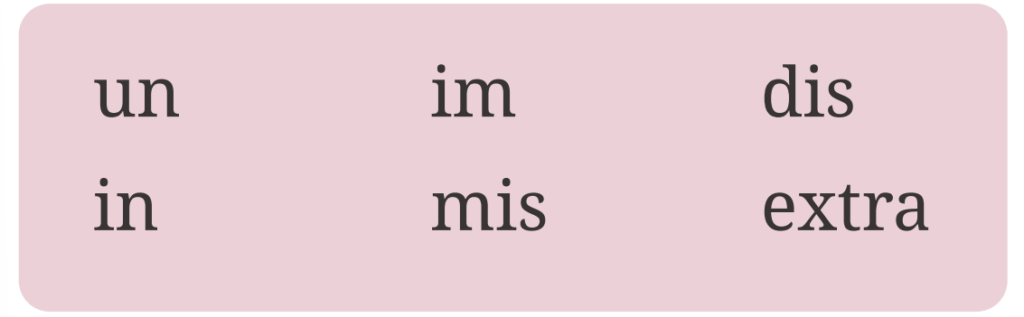
These words are made by adding suitable prefixes (‘un’, ‘ir’, and ‘in’) to give an opposite or negative meaning to the words.
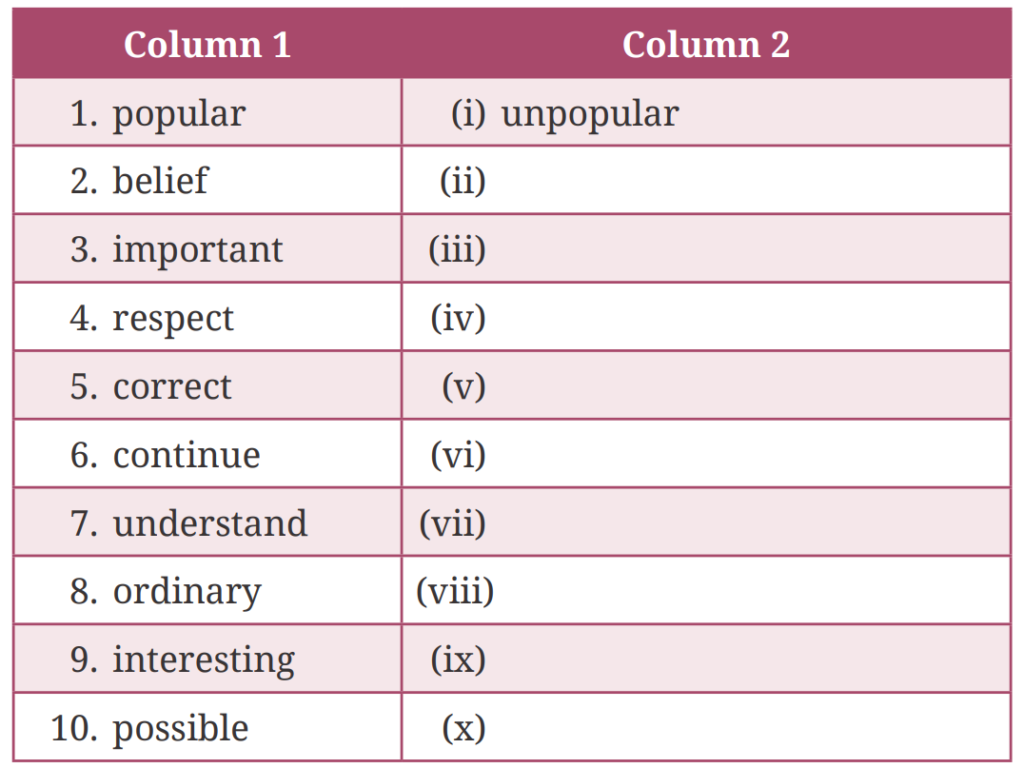
Now, make words by adding the suitable prefixes given in the box to the words from the text in Column 1. Write the prefixed words in Column 2. One example has been done for you.
Answer:
| Column 1 | Column 2 |
|---|---|
| 1. popular | (i) unpopular |
| 2. belief | (ii) disbelief |
| 3. important | (iii) unimportant |
| 4. respect | (iv) disrespect |
| 5. correct | (v) incorrect |
| 6. continue | (vi) discontinue |
| 7. understand | (vii) misunderstand |
| 8. ordinary | (viii) extraordinary |
| 9. interesting | (ix) uninteresting |
| 10. possible | (x) impossible |
III. Identify any five words with prefixes from the story and make sentences using each.
Answer:
- Independent: The grandmother wanted to become independent by learning to read.
- Impossible: The grandmother knew that learning at her age was not impossible.
- Unusual: It was unusual when the grandmother touched the narrator’s feet.
- Embarrassed: The grandmother felt embarrassed to ask others to read the story for her.
- Return: The narrator was happy to return to her village after the wedding.
IV. In the sentence, “I knew, then, that my student had passed with flying colours”, the phrase “passed with flying colours” is an idiom. It means outstanding performance.
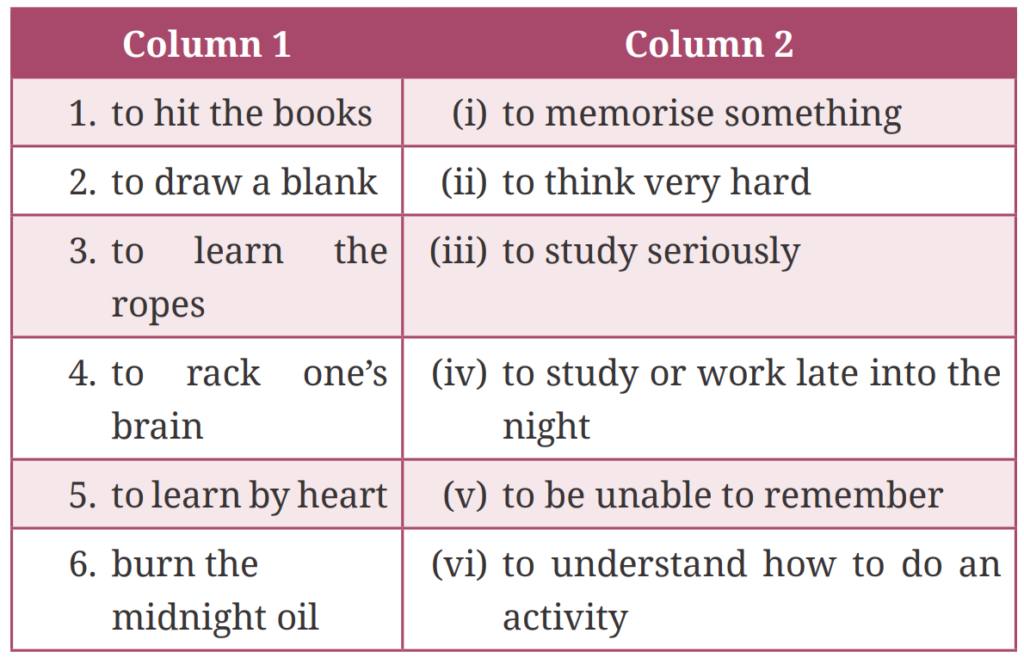
Now, match the idioms related to ‘learning’ given in Column 1 with their meanings in Column 2. You may
refer to a dictionary.
Now, use these idioms in sentences of your own.
Answer:
| Column 1 | Column 2 |
|---|---|
| 1. to hit the books | (iii) to study seriously |
| 2. to draw a blank | (v) to be unable to remember |
| 3. to learn the ropes | (vi) to understand how to do an activity |
| 4. to rack one’s brain | (ii) to think very hard |
| 5. to learn by heart | (i) to memorise something |
| 6. burn the midnight oil | (iv) to study or work late into the night |
V. Read the following sentences from the text and underline the verbs.
- Secretly, I bought Kashi Yatre which had been published as a novel by that time.
- I knew, then, that my student had passed with flying colours.
Answer:
- Secretly, I bought Kashi Yatre which had been published as a novel by that time.
- I knew, then, that my student had passed with flying colours.
(i) Fill in the blanks with simple past and past perfect tense form of the verbs given in brackets.
A. When the delegates ______ (arrive) at the conference, the keynote speaker ______ (already begin) the session.
Answer: When the delegates arrived at the conference, the keynote speaker had already begun the session.
B. After the students _____ (learn) how to identify fake news online, they ______ (start) verifying information before sharing it.
Answer: After the students had learnt how to identify fake news online, they started verifying information before sharing it.
C. Before kiran _____ (Start) using digital payment platforms, she _____ (ensure her understanding of online fraid prevention.
Answer: Before Kiran started using digital payment platforms, she had ensured her understanding of online fraud prevention.
D. By the time Varun _____ (recognise) the importance of budgeting, he _____ (exhaust) most of his savings.
Answer: By the time Varun recognised the importance of budgeting, he had exhausted most of his savings.
E. When Raghu ______ (log in) to the cybersecurity webinar, the instructor _____ (already discuss) the importance of strong passwords.
Answer: When Raghu logged in to the cybersecurity webinar, the instructor had already discussed the importance of strong passwords.
(ii) Fill in the blanks with the correct form of verbs given in brackets.
Last year, my parents and I A. ______ (take) a financial planning course. When we B. _____ (review) our expenses, we realised we C. _____ (spend) too much on unnecessary purchases. After my parents D. ______ (discuss) ways to save, I E. _______ (open) a savings account. By the time we F. ______ (set) our budget, the course G. ______ (already introduce) investment strategies. We H. _______ (hurry) to take notes, but many participants I. _______ (complete) their financial plans. Despite that, we J. _______ (enjoy) learning how to manage money wisely.
Answer: Last year, my parents and I A. took a financial planning course. When we B. reviewed our expenses, we realised we C. had spent too much on unnecessary purchases. After my parents D. discussed ways to save, I E. opened a savings account. By the time we F. set our budget, the course G. had already introduced investment strategies. We H. hurried to take notes, but many participants I. had completed their financial plans. Despite that, we J. enjoyed learning how to manage money wisely.
Listen And Respond: (How I Taught My Grandmother To Read Question Answer) Page-17
I. You will listen to a speaker talk about digital literacy. As you listen, complete the following sentences with one to three exact words that you hear. (Transcript for teacher on page 259)
- Literacy these days includes the ability to use ______
- Digital literacy is also about protecting ___________
- Digital literacy enables the elderly to __________
- Digital literacy encourages using the internet safely by helping us recognise _________ and ______
- The National Digital Literacy Mission helps people across the country by imparting _________
Answer:
- Literacy these days includes the ability to use digital tools.
- Digital literacy is also about protecting personal data.
- Digital literacy enables the elderly to stay connected.
- Digital literacy encourages using the internet safely by helping us recognise misinformation and scams.
- The National Digital Literacy Mission helps people across the country by imparting IT training.
Writing Task: (How I Taught My Grandmother To Read Question Answer) Page-19
I.
As a socially responsible citizen, you strongly believe that students can contribute significantly in promoting adult literacy. Write a letter to the Editor of a local newspaper emphasising the importance of student participation in adult literacy camps conducted by various organisations. Discuss the benefits of such initiatives for both students and society. Suggest effective ways to spread awareness and encourage more students to volunteer for this noble cause.
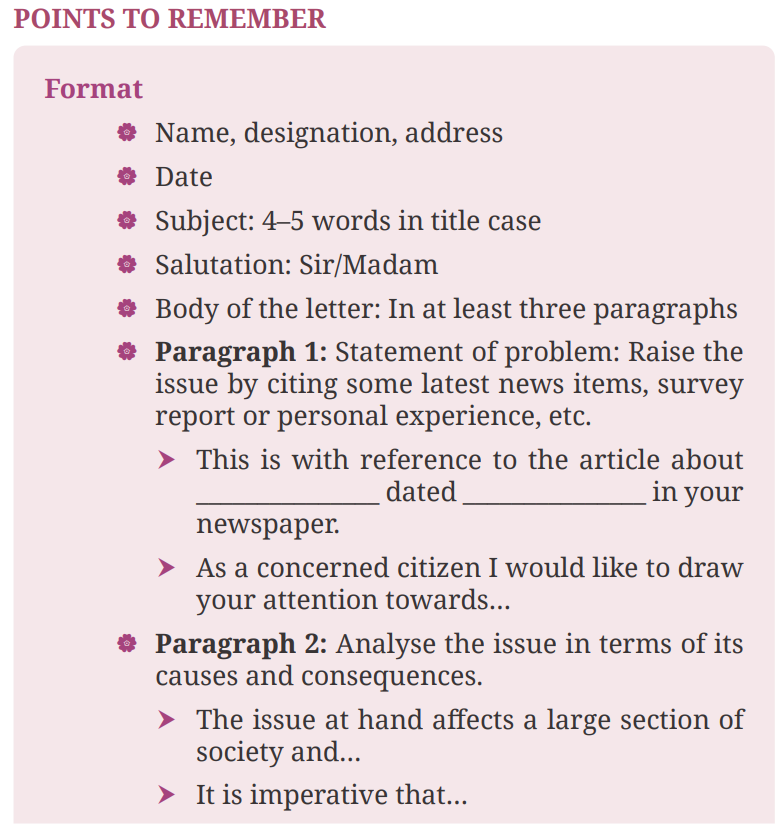
A letter to the editor is a formal letter in which the writer gives suggestions and creates awareness on an
issue of public interest or an issue already raised in an article/write-up/published letter.
Answer:
Subhendu Khatua
Solpata, Paschim Medinipur
West Bengal
Date: 9 March 2026
Subject: Student Role In Adult Literacy
Sir/Madam,
Through the columns of your respected newspaper, I would like to draw attention to the importance of student participation in adult literacy camps. Even today many adults in our society cannot read or write. Various organisations conduct literacy camps to help them, and students can play an important role in supporting these efforts.
Student participation in such camps can bring many benefits. Students can teach basic reading and writing to adults and help them become independent in their daily lives. At the same time, students learn the value of social service, patience, and responsibility. These programmes also help create a stronger bond between different generations in society.
To spread awareness, schools and colleges should encourage students to volunteer in literacy camps. Social media, posters, and awareness programmes can also motivate young people to take part in such activities. If more students join these initiatives, adult literacy can improve and society will progress.
I hope the concerned authorities and educational institutions will encourage more students to take part in this noble cause.
Yours faithfully,
Subhendu Khatua
Learning Beyond the Text: (How I Taught My Grandmother To Read Question Answer) Page-20
I.
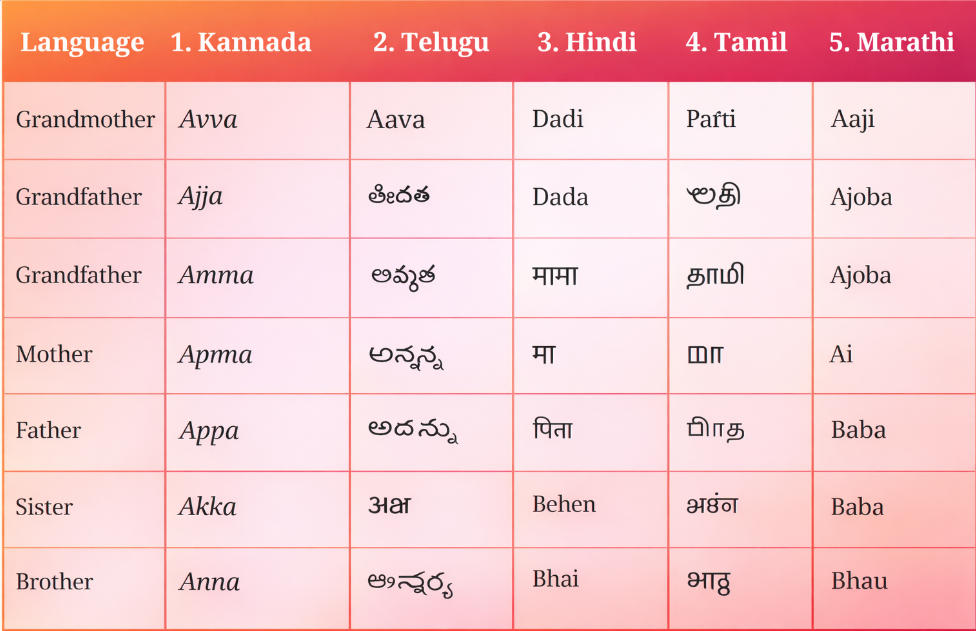
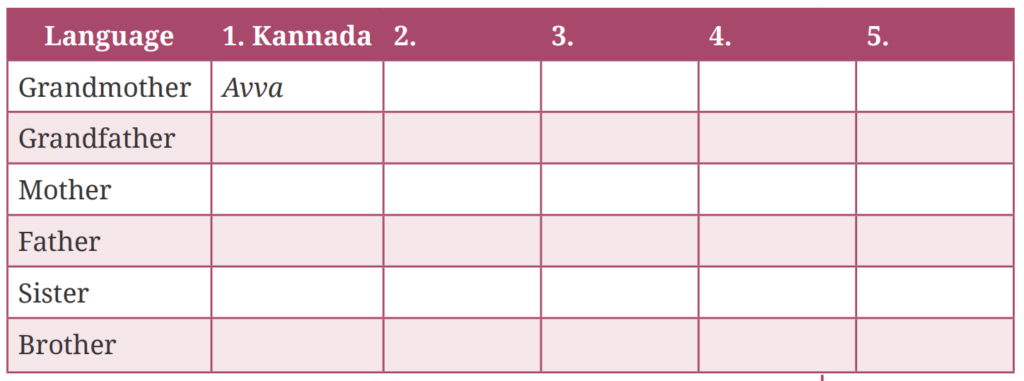
India has 22 major languages according to the Eighth Schedule of the Indian Constitution. Each language has
its own unique identity. Talk to your classmates and teacher and complete the given table with words from
any five Indian languages.
Answer: