

NCERT | Santoor | Class 5 The Frog Class 5 Question Answers Solutions is essential for young learners to build a strong foundation in the subject, and NCERT Class 5 English Chapter 5 Question Answer. Understanding the chapter thoroughly helps students grasp key concepts, improve comprehension, and perform well in exams.
In this article, NCERT Santoor The Frog NCERT Solutions Class 5 English Question Answers Solved | Santoor | Chapter 5, we provide detailed Santoor | NCERT The Frog Class 5 Extra Questions and Answers to make learning easier and more effective. Whether you are a student looking for well-explained solutions or a parent guiding your child, this guide will be a helpful resource for mastering the chapter with confidence. Also, we will include Santoor The Frog Class 5 Worksheet pdf Solved Meaning in Hindi and The Frog summary.
- The Frog Summary in English (The Frog Class 5 Question Answers)
- The Frog Summary in Hindi (The Frog NCERT Class 5 Question Answers)
- The Frog Summary in Bengali (The Frog Class 5 Question Answers)
- Let us Think (The Frog Class 5 Question Answers)
- Let us Learn (The Frog Class 5 Question Answers)
- Let us Speak (The Frog Class 5 Question Answers)
- A. Three tongue twisters are given below. Try speaking each tongue twister slowly at first. Gradually increase your speed with each repetition. Count how many times you can say it correctly without making a mistake.
- B. Listen and repeat Your teacher will say aloud the following pairs of words. Listen carefully and repeat each pair.
- Let us Listen (The Frog Class 5 Question Answers)
- Let us Write (The Frog Class 5 Question Answers)
- Let us Do (The Frog Class 5 Question Answers)
- Let us Explore (The Frog Class 5 Question Answers)
NCERT The Frog Class 5 Question Answers | Class 5 English | Santoor | Best Guide
The Frog Summary in English (The Frog Class 5 Question Answers)
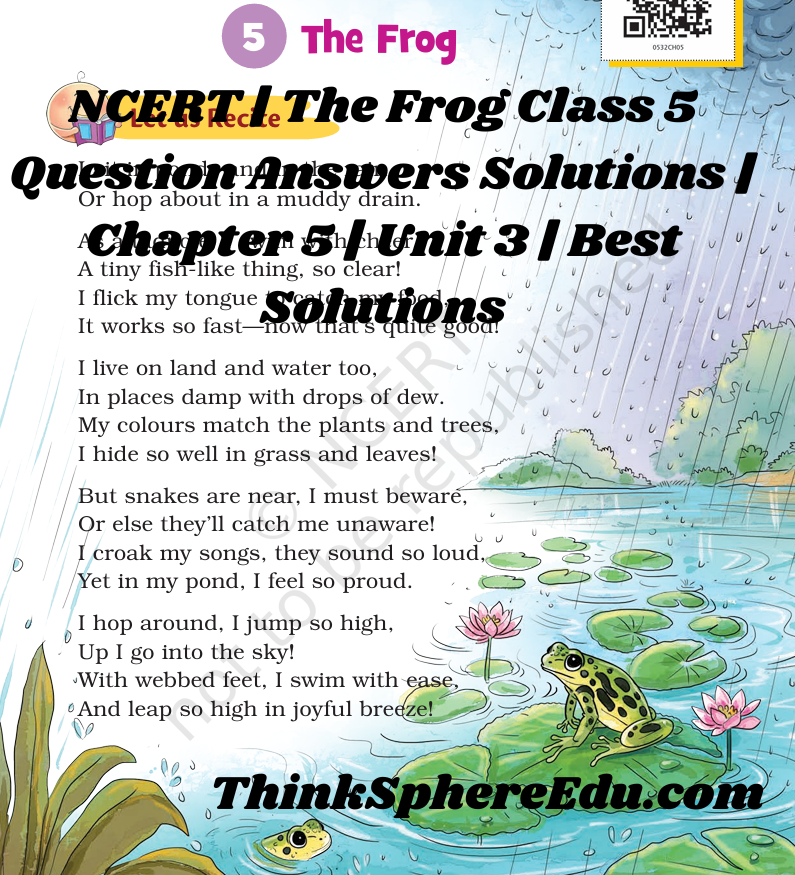
The poem is about a frog who tells the story of its own life. It lives in ponds, rain, and muddy places, and begins its life as a tadpole that swims happily like a tiny fish. As it grows, it uses its quick tongue to catch food. The frog can live both on land and in water and usually stays in damp places. Its colours help it hide among plants and leaves, but it must stay alert because snakes can attack it. The frog enjoys croaking loudly in the pond and feels proud of itself. It loves hopping, jumping high, and swimming easily with its webbed feet.
The Frog Summary in Hindi (The Frog NCERT Class 5 Question Answers)
यह कविता एक मेंढक के बारे में है जो अपनी ज़िंदगी की कहानी बताता है। यह तालाबों, बारिश और कीचड़ वाली जगहों पर रहता है, और अपनी ज़िंदगी एक टैडपोल के तौर पर शुरू करता है जो एक छोटी मछली की तरह खुशी से तैरता है। जैसे-जैसे यह बड़ा होता है, यह खाना पकड़ने के लिए अपनी तेज़ जीभ का इस्तेमाल करता है।
मेंढक ज़मीन और पानी दोनों जगह रह सकता है और आमतौर पर नमी वाली जगहों पर रहता है। इसके रंग इसे पौधों और पत्तियों के बीच छिपने में मदद करते हैं, लेकिन इसे अलर्ट रहना पड़ता है क्योंकि साँप इस पर हमला कर सकते हैं। मेंढक को तालाब में ज़ोर से टर्राना पसंद है और उसे खुद पर गर्व होता है। इसे उछलना, ऊँचा कूदना और अपने जालीदार पैरों से आसानी से तैरना पसंद है।
The Frog Summary in Bengali (The Frog Class 5 Question Answers)
কবিতাটি একটি ব্যাঙের গল্প, যে তার নিজের জীবনের গল্প বলে। এটি পুকুর, বৃষ্টি এবং কর্দমাক্ত স্থানে বাস করে এবং একটি ছোট মাছের মতো আনন্দের সাথে সাঁতার কাটতে থাকা একটি ট্যাডপোলের মতো তার জীবন শুরু করে। এটি বড় হওয়ার সাথে সাথে, এটি খাবার ধরার জন্য তার দ্রুত জিহ্বা ব্যবহার করে।
ব্যাঙটি স্থলে এবং জলে উভয় স্থানেই থাকতে পারে এবং সাধারণত স্যাঁতসেঁতে জায়গায় থাকে। এর রঙগুলি গাছপালা এবং পাতার মধ্যে লুকিয়ে থাকতে সাহায্য করে, তবে এটিকে সতর্ক থাকতে হবে কারণ সাপ এটিকে আক্রমণ করতে পারে। ব্যাঙটি পুকুরে জোরে ডাকতে উপভোগ করে এবং নিজেকে নিয়ে গর্বিত বোধ করে। এটি লাফানো, উঁচুতে লাফানো এবং তার জালযুক্ত পা দিয়ে সহজেই সাঁতার কাটতে পছন্দ করে।
Let us Think (The Frog Class 5 Question Answers)
A. Answer the following questions.
1. Where does the frog like to sit or spend time?
Answer: The frog likes to sit in ponds, in the rain, and sometimes in muddy drains.
2. How does the frog catch its food?
Answer: The frog catches its food by flicking its tongue very fast.
3. How does the frog move in water and on land?
Answer: The frog swims easily in water with its webbed feet and hops or jumps on land.
4. What helps the frog hide in its surroundings?
Answer: The frog’s colours match the plants and leaves, which help it hide well in its surroundings.
B. Think and discuss
1. What would it feel like to live like a frog, both in water and on land?
Answer: It would feel exciting because I could swim freely in the water and also jump around on land. I would enjoy moving in two different worlds.
2. If you could hop as high as a frog, what fun things would you do?
Answer: I would hop over puddles, jump across small walls, and play jumping games with my friends. It would feel like flying for a moment.
3. How is a frog’s life different from a fish’s life?
Answer: A frog lives both on land and in water, but a fish lives only in water. Frogs breathe air and can hop, while fish breathe through gills and swim all the time.
4. How are frogs’ webbed feet similar to the flippers used by scuba divers?
Answer: Both help in swimming. Webbed feet and flippers spread out in water and push the water back, making swimming easier and faster.
Let us Learn (The Frog Class 5 Question Answers)
A. Choose the correct words from the brackets and fill in the blanks.
- My colours match the plants ___________ trees. (or/and)
- Would you like to learn about frogs ________ tadpoles? (because/and)
- I hop around happily, __________ I must watch out for snakes! (but/so)
- Frogs swim easily _________ they have webbed feet. (because/or)
Answer:
- My colours match the plants and trees.
- Would you like to learn about frogs and tadpoles?
- I hop around happily, but I must watch out for snakes!
- Frogs swim easily because they have webbed feet.
B. The following words have been rearranged into sentences. Choose the correct option.
1. hunts/night/the/silently/tiger/at
- The tiger hunts silently at night.
- Tiger hunts the silently at night.
- Hunts the tiger at night silently.
Answer: The tiger hunts silently at night.
2. elephants/in/forests/live/large/ groups/in
- Elephants live large in groups forests.
- In groups large, elephants live in forests.
- Elephants live in large groups in forests.
Answer: Elephants live in large groups in forests.
3. web/a/spider/carefully/its/weaves
- A spider carefully weaves its web.
- Spider carefully weaves its web a.
- Carefully a spider weaves web its.
Answer: A spider carefully weaves its web.
4. crocodile/waits/the/silently/riverbank/ the/near
- Crocodile waits the silently the near riverbank.
- The silently crocodile waits near the riverbank.
- The crocodile waits silently near the riverbank.
Answer: The crocodile waits silently near the riverbank.
5. a/swims/turtle/slowly/in/ocean/the
- A turtle swims slowly in the ocean.
- Swims turtle slowly an ocean in.
- The ocean swims a slowly turtle in.
Answer: A turtle swims slowly in the ocean.
Let us Speak (The Frog Class 5 Question Answers)
A. Three tongue twisters are given below. Try speaking each tongue twister slowly at first. Gradually increase your speed with each repetition. Count how many times you can say it correctly without making a mistake.
- Four fierce frogs fight for flies.
- Fast frogs flip-flop across fluffy fields.
- Funny frogs flap floppy feet.
Answer: Do it by yourself and let me know in comment section.
B. Listen and repeat Your teacher will say aloud the following pairs of words. Listen carefully and repeat each pair.
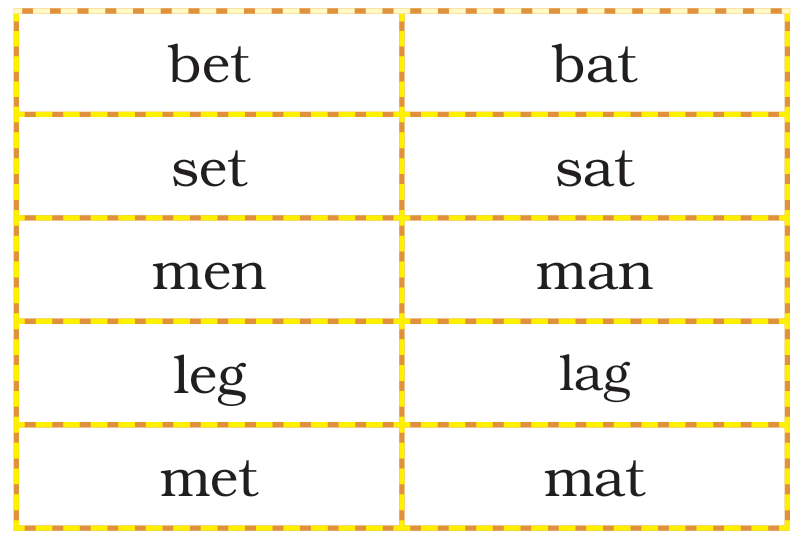
Answer: Do it by yourself and let me know in the comment section.
Let us Listen (The Frog Class 5 Question Answers)
Your teacher will read out instructions for you to follow and create your own ‘Frog’s World’ in the space provided on the next page.
- Draw the place: Imagine a place where your frog might be happy, like a pond, a forest or a rainy area.
- Draw your frog: Draw a frog in the above setting.
- Decorate with words: Around your drawing, write some words from the poem that describe the frog’s life. You can even write your own short sentence about the frog’s world.
- Colour it: Use colours to bring your frog’s world to life! Be creative and make it as colourful as you would like.
Answer: Do it by yourself.
Let us Write (The Frog Class 5 Question Answers)
Here is a message for you from Hopper, the frog.
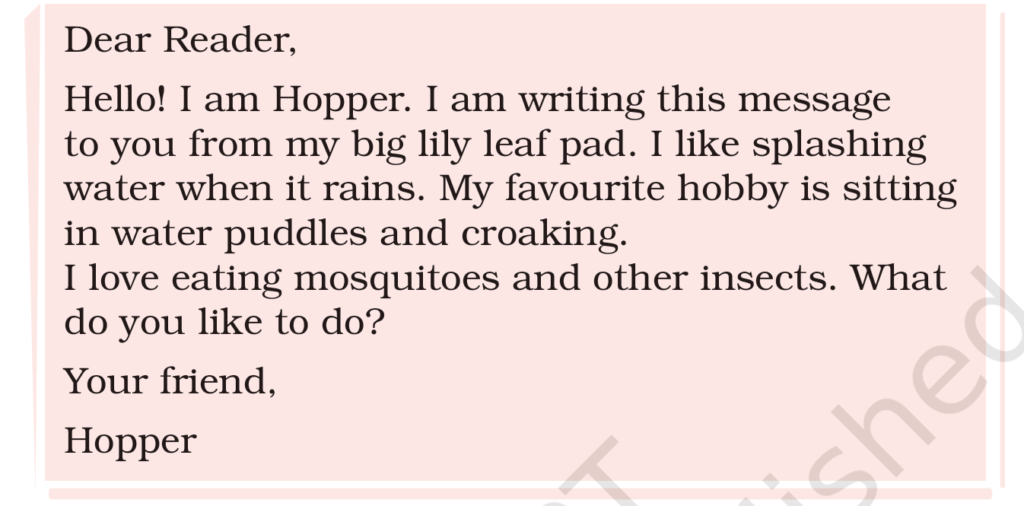
Write a reply to Hopper in your notebook and share it with your class.
Answer:
Here is a simple and friendly reply you can write to Hopper:
Dear Hopper,
Thank you for your lovely message! It was fun reading about your life on the lily leaf pad. I like the way you enjoy splashing water and sitting in puddles. I don’t eat insects like you, but I enjoy playing with my friends, reading storybooks, and drawing pictures.
I would love to visit your pond someday and hear your loud croaks!
Your friend,
(Write your name)
Let us Do (The Frog Class 5 Question Answers)
A. Five of us are hiding in the picture. Can you find us?
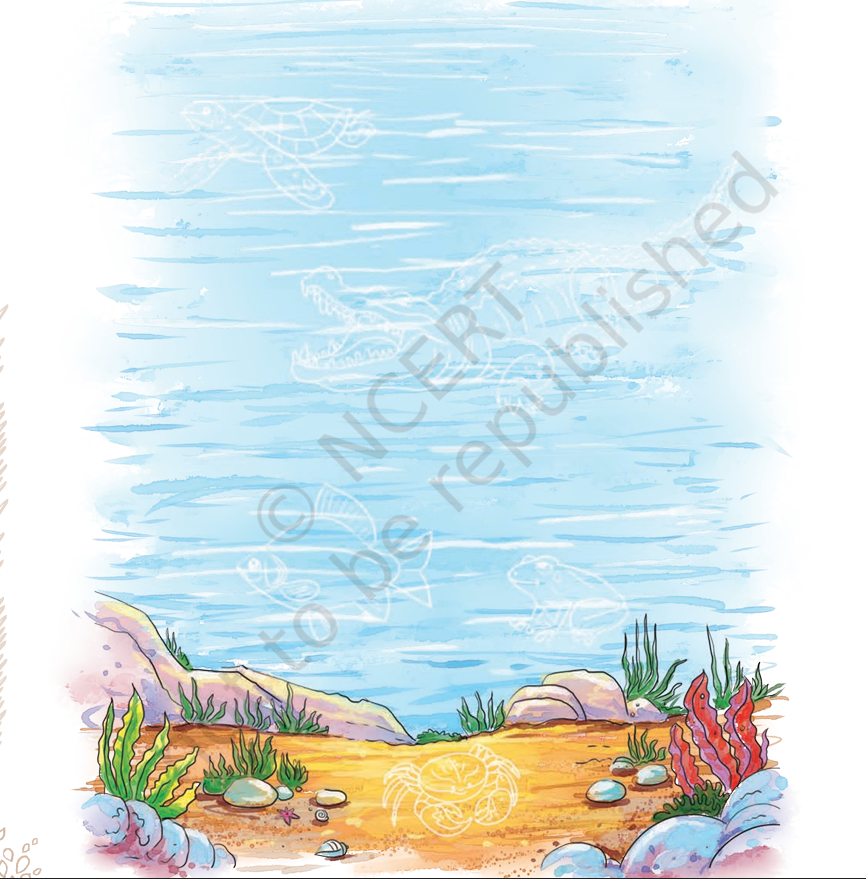
Answer: Yes, there is a crocodile, turtle, fish, frog, and crab.
B. Look at the following steps carefully and draw a duck in the given space.
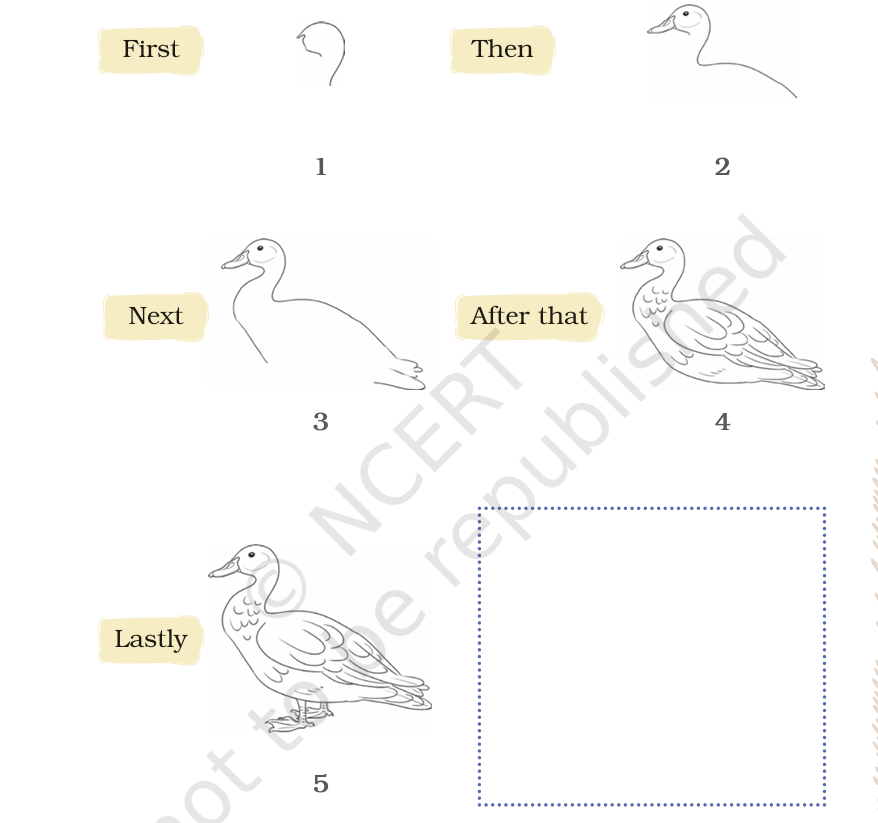
Answer: Do it by yourself and let me know in comment section.
C. Move three crayons to change the direction in which the fish is swimming.

Answer: Try it by yourself.
Let us Explore (The Frog Class 5 Question Answers)
Choose any two of the below and find out a few facts about them.
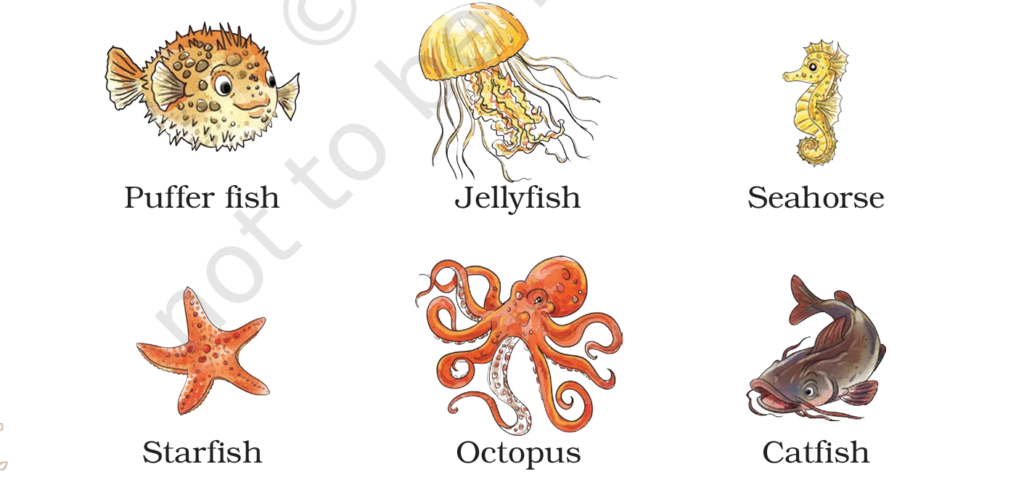
Answer:
Puffer Fish:
- Puffer fish can puff up like a ball when they feel scared.
- They have spikes on their body that protect them from predators.
- Some puffer fish are poisonous.
Jellyfish:
- Jellyfish have no bones, brain, or heart.
- They have stinging tentacles to catch food.
- Their bodies are mostly made of water.
Seahorse:
- Seahorses swim upright, unlike most fish.
- The male seahorse carries the babies in a pouch.
- They use their tails to hold on to sea plants.
Starfish:
- A starfish usually has five arms.
- If an arm is cut off, it can grow a new one.
- Starfish move using tiny tube feet on their underside.
Octopus:
- An octopus has eight arms called tentacles.
- It can change colour to hide from enemies.
- Octopuses are very intelligent sea animals.
Catfish:
- Catfish have whisker-like feelers called barbels.
- They live at the bottom of rivers or ponds.
- Some catfish can live in muddy water with very little oxygen.
The Frog Extra Question Answer Class 5 | Santoor
The Frog Short Answer Type Questions
1. Why does the frog need to be careful in its surroundings?
Answer: The frog needs to be careful because snakes are nearby and can catch it.
2. What does the frog enjoy doing during the rain?
Answer: The frog enjoys splashing in the water when it rains.
3. How does the frog describe its life as a tadpole?
Answer: As a tadpole, the frog swims happily like a tiny fish.
4. Why is the frog proud of its croaking?
Answer: The frog feels proud because its croaking is loud and strong in the pond.
5. What helps the frog swim easily in water?
Answer: The frog swims easily because it has webbed feet.
6. Why does the frog say its colours match the plants and trees?
Answer: The frog says this because its colours help it blend with leaves and grass, making it hard to spot.
7. What are some of the places where the frog likes to stay?
Answer: TThe frog likes to stay in ponds, rainwater, muddy drains, and damp places.
8. How does the frog catch its food?
Answer: The frog catches its food by quickly flicking its long tongue.
9. What does the frog do when it is happy?
Answer: When the frog is happy, it hops around and jumps high.
10. What does the frog do when it is happy?
Answer: The frog can live both on land and in water, unlike many other animals.
The Frog Long Answer Type Questions
1. Describe the frog’s life in water and on land. How does it enjoy both places?
Answer: The frog enjoys living both in water and on land. In water, it swims easily using its webbed feet and loves to splash around, especially when it rains. As a tadpole, it swims happily like a tiny fish. On land, the frog hops and jumps high, moves around in grassy areas, and croaks loudly from its pond. Its colours help it hide in plants and leaves, making it safe while living on land.
10. How does the frog protect itself from danger? Explain with examples from the poem.
Answer: The frog protects itself in different ways. Its colours match the plants, grass, and trees around it, allowing it to hide easily from enemies. It also stays alert because snakes are nearby and can attack it without warning. When the frog senses danger, it can quickly hop away or slip into the water to stay safe. These natural abilities help the frog survive.
3. Explain how the frog catches its food and why the process is special.
Answer: The frog can live both on land and in water, unlike many other animals.