
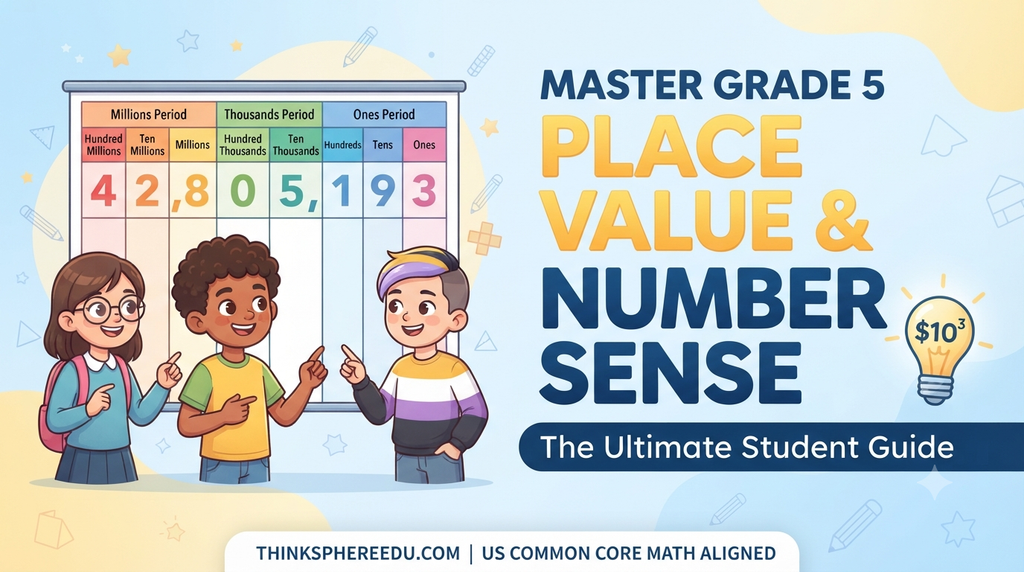

Welcome to 5th-grade math on ThinkSphereEdu.com! In this lesson, Master Grade 5 Place Value and Number Sense: The Ultimate Student Guide, you are stepping into a world of big numbers, cool patterns, and powerful mathematical shortcuts.
Have you ever wondered how scientists count stars in space, or how video game developers track millions of players online? They rely on key concepts like reading large numbers and recognizing powers of 10 grade 5 math principles.
When you understand how numbers work under the hood – from standard to expanded form practice grade 5 methods – math stops feeling like a set of confusing rules and starts feeling like solving a fun puzzle.
Whether you need a handy place value chart grade 5 students can rely on or quick tips to conquer homework, this complete guide on ThinkSphereEdu.com breaks down every single concept step-by-step!
- 1. What Is Place Value? (Grade 5 Place Value and Number Sense)
- 2. Place Value Chart Explained (Place Value Chart Grade 5)
- 3. Reading Large Numbers (Grade 5 Place Value and Number Sense)
- 4. Standard Form Practice (Grade 5 Place Value and Number Sense)
- 5. Expanded Form Practice (Expanded Form Practice Grade 5)
- 6. Comparing Whole Numbers (Grade 5 Place Value and Number Sense)
- 7. Ordering Whole Numbers (Grade 5 Place Value and Number Sense)
- 8. Powers of 10 Explained (Powers of 10 Grade 5 Math)
- 9. Multiplying by 10, 100, and 1,000
- 10. Dividing by 10, 100, and 1,000 (Grade 5 Place Value and Number Sense)
- The Division Shift Pattern
- Worksheet 1: Place Value & Identification
- Worksheet 2: Standard, Expanded & Word Form
- Worksheet 3: Comparing & Ordering
- Worksheet 4: Powers of 10, Multiplication & Division
- Answer Key 1: Place Value & Identification
- Answer Key 2: Standard, Expanded & Word Form
- Answer Key 3: Comparing & Ordering
- Answer Key 4: Powers of 10, Multiplication & Division
K-5 | Master Grade 5 Place Value and Number Sense: The Ultimate Student Guide
1. What Is Place Value? (Grade 5 Place Value and Number Sense)
At its core, place value is the value of a digit based on its position within a number.
In our everyday number system (called the Base-10 system), we only use ten digits: 0, 1, 2, 3, 4, 5, 6, 7, 8, and 9.
How do we build numbers larger than 9? By shifting digits to different positions. The spot where a digit stands determines how much it is worth.
Think of it like money:
- A $1 bill in your pocket gives you $1.
- A $10 bill gives you $10.
- A $100 bill gives you $100.
The digit 1 stays the same, but its position (or the bill it is printed on) changes its real-world value.
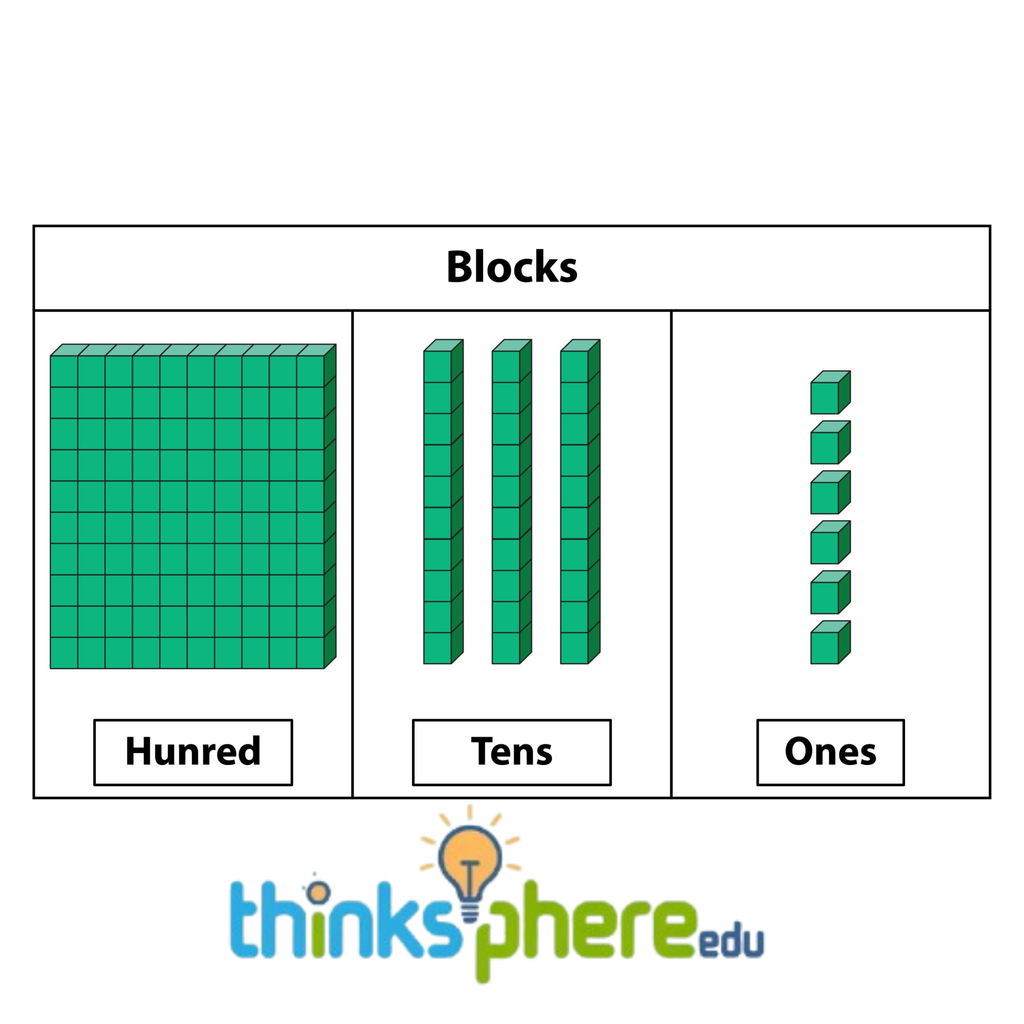
Value vs. Place Value
Students often mix up two key terms:
- Place (or Location): The name of the spot the digit occupies (such as Tens, Hundreds, or Thousands).
- Value: How much that digit is worth in that specific spot.
Example: Take the number 4,582.
- What is the place of the digit 5? Hundreds.
- What is the value of the digit 5? 500.
The 10-Times Rule
Our number system uses a simple rule: Moving one spot to the left multiplies a digit’s value by 10.
- 10 Ones = 1 Ten
- 10 Tens = 1 Hundred
- 10 Hundreds = 1 Thousand
- 10 Thousands = 1 Ten Thousand
If you move one position to the right, the digit becomes 1/10th of its original value.
2. Place Value Chart Explained (Place Value Chart Grade 5)
A Place Value Chart is a tool that organizes numbers into groups called periods. Each period contains three places: Ones, Tens, and Hundreds.
In 5th grade, you will work with numbers through the Millions period (and sometimes Billions!).
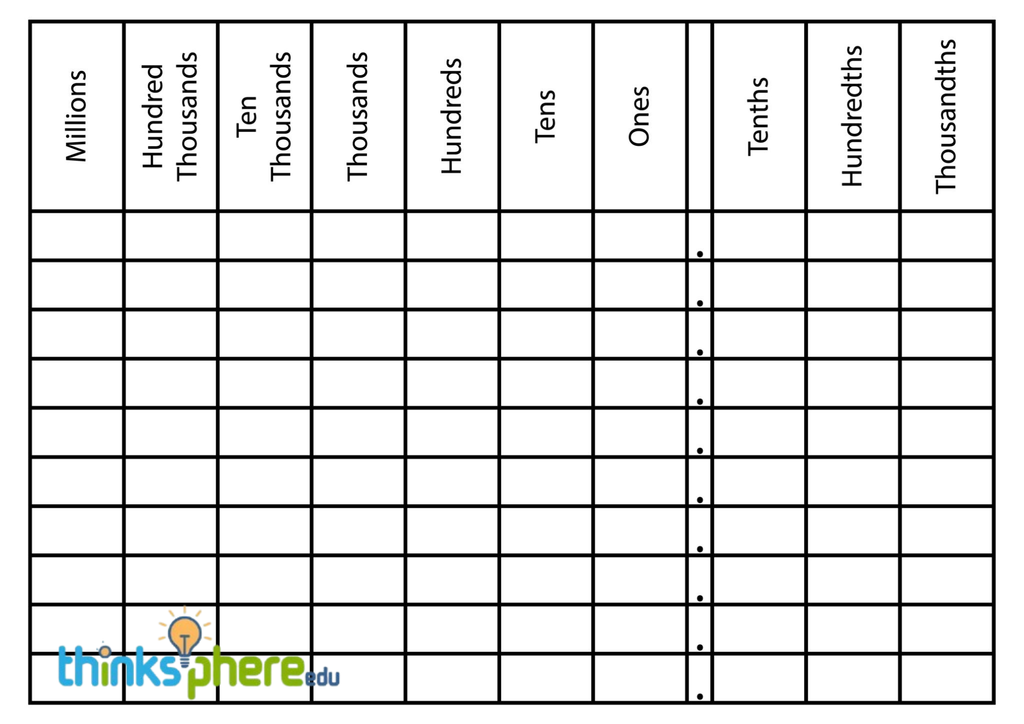
Understanding Periods
Notice how commas separate large numbers? Those commas break numbers up into periods:
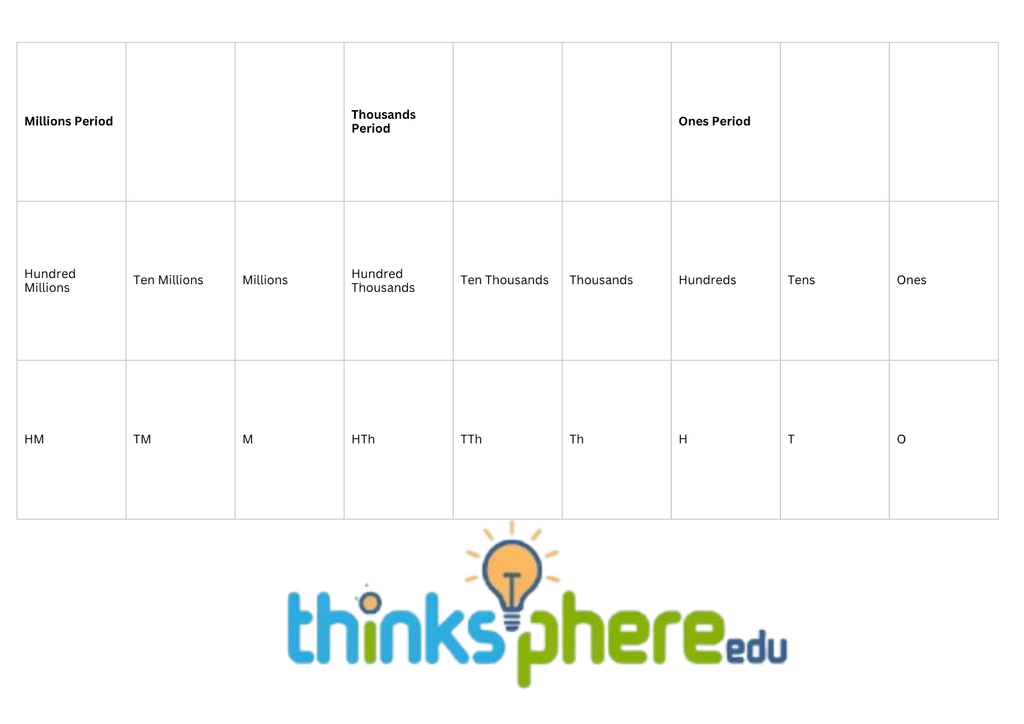
Every group of three digits gets its own period name. When you read a number out loud, you say the period name every time you see a comma (except for the ones period at the end).
Example: Placing 42,805,193 on the Chart
Let’s break down 42,805,193:
- Millions Period: 4 Ten Millions, 2 Millions (42 Million)
- Thousands Period: 8 Hundred Thousands, 0 Ten Thousands, 5 Thousands (805 Thousand)
- Ones Period: 1 Hundred, 9 Tens, 3 Ones (193)
The place value chart keeps each digit organized so you can read and calculate large numbers without making mistakes.
3. Reading Large Numbers (Grade 5 Place Value and Number Sense)
Reading a number with 7 or 8 digits might look intimidating at first, but following a few clear steps makes it simple.
How to Read a Large Number Step-by-Step
- Start at the far left (the largest period).
- Read the three-digit block inside that period just like a regular 3-digit number.
- Say the period name when you reach a comma.
- Keep going left-to-right until you finish the Ones period (do not say “ones” at the end).
Important Rule: Never use the word “and” when reading whole numbers! In math, “and” signifies a decimal point.
- Correct: Three hundred forty-two thousand, five hundred six.
- Incorrect: Three hundred AND forty-two thousand, five hundred AND six.
Practice Reading These Numbers
Number 1: 6,412,095
- Millions: “Six million,”
- Thousands: “four hundred twelve thousand,”
- Ones: “ninety-five.”
- Full Reading: Six million, four hundred twelve thousand, ninety-five.
Number 2: 50,008,300
- Millions: “Fifty million,”
- Thousands: “eight thousand,”
- Ones: “three hundred.”
- Full Reading: Fifty million, eight thousand, three hundred.
4. Standard Form Practice (Grade 5 Place Value and Number Sense)
Numbers appear in three common formats in math: Standard Form, Expanded Form, and Word Form.
Standard Form is the regular way we write numbers using digits.
- Example:
743,210
Rules for Standard Form
- Use Commas Correctly: Place commas every three digits, starting from the right.
- Watch Out for Zero as a Place Holder: If a place value has no value, put a
0there. Missing a zero changes the entire value of the number!
Example Problem: Write three million, fifty-four thousand, six hundred twelve in standard form.
- Millions period:
3 - Thousands period:
054(we need a 0 in the hundred-thousands place because no hundred-thousands were mentioned) - Ones period:
612
Standard Form: 3,054,612
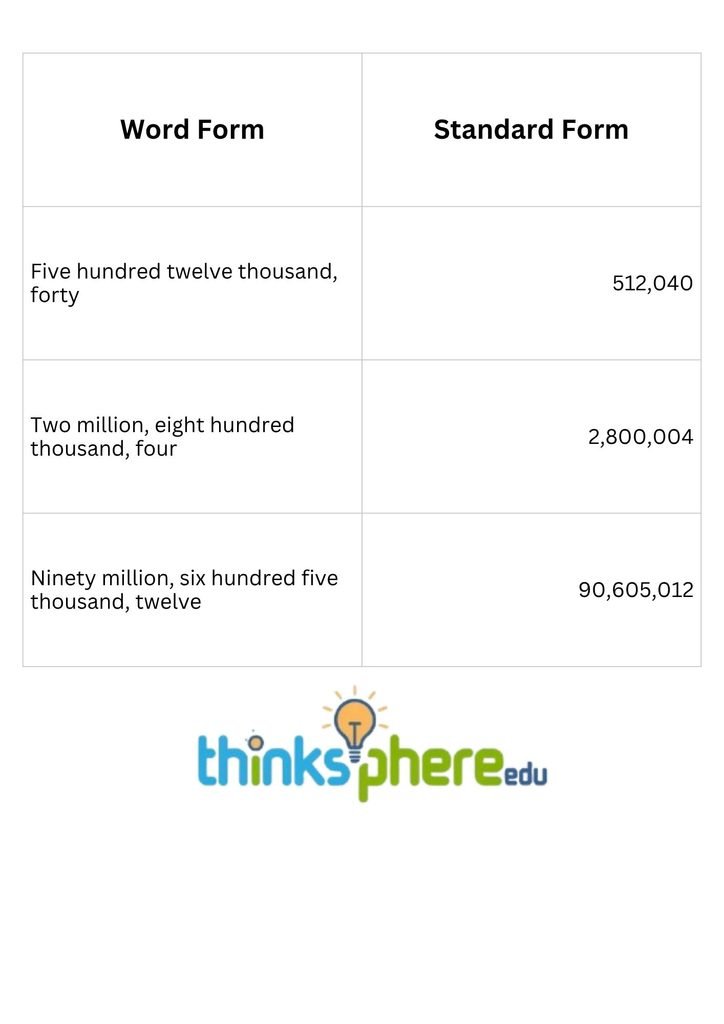
Practice Table: Standard Form vs. Word Form
5. Expanded Form Practice (Expanded Form Practice Grade 5)
Expanded Form stretches a number out to show the individual value of every digit added together. It is like looking at a building’s blueprint to see every brick inside.
Standard Expanded Form
In 4th grade, you wrote expanded form using simple addition:
45,321 = 40,000 + 5,000 + 300 + 20 + 1
5th Grade Expanded Form (Using Multiplication)
In 5th grade, you take expanded form a step further by multiplying each digit by its place value position:
45,321 = (4 X 10,000) + (5 X 1,000) + (3 X 100) + (2 X 10) + (1 X 1)
Step-by-Step Example
Let’s convert 806,450 into 5th-grade Expanded Form.
- 8 is in the Hundred Thousands place -> (8 X 100,000)
- 0 is in the Ten Thousands place -> Skip zeros! They add no value.
- 6 is in the Thousands place -> (6 X 1,000)
- 4 is in the Hundreds place -> (4 X 100)
- 5 is in the Tens place -> (5 X 10)
- 0 is in the Ones place -> Skip zeros.
Final Expanded Form:
(8 X 100,000) + (6 X 1,000) + (4 X 100) + (5 X 10)
6. Comparing Whole Numbers (Grade 5 Place Value and Number Sense)
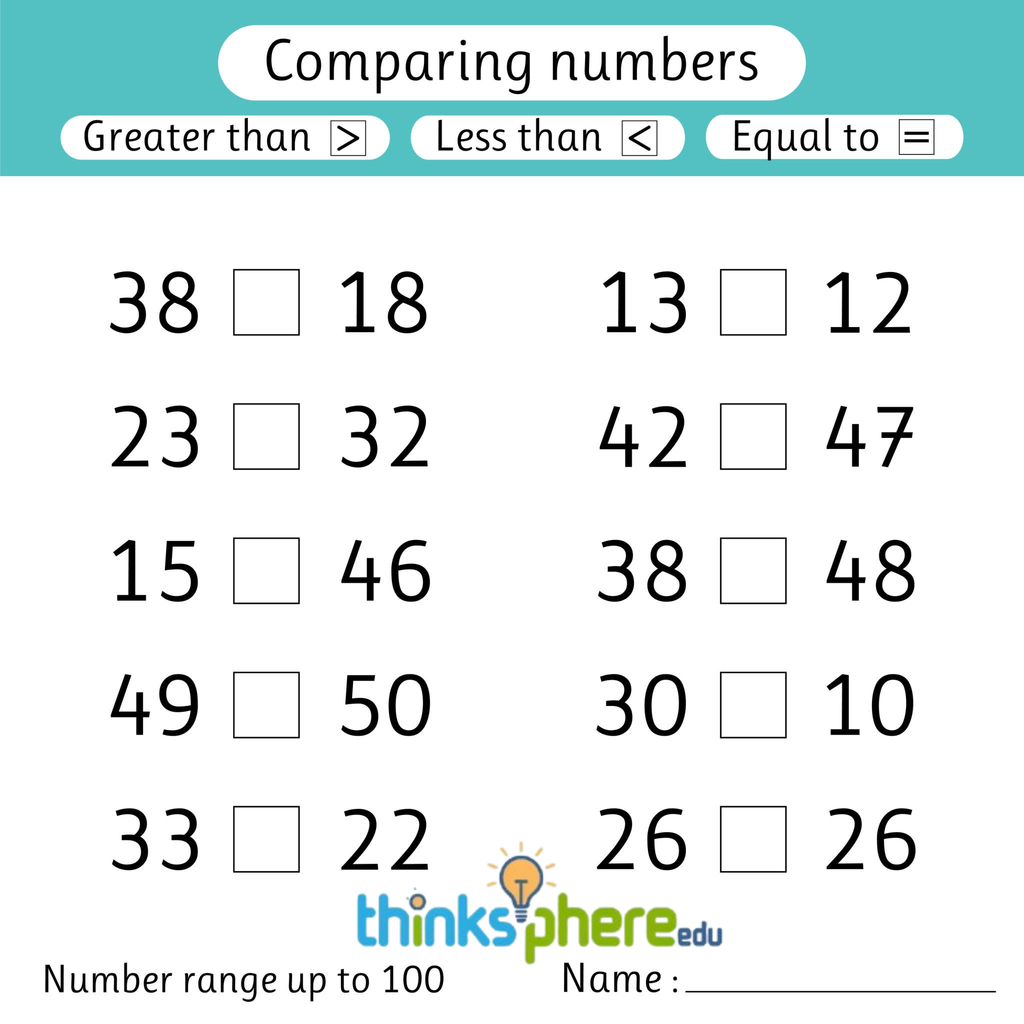
Comparing numbers means figuring out which number is larger, smaller, or if they are equal.
We use three primary math symbols to compare numbers:
- > Greater than
- < Less than
- = Equal to
Memory Trick: Think of the symbol as an alligator mouth. The alligator is hungry, so it always opens its mouth toward the bigger number!
Steps to Compare Large Numbers
1. Count the Digits: The number with more total digits is always greater.
- Example: 12,450 (5 digits) vs. 8,999 (4 digits). 12,450 > 8,999.
2. Line Up Place Values: If the digit counts are equal, line up the numbers vertically by place value.
3. Compare Left to Right: Start at the largest place value on the far left. Find the first spot where the digits differ.
Example Walkthrough: Compare 4,582,109 and 4,589,001.
- Millions place: Both have
4(Equal) - Hundred Thousands place: Both have
5(Equal) - Ten Thousands place: Both have
8(Equal) - Thousands place: One has
2, the other has9.
Since 9 > 2, 4,589,001 is the larger number.
Result: 4,582,109 < 4,589,001
7. Ordering Whole Numbers (Grade 5 Place Value and Number Sense)
Ordering numbers means arranging a list of numbers from least to greatest (ascending order) or greatest to least (descending order).
Step-by-Step Strategy for Ordering Numbers
- Stack the numbers vertically with their ones places aligned.
- Count the digits in each number.
- Compare digits starting from the leftmost column.
- Group and rank the numbers step-by-step.
Example Problem
Order these numbers from least to greatest:
845,1201,204,50084,999841,900
Step 1: Count digits
84,999(5 digits) -> This is the smallest number.845,120 (6 digits)841,900 (6 digits)1,204,500 (7 digits) -> This is the largest number.
Step 2: Compare the two 6-digit numbers (845,120 and 841,900)
- Hundred thousands: Both have
8 - Ten thousands: Both have
4 - Thousands: 841,900 has 1, while 845,120 has 5.
- Since 1 < 5, 841, 900 is smaller than 845, 120.
Final Ordered List (Least to Greatest):
84,999 < 841,900 < 845,120 < 1,204,500
8. Powers of 10 Explained (Powers of 10 Grade 5 Math)
In 5th grade, you will start writing powers of 10 using exponents according to US Common Core Math Standards. An exponent is a small number written above and to the right of a base number.
10³
- Base (10): The number being multiplied.
- Exponent (3): Tells you how many times to multiply 10 by itself.
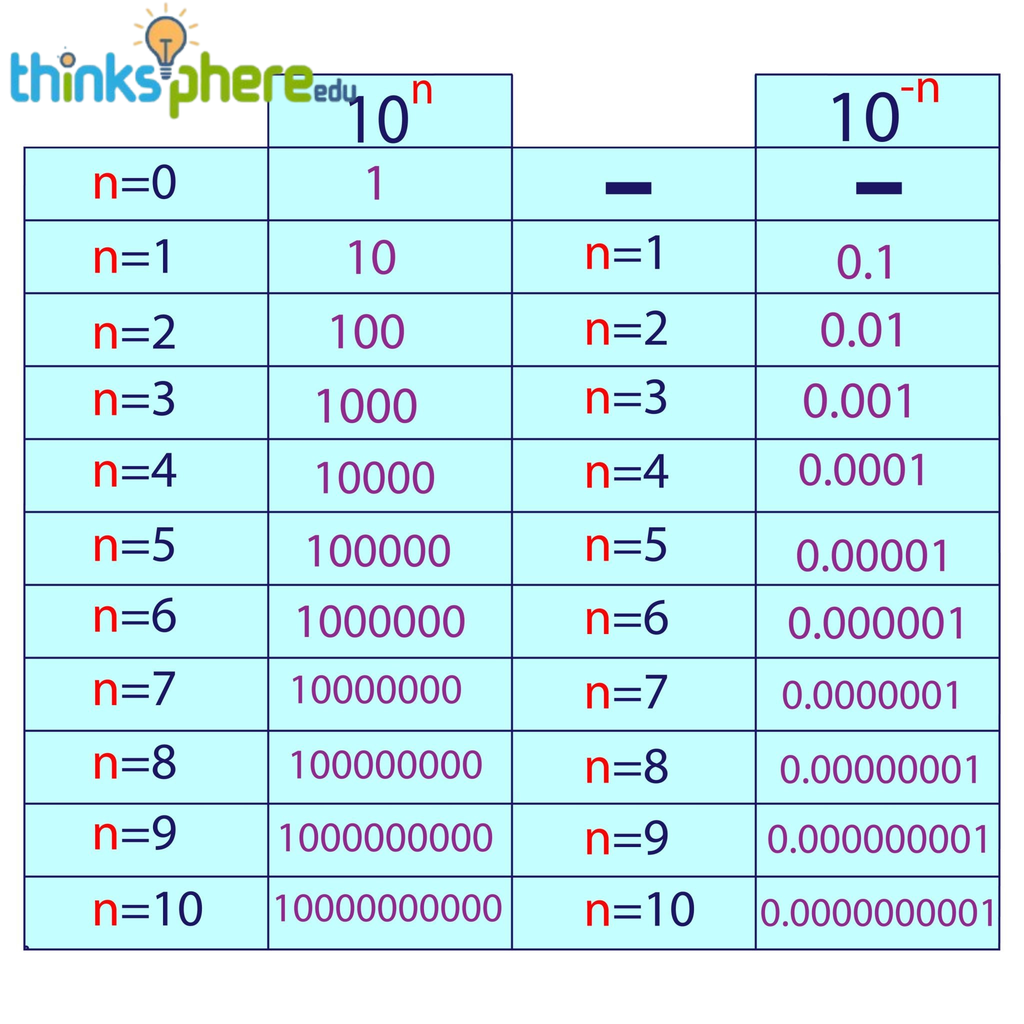
Powers of 10 Patterns ((Powers of 10 Grade 5 Math))
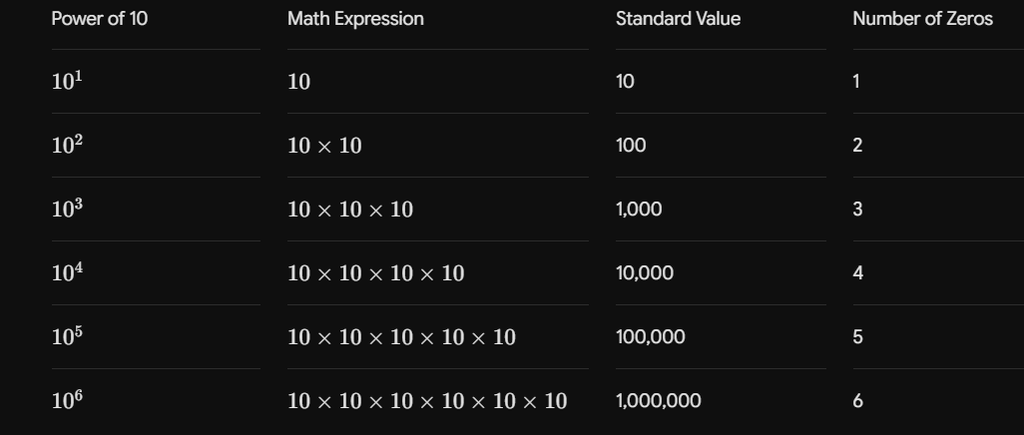
Key Shortcut
The exponent tells you exactly how many zeros follow the 1 in standard form!
- 10⁴ = 1 followed by 4 zeros = 10,000
- 10⁷ = 1 followed by 7 zeros = 10,000,000
9. Multiplying by 10, 100, and 1,000
Multiplying by powers of 10 is one of the quickest mental math tricks in 5th grade. You don’t need long multiplication!
The Place Value Shift
When you multiply a whole number by 10, 100, or 1,000, every digit shifts to the left on the place value chart.
- Multiply by 10 (10ⁱ): Digits shift 1 spot left (add 0 to the end).
- Multiply by 100 (10²): Digits shift 2 spots left (add 00 to the end).
- Multiply by 1,000 (10³): Digits shift 3 spots left (add 000 to the end).
Examples in Action
- 45 X 10 = 450
- 45 X 100 = 4,500
- 45 X 1,000 = 45,000
- 45 X 10⁴ = 450,000
Real-World Application: A factory produces 320 boxes of toys each hour. How many toys are produced in 100 hours?
Calculation: 320 X 100 = 32,000 toys
10. Dividing by 10, 100, and 1,000 (Grade 5 Place Value and Number Sense)
Division is the opposite of multiplication. When you divide by powers of 10, digits shift to the right on the place value chart, making the number smaller.
The Division Shift Pattern
For whole numbers ending in zeros:
- Divide by 10 (10ⁱ): Digits shift 1 spot right (remove 1 zero).
- Divide by 100 (10²): Digits shift 2 spots right (remove 2 zeros).
- Divide by 1,000 (10³): Digits shift 3 spots right (remove 3 zeros).
Examples in Action
- 60,000 ÷ 10 = 6,000
- 60,000 ÷ 100 = 600
- 60,000 ÷ 1,000 = 60
- 60,000 ÷ 10⁴ = 6
Pattern Summary:
- Multiplying by powers of 10 -> Number gets bigger -> Shift digits left (add zeros).
- Dividing by powers of 10 -> Number gets smaller -> Shift digits right (remove zeros).
Grade 5 Place Value Worksheets (Grade 5 Place Value and Number Sense)
Practice makes perfect! Work through these practice problems to test your understanding. Answers are located at the bottom of the page.
Worksheet 1: Place Value & Identification
1. What is the place of the underlined digit in 6, 412, 890?
2. What is the value of the digit 7 in 75, 301, 249?
3. In the number 4,450, how many times greater is the 4 in the thousands place compared to the 4 in the hundreds place?
Worksheet 2: Standard, Expanded & Word Form
1. Write this number in Standard Form: Eight million, five hundred two thousand, forty-one.
2. Write 3, 408, 210 in 5th-grade Expanded Form using multiplication.
3. Write 600, 000 + 40, 000 + 300 + 5 in Standard Form.
Worksheet 3: Comparing & Ordering
1. Compare using >, <, or =:
- 9, 450, 112 _ _ _ _ 9, 451, 000
- (5 X 100, 000) + (2 X 10) _ _ _ _ _ 500, 020
2. Order these numbers from least to greatest:
- 452, 100 | 45, 999 | 4,500, 000 | 452, 099
Worksheet 4: Powers of 10, Multiplication & Division
1. Write 10 X 10 X 10 X 10 in exponential form.
2. Solve: 84 X 10³ = _________
3. Solve: 530, 000 ÷ 100 = ____
4. Solve: 7, 000 ÷ 10² = _______
Answer Keys
Answer Key 1: Place Value & Identification
1. Hundred Thousands place
2. 70,000,000 (Seventy Million)
3. 10 times greater (Moving one place value to the left multiplies the value by 10).
Answer Key 2: Standard, Expanded & Word Form
1. 8,502,041
2. (3 × 1,000,000) + (4 × 100,000) + (8 × 1,000) + (2 × 100) + (1 × 10)
2. 640,305
Answer Key 3: Comparing & Ordering
1.
- 9,450,112 < 9,451,000
- = (Both are equal to 500,020)
2. 45,999 < 452,099 < 452,100 < 4,500,000
Answer Key 4: Powers of 10, Multiplication & Division
1. 10⁴
2. 84,000 (84 × 1,000)
3. 5,300 (Remove 2 zeros)
4. 70 (7,000 ÷ 100)