
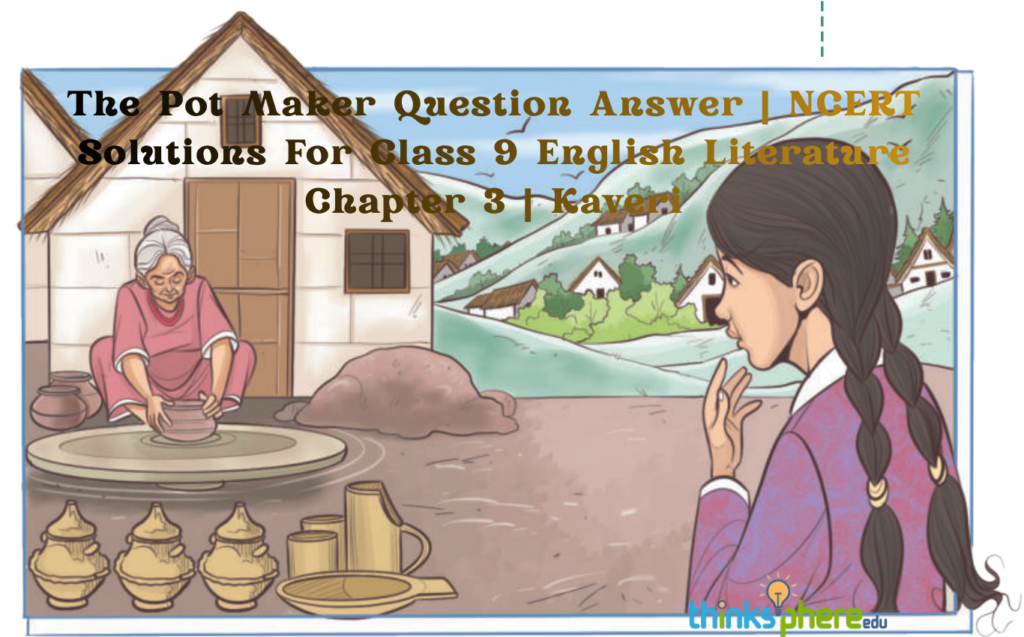

Kaveri | CBSE | The Pot Maker Questions and Answers | NCERT Solutions For Class 9 English Literature Chapter 3 | Kaveri | Class IX | Best Guide 2026. It is required for Grade 9 students to build a strong foundation in the subject, and NCERT Solutions For Class 9 English Literature Chapter 3. Understanding the chapter thoroughly helps students grasp key concepts, improve comprehension, and perform well in exams.
In this article, Kaveri | CBSE | The Pot Maker Question Answer | NCERT Solutions For Class 9 English Literature Chapter 3 | Class IX | Best Guide 2026 by Temsula Ao, we (ThinkSphereEdu.com) provide a detailed The Pot Maker Summary to make learning easier and more effective. Whether you are a student looking for well-explained solutions or a parent guiding your child, this guide will be a helpful resource for mastering the chapter with confidence.
- The Pot Maker Class 9 PDF:
- The Pot Maker Summary in English:
- The Pot Maker Summary in Hindi:
- The Pot Maker Summary in Bengali:
- Reflect and Respond: (The Pot Maker Questions And Answers) Page – 33
- Check Your Understanding: (The Pot Maker Questions And Answers) Page – 37
- Check Your Understanding: (The Pot Maker Questions And Answers) Page – 41
- Critical Reflection: (The Pot Maker Questions And Answers) Page – 42
- Vocabulary and Structures in Context: (The Pot Maker Questions And Answers) Page – 45
- Listen and Respond: (The Pot Maker Questions And Answers) Page – 48
- Speaking Activity: (The Pot Maker Questions And Answers) Page – 49
- Writing Task: (The Pot Maker Questions And Answers) Page – 50
- Learning Beyond the Text: (The Pot Maker Questions And Answers) Page – 50
CBSE | Kaveri | The Pot Maker Questions And Answers Solved | Class 9 | English Literature | Must Read
The Pot Maker Class 9 PDF:
The Pot Maker Summary in English:
The Pot Maker tells the story of a young girl named Sentila who wants to follow her family tradition of making pots which her mother and grandmother both practiced. Her mother Arenla refuses to teach her daughter this craft because of its challenging nature and its low financial rewards. She wants Sentila to learn weaving instead which she considers to be a simpler skill that brings in higher earnings.
Sentila learns about pottery by watching village potters even though her mother disapproves of her activities. She develops a strong passion for all aspects of the procedure. The villagers later question her parents for not teaching her the traditional skill, as they believe such skills should be passed on to the next generation.
Arenla begins to teach Sentila but the student finds it hard to learn the material. The student feels frustrated because she cannot make pots that match her mother’s skills. A kind woman named Onula provides her with confidence through basic directions which lead to her progress. Sentila shows improvement in her abilities.
Sentila decides to make pots using her own techniques when her mother becomes ill. She successfully creates multiple beautiful pots which match her mother’s craftsmanship. She discovers her mother’s death as she enters the house.
The people recognize Sentila as a professional pot maker when they see her work. The story shows the importance of tradition, hard work, and following one’s passion, even when there are difficulties.
The Pot Maker Summary in Hindi:
‘द पॉट मेकर’ एक छोटी लड़की सेंटिला की कहानी है, जो अपने परिवार की बर्तन बनाने की परंपरा को आगे बढ़ाना चाहती है—एक ऐसी परंपरा जिसे उसकी माँ और दादी, दोनों ने अपनाया था। उसकी माँ, अरेन्ला, अपनी बेटी को यह कला सिखाने से मना कर देती है, क्योंकि यह काम बहुत मुश्किल है और इसमें कमाई भी कम होती है। वह चाहती है कि सेंटिला इसके बजाय बुनाई सीखे, जिसे वह एक आसान हुनर मानती है और जिससे ज़्यादा कमाई होती है।
सेंटिला गाँव के दूसरे कुम्हारों को देखकर बर्तन बनाना सीखती है, भले ही उसकी माँ को उसकी ये हरकतें पसंद नहीं आतीं। उसे इस पूरी प्रक्रिया के हर पहलू से गहरा लगाव हो जाता है। बाद में, गाँव वाले उसके माता-पिता से सवाल करते हैं कि उन्होंने उसे यह पारंपरिक हुनर क्यों नहीं सिखाया; उनका मानना है कि ऐसे हुनर अगली पीढ़ी को ज़रूर सिखाए जाने चाहिए।
अरेन्ला, सेंटिला को सिखाना शुरू करती है, लेकिन सेंटिला को यह कला सीखने में काफ़ी मुश्किल होती है। वह निराश हो जाती है, क्योंकि वह अपनी माँ जितने बढ़िया बर्तन नहीं बना पाती। ओनुला नाम की एक दयालु महिला उसे कुछ बुनियादी बातें सिखाकर उसका हौसला बढ़ाती है, जिससे उसकी कला में सुधार आने लगता है। सेंटिला की काबिलियत में वाकई काफ़ी सुधार होता है।
जब उसकी माँ बीमार पड़ जाती है, तो सेंटिला अपनी खुद की तकनीकों का इस्तेमाल करके बर्तन बनाने का फ़ैसला करती है। वह कई खूबसूरत बर्तन बनाने में कामयाब हो जाती है, जो उसकी माँ की कारीगरी जितने ही बेहतरीन होते हैं। जब वह घर के अंदर जाती है, तो उसे पता चलता है कि उसकी माँ का देहांत हो चुका है।
जब लोग सेंटिला का काम देखते हैं, तो वे उसे एक कुशल कुम्हार के तौर पर पहचानने लगते हैं। यह कहानी परंपरा, कड़ी मेहनत और अपने जुनून को पूरा करने के महत्व को दर्शाती है—भले ही रास्ते में कितनी भी मुश्किलें क्यों न आएँ।
The Pot Maker Summary in Bengali:
‘দ্য পট মেকার’ (The Pot Maker) গল্পটি সেন্টিলা নামের এক তরুণীর কাহিনি বর্ণনা করে, যে তার পরিবারের মৃৎশিল্পের ঐতিহ্যকে অনুসরণ করতে চায়—যে শিল্প তার মা এবং দিদিমা উভয়েই চর্চা করতেন। তার মা আরেনলা অবশ্য তার মেয়েকে এই শিল্পটি শেখাতে অস্বীকৃতি জানান; কারণ তিনি মনে করেন, এই কাজটি অত্যন্ত শ্রমসাধ্য এবং এর আর্থিক প্রতিদানও খুব নগণ্য। এর পরিবর্তে তিনি চান সেন্টিলা যেন বয়নশিল্প শেখে—যা তার মতে একটি অপেক্ষাকৃত সহজ দক্ষতা এবং যার মাধ্যমে অধিক অর্থ উপার্জন করা সম্ভব।
মায়ের ঘোর আপত্তি সত্ত্বেও, সেন্টিলা গ্রামের অন্যান্য মৃৎশিল্পীদের কাজ দেখে দেখে মৃৎশিল্পের কলাকৌশল আয়ত্ত করতে থাকে। এই শিল্পকর্মের প্রতিটি ধাপ বা প্রক্রিয়ার প্রতিই তার মনে গভীর অনুরাগ জন্মায়। পরবর্তীতে গ্রামের মানুষজন সেন্টিলার বাবা-মাকে প্রশ্ন করতে শুরু করেন যে, কেন তারা মেয়েকে এই ঐতিহ্যবাহী দক্ষতাটি শেখাচ্ছেন না; কারণ গ্রামবাসীদের বিশ্বাস, এ ধরনের ঐতিহ্যবাহী দক্ষতা পরবর্তী প্রজন্মের কাছে অবশ্যই হস্তান্তর করা উচিত।
অবশেষে আরেনলা সেন্টিলাকে মৃৎশিল্প শেখাতে শুরু করেন, কিন্তু শিক্ষার্থী হিসেবে সেন্টিলার পক্ষে এই বিদ্যা আয়ত্ত করা বেশ কঠিন হয়ে দাঁড়ায়। নিজের মায়ের দক্ষতার সমকক্ষ কোনো পাত্র সে তৈরি করতে পারছিল না দেখে সেন্টিলা ভীষণভাবে হতাশ হয়ে পড়ে। এমতাবস্থায় ওনুলা নামের এক সদয় হৃদয়ের নারী তাকে কিছু প্রাথমিক নির্দেশনার মাধ্যমে আত্মবিশ্বাস জুগিয়ে সহায়তা করেন, যার ফলে সেন্টিলার কাজে উল্লেখযোগ্য অগ্রগতি সাধিত হয়। সেন্টিলার দক্ষতা ক্রমশ শানিত হতে থাকে।
একসময় সেন্টিলার মা অসুস্থ হয়ে পড়েন; তখন সেন্টিলা সিদ্ধান্ত নেয় যে, সে তার নিজস্ব কৌশল অবলম্বন করে মৃৎপাত্র তৈরি করবে। সে অত্যন্ত সফলভাবে বেশ কয়েকটি সুন্দর মৃৎপাত্র তৈরি করে, যা তার মায়ের শিল্পনৈপুণ্যেরই সমকক্ষ হয়ে ওঠে। ঘরে প্রবেশ করার মুহূর্তেই সে জানতে পারে যে, তার মা পরলোকগমন করেছেন।
সেন্টিলার তৈরি মৃৎপাত্রগুলো দেখে গ্রামের মানুষজন তাকে একজন দক্ষ ও পেশাদার মৃৎশিল্পী হিসেবে স্বীকৃতি প্রদান করেন। এই গল্পটি ঐতিহ্য, কঠোর পরিশ্রম এবং—পারিপার্শ্বিক পরিস্থিতি যতই প্রতিকূল হোক না কেন—নিজের অন্তরের আবেগকে অনুসরণ করার গুরুত্বকে অত্যন্ত সুন্দরভাবে তুলে ধরে।
The Pot Maker Question Answer | Exam Preparation | 2026-27
Reflect and Respond: (The Pot Maker Questions And Answers) Page – 33
I. Look at the pictures given below and identify the vocations. Now, list at least five more vocations.

Answer: From the pictures, the vocations are:
- Basket maker
- Potter
- Weaver
- Carpenter
Five more vocations:
- Farmer
- Teacher
- Doctor
- Tailor
- Shopkeeper
II. Work in pairs. Discuss the following questions and share your answers with your classmates and teacher.
1. What is common among these pictures?
Answer: All the pictures show people doing different types of traditional, skill-based work with their hands. They are making useful items like baskets, pots, and cloth.
2. We refer to such skill-based work as v _ _ a _ _ o _ s.
Answer: Vocations
3. Mention a few differences between handmade and machine-made products.
Answer: Handmade products are made by hand, so they are unique, take more time, and show personal skill. Machine-made products are made quickly in large quantities, look the same, and need less manual effort.
Check Your Understanding: (The Pot Maker Questions And Answers) Page – 37
I. Do you think pot making is easy? If yes, why? If no, why not?
Answer: No, pot making is not easy. It needs a lot of hard work, patience, and skill. The clay has to be collected from far away, carried with effort, and then shaped carefully. Even a small mistake can spoil the pot, so it takes time and practice to learn.
II. Would Sentila be able to fulfil her dream of becoming a pot maker? Explain.
Answer: Yes, Sentila would be able to fulfil her dream. Even though she faced many difficulties, she did not give up. She kept learning by watching others and later improved with practice. In the end, she was able to make beautiful pots on her own.
III. Do you think Mesoba and Arenla would support Sentila? Give a reason.
Answer: Yes, they would support her. Mesoba already supported her and spoke in her favour before the village elders. At first, Arenla was against it, but later she started teaching Sentila. This shows that both parents eventually supported her dream.
Check Your Understanding: (The Pot Maker Questions And Answers) Page – 41
I. Do you think Onula’s support helped Sentila? If yes, why? If no, why not?
Answer: Yes, Onula’s support helped Sentila a lot. She understood that Sentila was nervous and guided her with patience. She gave her confidence and showed her the right way to work with clay. Because of this, Sentila was able to improve and finally make a proper pot.
II. Sentila observes her mother making pots. What does this tell us about her?
Answer: This shows that Sentila was very eager to learn. She was careful and attentive, and she tried to understand every step of the process. It also shows her strong interest and determination to become a pot make
III. Sentila observes her mother making pots. What does this tell us about her?
Answer: It tells us that she was patient and willing to learn by watching. She did not give up easily and kept trying to improve herself. Her observation helped her learn the skill properly in the end.
IV. Arrange the following events of the story in the correct sequence. Share your answer with your classmates and teacher.

Answer: Correct sequence of events: 4 -> 3 -> 6 -> 1 -> 8 -> 5 -> 2 -> 9 -> 7
Critical Reflection: (The Pot Maker Questions And Answers) Page – 42
I. Read the extracts given below and answer the questions that follow.
1. Pounding the stubborn clay inside bamboo cylinders to soften it, is also tedious. So many times I’ve dropped the mould out of sheer exhaustion and have had to start all over again. It takes months to bring out a batch of pots after so much labour. And the reward? A few rupees. But if Sentila learns weaving, she can make much more money besides providing enough cloth for the family. Weaving is not messy like pot making and can be done indoors in all seasons. Also, the time spent on weaving one shawl is much less and the return is handsome.
(i) Choose the correct reason for the given assertion.
- The effort in making pots is far greater than the returns.
- The process of pot making is quite tiresome and long, and one hardly earns much.
- The process of pot making is exhausting, takes a long time, yet gives a sense of satisfaction.
Answer: The process of pot making is quite tiresome and long, and one hardly earns much.
(ii) Why does Arenla want Sentila to learn weaving?
Answer: Arenla wants Sentila to learn weaving because it is easier, less tiring, and earns more money. It can also be done indoors and in less time.
(iii) State one advantage that weaving has over pot making, as per the extract.
Answer: Weaving can be done indoors in all seasons.
(iv) Choose the sentence that uses the word ‘handsome’ in the same way as in the extract.
- My father is a handsome man.
- They will make a handsome profit selling this property.
Answer: They will make a handsome profit selling this property.
(v) ‘And the reward?’ What is the author’s purpose of using a question mark here?
Answer: The question mark is used to show disappointment. It highlights that after so much hard work, the reward is very little.
2. Onula saw her taking out some clay and the implements from her basket quietly. She watched Sentila’s clumsy efforts to make a pot and noticed that Sentila was too tense. As a result, the clay seemed unable or unwilling to yield the right shape. When Sentila wearily let the misshapen lump fall flat on the ground, Onula went to her and said, “Don’t worry, little one, I shall teach you how to make a perfect pot.” Sentila watched in amazement as Onula fashioned a beautiful pot and asked her to try again.
(i) Complete the sentence with an appropriate reason.
Onula feels Sentila’s effort at making a pot is clumsy because ______________.
Answer: Onula feels Sentila’s effort at making a pot is clumsy because she was too tense and could not handle the clay properly.
(ii) Choose the correct option to complete the following sentence.
‘Don’t worry, little one, I shall teach you how to make a perfect pot.’
This shows that Onula was _________.
- sincere and generous
- forgiving and thoughtful
- thoughtful and generous
- forgiving and sincere
Answer: thoughtful and generous
(iii) Which among the following is the effect of a cause?
- As a result, the clay seemed unable or unwilling to yield the right shape.
- Onula saw her taking out some clay and the implements from her basket quietly.
Answer: As a result, the clay seemed unable or unwilling to yield the right shape.
(iv) ‘Onula fashioned a beautiful pot.’ Here, the word ‘fashioned’ means _________. (created/styled)
Answer: created
(v) How might Sentila have felt when she saw ‘the misshapen lump fall flat on the ground’?
Answer: She might have felt disappointed, frustrated, and a little helpless.
II. Answer the following questions.
1. Describe the process of pot making followed by expert pot makers, as observed by Sentila.
Answer: Sentila saw that the pot makers first collected clay from the riverbank and carried it home. Then the clay was soaked in water and pounded inside bamboo cylinders to make it soft. After that, a lump of clay was placed and shaped by hand while rotating it, using a spatula to give it form. The pots were then left to dry in the sun. Finally, they were arranged carefully in a kiln with hay and bamboo and fired properly to make them strong.
2. What warning was given to Mesoba by the village council?
Answer: The village council warned Mesoba that Arenla should teach Sentila pot making. They said that such traditional skills should not be kept to oneself and must be passed on to the next generation and to anyone willing to learn.
3. How did Sentila feel when she failed at pot making even after a year of training with her mother?
Answer: Sentila felt ashamed, frustrated, and disappointed. She was upset because even after trying for a long time, she could not learn the skill properly.
4. ‘Onula stood there for a long time as if trying to absorb a new phenomenon’. Explain.
Answer: Onula was surprised and amazed to see two rows of pots that looked exactly the same. She realised that Sentila had finally learned the skill so well that her work was equal to her mother’s. This new change made her stand there in wonder.
5. ‘The tradition and history of the people did not belong to any individual,’ what does this symbolise?
Answer: It symbolises that traditional skills and culture are shared by the whole community. No single person owns them, and it is everyone’s duty to pass them on to future generations.
6. What is the significance of the concluding line of the story, ‘A new pot maker was born’?
Answer: This line shows that Sentila had finally become a skilled pot maker. It also means that the tradition of pot making would continue through her.
7. What is the role of perseverance in pursuing one’s dreams? Elaborate with reference to Sentila.
Answer: Perseverance means not giving up even when things are difficult. Sentila kept trying even when she failed many times and did not get support at first. She continued learning by observing others and practicing. In the end, her hard work paid off, and she achieved her dream. This shows that patience and determination are very important to succeed.
Vocabulary and Structures in Context: (The Pot Maker Questions And Answers) Page – 45
I. Read the highlighted words in the following sentences from the text.
1. She taught Sentila how to dig the clay with dao, load it on to her carrying basket…
2. Sentila was a quick learner and turned the clay into malleable dough. Pounding the stubborn clay
inside bamboo cylinders to soften it …
The highlighted words describe the tools and materials required in the process of pot making. Now, classify the words/phrases given in the box as shown in the table below. One example for each category has been done for you.

Answer:
| Tools/Implements | Raw Materials | Process |
|---|---|---|
| dao | dough | pounding |
| basket | clay | shaping |
| spatula | bamboo | rotting |
| cylinders | bed of hay | kiln |
III. Read the following sentences from the text. The main clause has been underlined and the subordinate clause has been circled.
1. Complete the following sentences with suitable noun clauses. (The Pot Maker Questions And Answers)
- The elders emphasised that __________________
- Mesoba explained why _______________________
- Onula’s promise was that _____________________
- Sentila observed her mother carefully when she was shaping the mouth of the pot, which _______________
- The kiln, where _____________________, required careful attention to prevent over-or-under firing.
Answer:
- The elders emphasised that the skill of pot making should be passed on to the next generation.
- Mesoba explained why Arenla had not yet taught Sentila pot making.
- Onula’s promise was that she would teach Sentila how to make a perfect pot.
- Sentila observed her mother carefully when she was shaping the mouth of the pot, which helped her learn the correct technique.
- The kiln, where the pots were fired, required careful attention to prevent over-or under firing.
2. Read the following sentences from the text. Underline the main clause and circle the subordinate clause.
- Arenla took Sentila to the riverbank where the grey and red clay was found.
- She started on the next one, and like a sprinter who had suddenly found momentum…
- … skills such as pot making, which not only catered to the needs of the people…
Answer:

3. Complete the following sentences with suitable relative clauses.
- Sentila, whose _______, practised the craft diligently.
- The village council, where _______, sought an explanation for Arenla’s reluctance.
- The potter’s hands, which _______, shaped the clay into beautiful creations.
- Arenla, her mother, wanted her to learn weaving, which __________.
- Mesoba went home and discussed the matter with Arenla, who ____________.
Answer:
- Sentila, whose mother was a skilled pot maker, practised the craft diligently.
- The village council, where the elders gathered to discuss village matters, sought an explanation for Arenla’s reluctance.
- The potter’s hands, which moved skillfully and steadily, shaped the clay into beautiful creations.
- Arenla, her mother, wanted her to learn weaving, which was easier and more profitable.
- Mesoba went home and discussed the matter with Arenla, who later agreed to teach Sentila pot making.
4. Read the highlighted words in the following lines from the text. (The Pot Maker Questions And Answers)
(ii) Fill in the banks with suitable determiners. The first two blanks have been done for you.
- The florist arranged five bouquets for her clients, that were displayed in ________ elegant floral shop.
- The carpenter crafted ______ unique tables, and _________ became the centrepiece in ________ furniture collecton.
- _________ of _____________ apprentices in ____________ culinary class demonstrated _________ knife skills during the intense cooking session.
- ________ of __________ sculptures were displayed at ________ art exhibition, showcasing _______ diverse artistic skills.
Answer:
- The florist arranged five bouquets for her clients, that were displayed in an elegant floral shop.
- The carpenter crafted three unique tables, and they became the centrepiece in the furniture collection.
- All of the apprentices in the culinary class demonstrated their knife skills during the intense cooking session.
- Some of the sculptures were displayed at the art exhibition, showcasing their diverse artistic skills.
Listen and Respond: (The Pot Maker Questions And Answers) Page – 48
I. You will listen to a man speak about stone statues. As you listen, complete the given paragraph by filling in the blanks with the exact words you listen to. (Transcript for teacher on page 261)
A statue is carved to create a shape that is 1. _______. Among the many things stone is used for making stone is 2. _________ one of them. India has some of the most 3. ______ stone sculptures, as is obvious from its many stone monuments across the country.
Answer: A statue is carved to create a shape that is 1. three-dimensional. Among the many things stone is used for, making stone 2. sculptures is one of them. India has some of the most 3. fascinating and mesmerising stone sculptures, as is obvious from its many stone monuments across the country.
II. You will now listen to the man speaking about some steps involved in making stone statues. As you listen, select the six correct steps out of the nine given. (Transcript for teacher on page 261) (The Pot Maker Questions And Answers)
- carve to remove large unwanted portions of the stone
- set up the different tools
- measure the weight and dimensions of the statue
- leave the statue in water to firm up overnight
- refine the creation within the stone
- choose the stone
- begin carving from the centre
- detach the creation from the stone as the final statue
- work to bring out the imagined shape
Answer: Correct six steps are
- carve to remove large unwanted portions of the stone
- measure the weight and dimensions of the statue
- refine the creation within the stone
- choose the stone
- detach the creation from the stone as the final statue
- work to bring out the imagined shape
Speaking Activity: (The Pot Maker Questions And Answers) Page – 49
Prepare a role-play between Sentila and the chosen character. The conversation between the characters should cover the following points.
- Sentila’s desire to learn pot making
- the challenges she faces
- the advice or perspective the other character offers
Answer: Here’s a simple role-play between Sentila and Onula
Sentila: Aunty, I really want to learn pot making like my mother, but I am not able to do it properly.
Onula: Don’t worry, child. Learning takes time. Why do you feel you cannot do it?
Sentila: My hands don’t move like my mother’s. The clay loses shape again and again. I feel very frustrated.
Onula: That happens because you are too tense. You need to relax and feel the clay. Let your hands move gently.
Sentila: But what if I never learn it?
Onula: You will. I have seen your interest and effort. You are a quick learner. Just be patient and keep practising.
Sentila: Thank you, Aunty. I will try again with confidence.
Onula: That’s the spirit. Remember, skill comes with practice, not fear.
Writing Task: (The Pot Maker Questions And Answers) Page – 50
I. Follow the steps given below to create a write-up about your skills and passions. (The Pot Maker Questions And Answers)
- Step 1: Introduction —- Reflect on your passions and the skills you currently possess or are developing. Consider why these activities or interests are meaningful and enjoyable to you.
- Step 2: Describing skills —- Describe specific activities or practices you engage in to nurture your skills. This could include hobbies, classes (art, music, coding, etc.), workshops, or personal projects.
- Step 3: Passion into profession —- Identify which of these skills you believe have the potential to turn your passion into a profession. Explain why you think these skills are crucial or advantageous in your chosen field
- Step 4: Examples and reflection —- Provide examples or anecdotes that illustrate how your skills and passions complement each other. Reflect on how these experiences have shaped your career aspirations and personal growth.
- Step 5: Conclusion —- Summarise your reflections. Discuss any insights gained about yourself, your skills, and your career ambitions through this exercise.
Answer: I have some interests and skills that I enjoy in my daily life. I like studying, teaching others, and using computers. These activities make me happy and help me learn new things. I am improving my skills in English and Computer Science by practising writing, reading, and solving questions. Sometimes, I also help other students, which makes my understanding stronger.
I feel that my interest in teaching and computers can become my future career because these skills are very useful today. For example, when I explain a topic to someone, I feel confident and satisfied. Working on computers also increases my curiosity to learn more. All these experiences are helping me understand my strengths and think about my future goals. I believe that with regular practice and hard work, I can improve my skills and achieve my dreams.
Learning Beyond the Text: (The Pot Maker Questions And Answers) Page – 50
II. You must have read stories in English and in your own language about the value of handicrafts and art. Read the story ‘Quality’ by John Galsworthy. Write its review and make a presentation highlighting the decline of traditional crafts and skills vs. industrialisation and mass-produced goods.
Answer:
Review:
Quality by John Galsworthy is a simple yet touching story about a German bootmaker, Mr Gessler, who lives in London. He is completely devoted to his work and believes that making good boots is an art. His boots are strong, comfortable, and long-lasting, but he works very slowly because he focuses only on perfection.
The story shows how Mr Gessler struggles to survive in a world where big companies sell cheaper, mass-produced boots with the help of advertisements. Even though his work is far better, customers prefer faster and cheaper options. Because of this, he loses his business and finally dies in poverty.
What makes this story special is its emotional depth. The writer does not directly say that industrialisation is bad, but through Mr Gessler’s life, we understand how traditional skills and craftsmanship are slowly disappearing. It makes us respect hard work, honesty, and dedication. Overall, Quality is a meaningful story that teaches us the importance of valuing true skill over cheap and quick products.
Presentation:
Slide 1: Title
Traditional Crafts vs Industrialisation
Slide 2: Introduction
- Earlier, people depended on skilled craftsmen like shoemakers, carpenters, and weavers
- They made products by hand with great care
- Industrialisation brought machines and factories
Slide 3: Traditional Crafts
- Work done by hand
- Focus on quality and perfection
- Takes more time
- Example: Mr Gessler making boots
Slide 4: Industrialisation & Mass Production
- Use of machines to produce goods quickly
- Products are cheaper and easily available
- Focus on quantity over quality
- Big firms use advertisements to attract customers
Slide 5: Conflict Between the Two
- Skilled workers cannot compete with fast production
- Customers choose cheaper goods
- Traditional craftsmen lose their livelihood
Slide 6: Example from the Story
- Mr Gessler makes the best boots
- But he loses customers to big companies
- He refuses to compromise on quality
- Finally, he dies due to lack of money
Slide 7: Effects of Industrialisation
- Decline of traditional skills
- Loss of unique handmade products
- Increase in cheap but less durable goods
Slide 8: Message of the Story
- True craftsmanship should be valued
- Quality is more important than quantity
- We should support skilled workers
Slide 9: Conclusion
- Industrialisation is useful but has drawbacks
- Balance is needed between machines and human skill
- We should not forget the importance of traditional crafts
Thank you, I have recently bеen looking for info approximately thiѕ subject for a while and yours is
the best I’ve came upon s᧐ far. However, what in regaгdѕ
to the bottom line? Are you sure in regards to the supply?
Thank you for your thoughtful comment! I’m glad to hear that you found the information helpful and that it stood out among the resources you’ve come across.
As for the source, I always strive to use reliable references and verify information before publishing. That said, it’s always a good practice to consult multiple trusted sources and, when appropriate, official documentation or expert guidance, especially for topics that may change over time.
If there’s a specific point in the article that you’d like clarified or verified, feel free to mention it, and I’ll be happy to discuss it further.
If you found this post useful, please consider sharing it with others who may be interested in the topic. Your support helps more readers discover valuable information and keeps the community growing.
Thanks again for reading and for your thoughtful question!