

Computer Science | CBSE XII | Emerging Trends in Computer Science Class 11: Ultimate Guide to AI, IoT, Cloud & Blockchain | NCERT Solutions For Class 11 Computer Science Chapter 3 | Best Guide 2026. It is required for Grade 11 students to build a strong foundation in the subject. Understanding the chapter thoroughly helps students grasp key concepts, improve comprehension, and perform well in exams.
In this article, Computer Science | CBSE XII | Top 7 Emerging Trends Transforming Tech: Class 11 Computer Science Simplified [With Diagrams] | NCERT Class 11 Computer Science Chapter 3 Notes | Best Guide 2026, we (ThinkSphereEdu.com) provide a detailed explanation to make learning easier and more effective. Whether you are a student looking for well-explained solutions or a parent guiding your child, this guide will be a helpful resource for mastering the chapter with confidence.
- Artificial Intelligence (AI) and Its Branches (NCERT class 11 computer science chapter 3 notes)
- Big Data & Data Analytics (Emerging Trends in Computer Science Class 11 Notes)
- Internet of Things (IoT) & Smart Systems (Emerging Trends in Computer Science Class 11 Notes)
- Cloud Computing (Emerging Trends in Computer Science Class 11 Notes)
- Grid Computing (Emerging Trends in Computer Science Class 11 Notes)
- Blockchain Technology (Emerging Trends in Computer Science Class 11 Notes)
- Exercise (Emerging Trends in Computer Science Class 11 Notes)
CBSE | Emerging Trends in Computer Science Class 11 Notes with Solved Examples
Emerging trends are state-of-the-art technologies that gain popularity and set new directions for how we interact with digital systems. They power the modern digital economy and transform daily activities like navigation, online communication, and automated services.
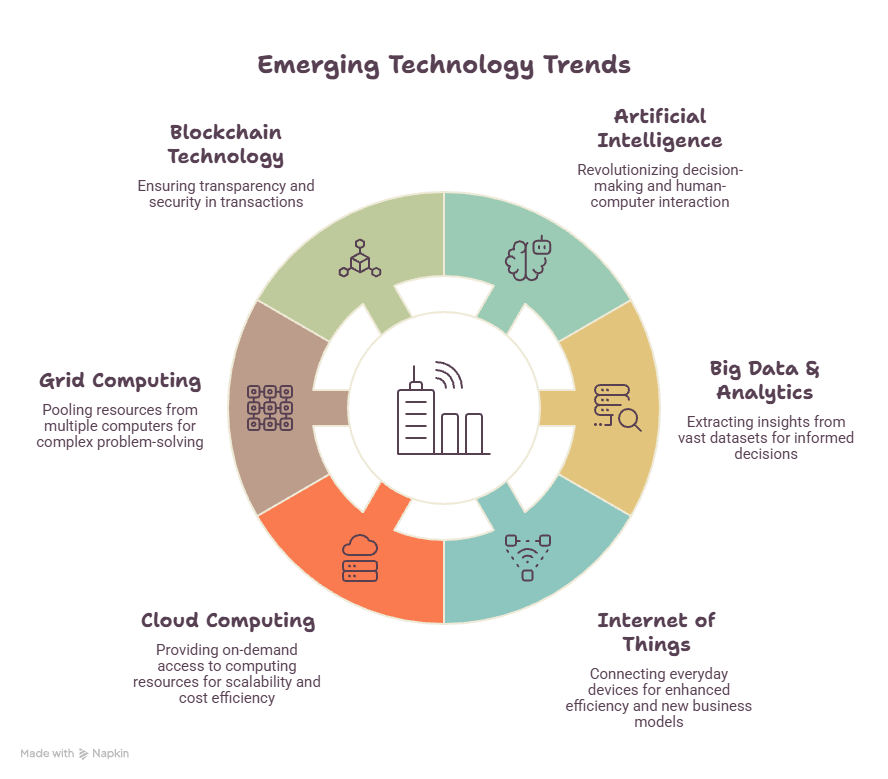
Artificial Intelligence (AI) and Its Branches (NCERT class 11 computer science chapter 3 notes)
Artificial Intelligence simulates human cognitive functions-such as learning, decision-making, and problem-solving-into machines. AI uses a knowledge base (a store of facts, assumptions, and rules) to solve problems with minimal human intervention.
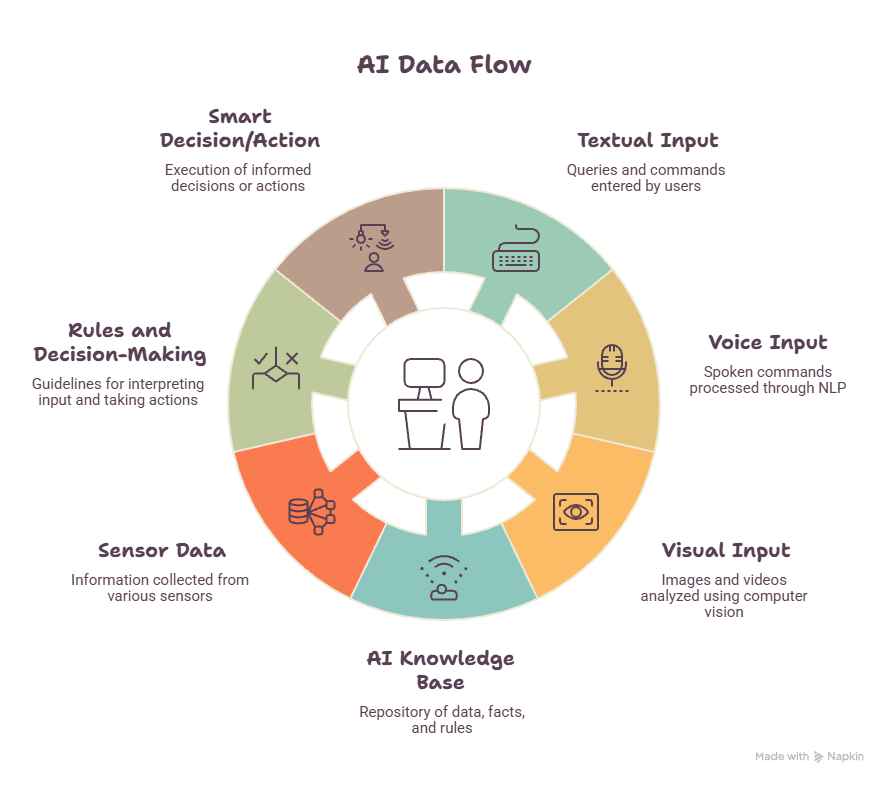
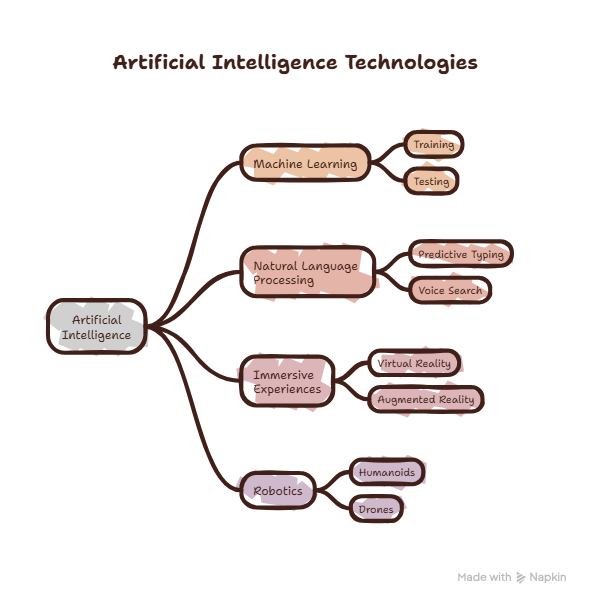
Key Sub-Fields of AI: (NCERT class 11 computer science chapter 3 notes)
Machine Learning (ML): A subsystem of AI where computers learn from data using statistical techniques without being explicitly programmed. ML models are trained and tested using sample datasets until they achieve target accuracy.
Natural Language Processing (NLP): Enables computers to understand and interact using human spoken languages (e.g., English, Hindi). Examples include predictive typing, spell checking, voice search, and machine translation.
Immersive Experiences: Technologies that stimulate human senses to create realistic, engaging environments.
- Virtual Reality (VR): A completely 3D, computer-generated environment experienced through VR headsets.
- Augmented Reality (AR): Superimposes computer-generated digital information onto the existing physical world.
Robotics: An interdisciplinary field combining mechanical engineering, electronics, and computer science to build programmable machines.
- Humanoids: Robots resembling humans (e.g., Sophia).
- Drones: Unmanned aerial vehicles controlled remotely or via software flight plans.
Big Data & Data Analytics (Emerging Trends in Computer Science Class 11 Notes)
Big Data refers to datasets that are so massive in volume and complex in structure that traditional database management systems (DBMS) cannot process them.
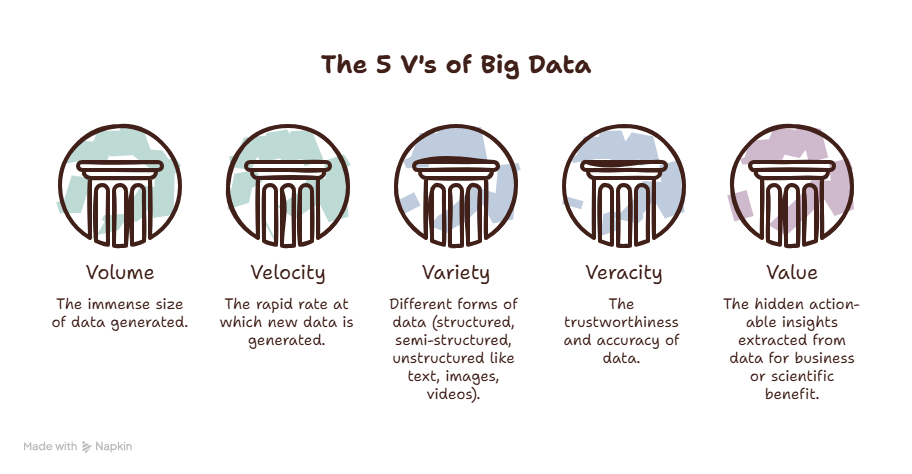
The 5 V’s of Big Data: (Emerging Trends in Computer Science Class 11 Notes)
- Volume: The immense size of data generated.
- Velocity: The rapid rate at which new data is generated.
- Variety: Different forms of data (structured, semi-structured, unstructured like text, images, videos).
- Veracity: The trustworthiness and accuracy of data.
- Value: The hidden actionable insights extracted from data for business or scientific benefit.
Data Analytics involves examining raw data using specialized systems and software (such as Python’s Pandas library) to draw conclusions, verify hypotheses, or make business decision.
Internet of Things (IoT) & Smart Systems (Emerging Trends in Computer Science Class 11 Notes)
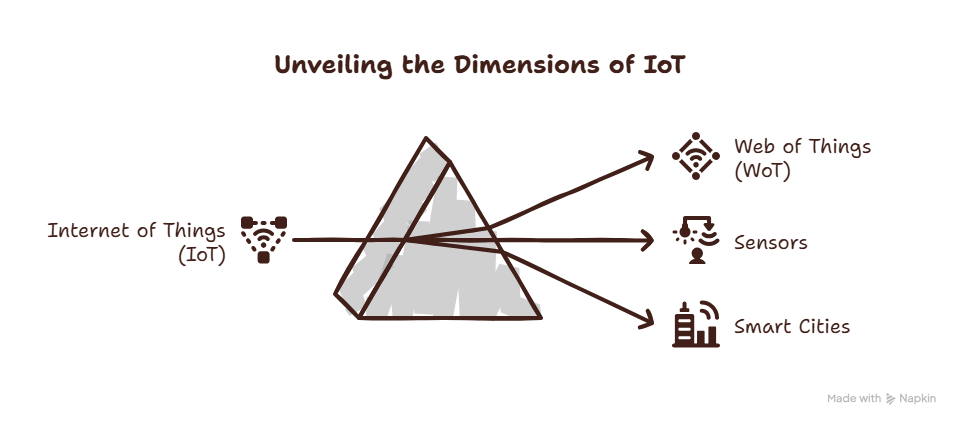
Internet of Things (IoT) is a network of physical devices embedded with hardware, software, and microcontrollers that allow them to connect and exchange data with each other over the Internet.
Related Concepts: (Emerging Trends in Computer Science Class 11 Notes)
- Web of Things (WoT): Uses standard web services to allow disparate IoT devices to communicate through a unified web interface rather than needing separate standalone apps for each device.
- Sensors: Devices that monitor the physical environment (e.g., accelerometers and gyroscopes in smartphones, thermal sensors, or seismic detectors) and pass processed data to connected systems.
- Smart Cities: Integration of IoT, wireless sensors, and computer networks to efficiently manage city infrastructure, such as monitoring bridge structural health, traffic congestion, and tunnel leaks.
Cloud Computing (Emerging Trends in Computer Science Class 11 Notes)
Cloud Computing delivers computer-based services-such as servers, databases, software, and storage-over the Internet on a flexible, pay-per-use basis.
Service Models of Cloud Computing: (Blockchain Technology Applications)
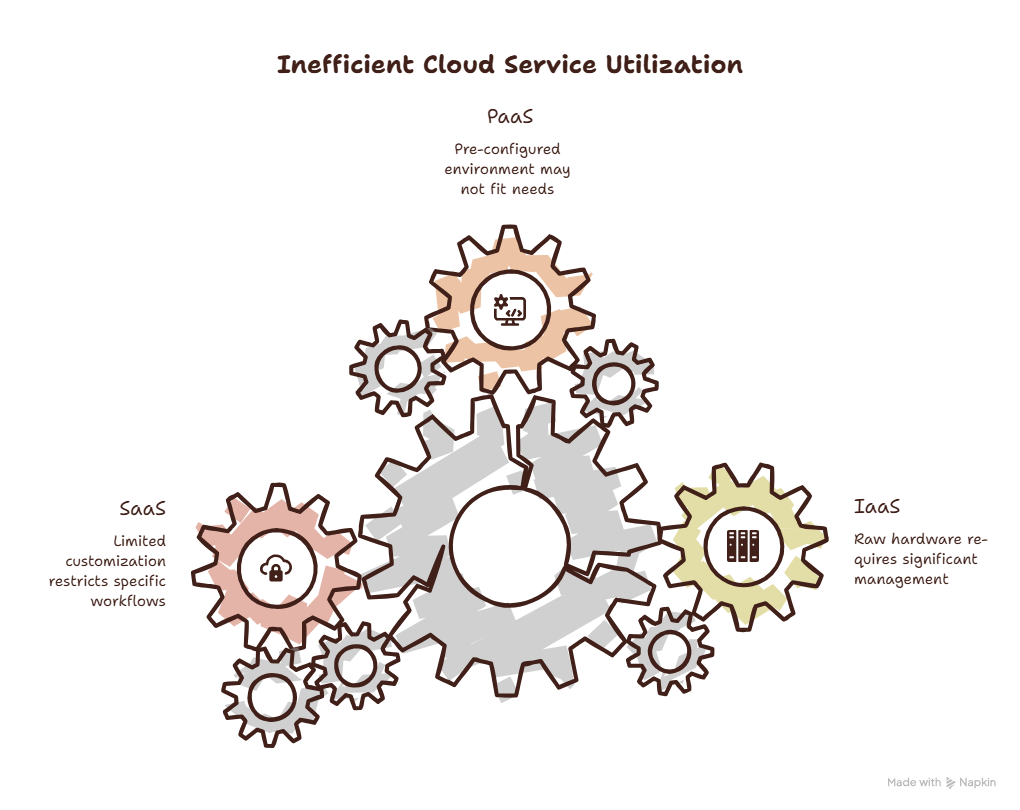
- Infrastructure as a Service (IaaS): Provides raw hardware components like virtual machines, remote servers, networks, and storage (e.g., renting server space).
- Platform as a Service (PaaS): Provides a pre-configured environment to develop, test, and host applications (e.g., a server pre-installed with Apache, MySQL, and Python).
- Software as a Service (SaaS): Delivers fully functional application software over the web via subscription without requiring local installation (e.g., Google Docs, Office 365).
Grid Computing (Emerging Trends in Computer Science Class 11 Notes)
Grid Computing combines geographically distributed, heterogeneous computer nodes into a network that operates as a virtual supercomputer to perform computationally intensive tasks.
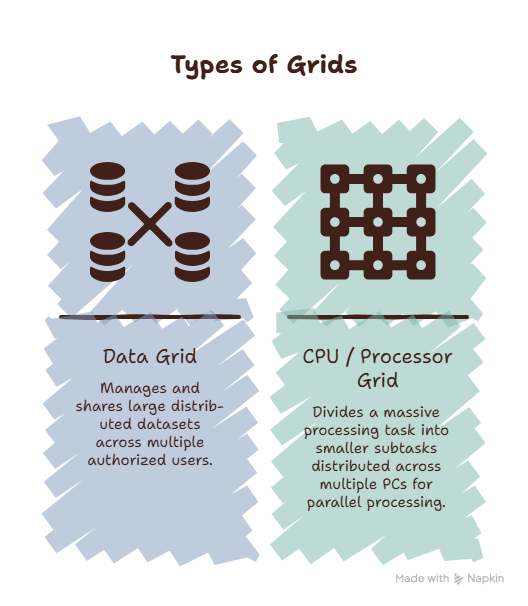
Types of Grids: (Emerging Trends in Computer Science Class 11 Notes)
- Data Grid: Manages and shares large distributed datasets across multiple authorized users.
- CPU / Processor Grid: Divides a massive processing task into smaller subtasks distributed across multiple PCs for parallel processing.
Grid vs. Cloud Computing: (Artificial Intelligence and Machine Learning)
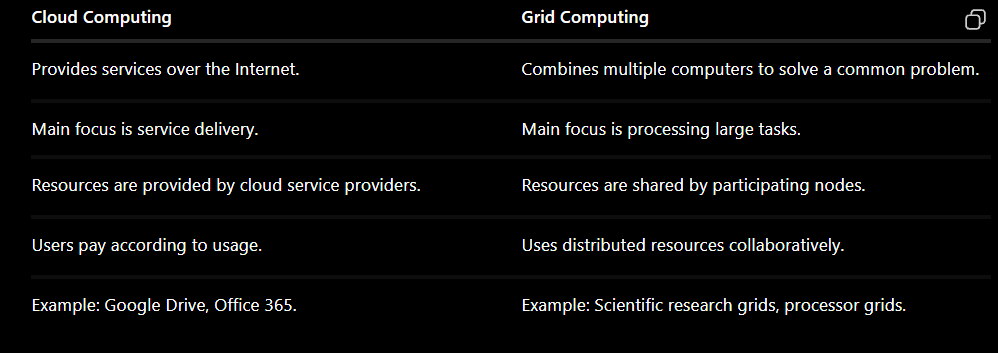
- Cloud Computing: Service-oriented model where a provider rents infrastructure/software to users.
- Grid Computing: Collaborative model where multiple computers pool their spare computing power together to solve a single complex problem.
Blockchain Technology (Emerging Trends in Computer Science Class 11 Notes)
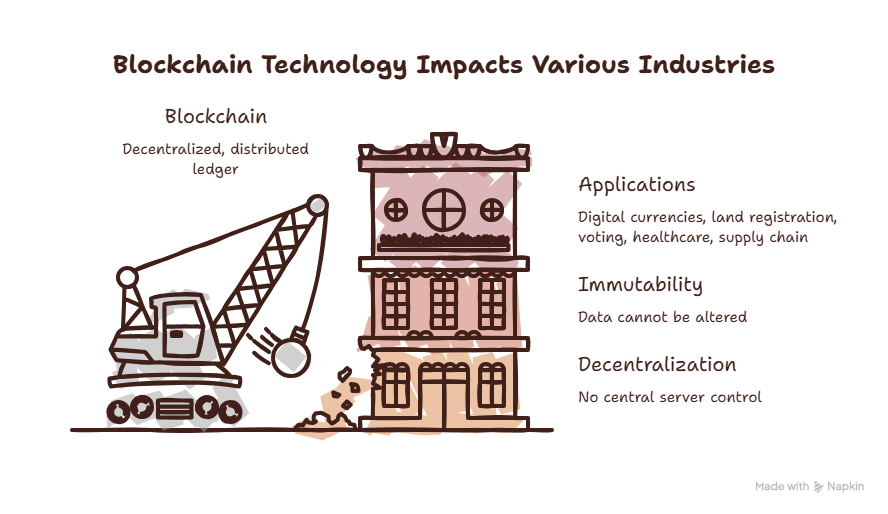
A Blockchain is a decentralized, distributed, and open ledger shared across a network of computers. Transactions are stored in secured chunks called blocks, which are cryptographically linked into an immutable chain.
Key Highlights: (Internet of Things Smart Home Applications)
- Decentralized & Append-Only: No central server controls the database; every participating node holds a complete copy. Once verified by network consensus, data cannot be altered or deleted.
- Applications: Beyond digital currencies (cryptocurrencies), blockchain is applied in secure land registration, voting systems, healthcare data sharing, and supply chain tracking.
NCERT Solutions for Class 11 Computer Science Chapter 3 – Emerging Trends All Exercise Questions Answered
Exercise (Emerging Trends in Computer Science Class 11 Notes)
1. List some of the cloud-based services that you are using at present.
Answer:
- Google Drive
- Google Docs
- Microsoft Office 365
- Dropbox
- Gmail
- OneDrive
- Online photo backup services
2. What do you understand by the Internet of Things? List some of its potential applications.
Answer: IoT is a network of devices having embedded hardware and software that can communicate and exchange data with other devices through a network.
Applications of IoT:
- Smart homes
- Smart offices
- Smart cities
- Remote control of home appliances
- CCTV monitoring
- Traffic management
- Healthcare monitoring
- Disaster management
3. Write short notes on the following:
- Cloud Computing
- Big data and its Characteristics
Answer:
Cloud Computing:
Cloud computing is a technology in which computer-based services such as software, hardware, databases and storage are provided over the Internet. Users can access these resources from anywhere using any device. Cloud service providers offer resources on a pay-per-use basis. It provides cost-effective and on-demand services.
Big data and its Characteristics:
Big Data refers to extremely large and complex datasets that cannot be processed efficiently using traditional tools. It includes structured, semi-structured and unstructured data.
Characteristics of Big Data (5 Vs)
- Volume – Huge amount of data.
- Velocity – High speed of data generation.
- Variety – Different forms of data such as text, images and videos.
- Veracity – Trustworthiness and accuracy of data.
- Value – Useful information and knowledge hidden in data.
4. Explain the following along with their applications.
- Artificial Intelligence
- Machine Learning
Answer:
(a) Artificial Intelligence
Artificial Intelligence is a technology that simulates human intelligence in machines. AI enables machines to learn, make decisions and solve problems with minimum human intervention.
Applications:
- Siri
- Alexa
- Google Assistant
- Route guidance in maps
- Automatic photo tagging
- Facial recognition systems
(b) Machine Learning
Machine Learning is a subsystem of AI in which computers learn from data using statistical techniques without being explicitly programmed. It uses algorithms to learn patterns and make predictions.
Applications:
- Weather forecasting
- Recommendation systems
- Spam filtering
- Predictive typing
- Disease prediction
5. Differentiate between cloud computing and grid computing with suitable examples.
Answer:
6. Justify the following statement:
“Storage of data is cost-effective and time saving in cloud computing.”
Answer: Cloud computing provides storage over the Internet on a pay-per-use basis. Users do not need to purchase expensive storage devices or maintain infrastructure. Data can be accessed from anywhere at any time, saving both cost and time.
7. What is on-demand service? How it is provided in cloud computing?
Answer: On-demand service means resources are provided whenever required by the user and users pay only for what they use.
In cloud computing, cloud providers offer infrastructure, platforms and software whenever needed. Users can access these services through the Internet without purchasing the resources permanently.
8. Write examples of the following:
- Government provided cloud computing platform
- Large scale private cloud service providers and the services they provide
Answer:
(a) Government Provided cloud computing platform:
GI Cloud (MeghRaj) – Government of India Cloud Initiative.
(b) Large scale private cloud service providers and the services they provide
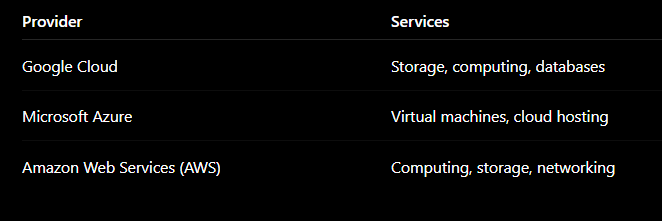
9. A company interested in cloud computing is looking for a provider who offers a set of basic services, such as virtual server provisioning and on demand storage that can be combined into a platform for deploying and running customised applications. What type of cloud computing model fits these requirements?
- Platform as a Service
- Software as a Service
- Application as a Service
- Infrastructure as a Service
Answer: (d) Infrastructure as a Service (IaaS)
IaaS provides virtual servers, storage, operating systems and networking resources on demand.
10. If the government plans to make a smart school by applying IoT concepts, how can each of the following be implemented in order to transform a school into IoT-enabled smart school?
- e-textbooks
- Smart boards
- Online Tests
- Wifi sensors on classrooms doors
- Sensors in buses to monitor their location
- Wearables (watches or smart belts) for attendance monitoring.
Answer: Smart School using IoT Concepts
- e-Textbooks – Students can access digital textbooks online through smart devices.
- Smart Boards – Interactive boards connected to the Internet can display digital content and support online learning.
- Online Tests – Students can take tests online and receive instant evaluation and results.
- WiFi Sensors on Classroom Doors – Sensors can monitor entry and exit of students and provide security alerts.
- Sensors in Buses – GPS-enabled sensors can track the location of school buses and provide real-time updates.
- Wearables for Attendance Monitoring – Smart watches or belts can automatically record student attendance and monitor activities.
11. Five friends plan to try a startup. However, they have a limited budget and limited computer infrastructure. How can they avail the benefits of cloud services to launch their startup?
Answer: The friends can use cloud computing services instead of buying costly hardware and software. They can rent storage, servers, development platforms and software on a pay-per-use basis. This reduces infrastructure cost and maintenance expenses while allowing them to scale their business when needed.
12. Governments provide various scholarships to students of different classes. Prepare a report on how blockchain technology can be used to promote accountability, transparency and efficiency in distribution of scholarships?
Answer: Blockchain can improve scholarship distribution by maintaining a decentralized and secure record of all transactions. Every transaction is verified by all participating nodes before being added to the ledger. This ensures:
- Transparency in fund distribution
- Accountability of authorities
- Prevention of fraud and duplication
- Secure record keeping
- Faster verification process
- Efficient tracking of scholarship payments
Students and authorities can easily verify scholarship status through the blockchain ledger.
13. How are IoT and WoT related?
Answer: IoT connects smart devices and enables them to communicate through networks. WoT (Web of Things) extends IoT by using web technologies and web services to connect and manage different devices through a common interface. Thus, WoT helps IoT devices communicate more efficiently using the web.
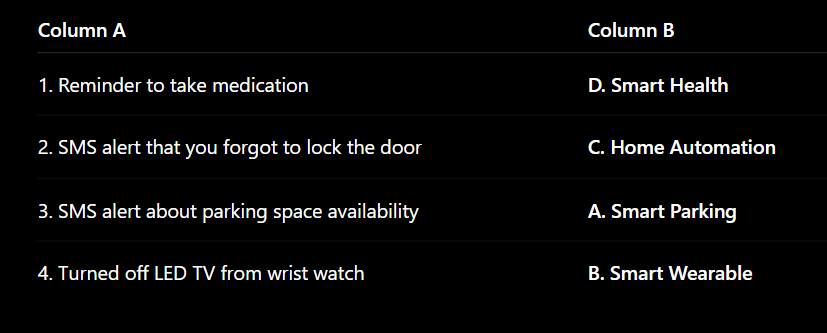
14. Match the columns:
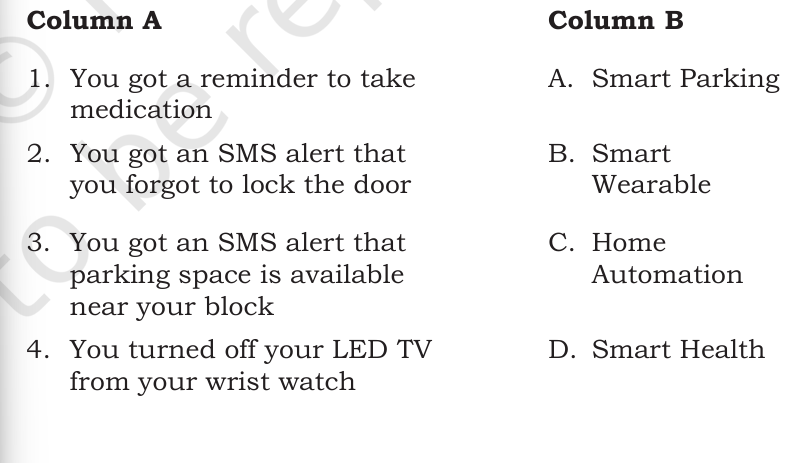
Answer:
NCERT Solutions for Class 11 Computer Science Chapter 3 – Emerging Trends (Important Question–Answer Paper)
1. What is a Knowledge Base in Artificial Intelligence?
Answer: A Knowledge Base is a store of information consisting of facts, assumptions, and rules which an AI system uses for decision-making. It helps intelligent machines make decisions and solve problems with minimum human intervention.
2. How does Artificial Intelligence make machines intelligent?
Answer: Artificial Intelligence simulates human intelligence in machines. It enables machines to learn, make decisions, solve problems, and perform tasks automatically by using a knowledge base and past experiences.
3. What are training data and testing data in Machine Learning?
Answer: In Machine Learning, models are first trained using training data and then tested using testing data. After repeated training, the models become capable of making accurate predictions on new and unknown data.
4. Define Natural Language Processing (NLP).
Answer: Natural Language Processing (NLP) is a branch of Artificial Intelligence that enables interaction between humans and computers using natural languages such as English and Hindi. It supports text-to-speech and speech-to-text conversion.
5. Mention any four applications of NLP.
Answer:
- Predictive typing
- Spell checking
- Machine translation
- Automated customer service
6. What are immersive experiences?
Answer: Immersive experiences allow users to visualise, feel and react through stimulation of their senses. They make interactions more realistic, engaging and interactive.
7. Define Virtual Reality (VR).
Answer: Virtual Reality is a three-dimensional computer-generated environment that simulates the real world. Users can interact with and explore this environment through VR devices such as VR headsets.
8. State any four applications of Virtual Reality.
Answer:
- Gaming
- Military training
- Medical procedures
- Entertainment
9. What is Augmented Reality (AR)?
Answer: Augmented Reality is the superimposition of computer-generated information on existing physical surroundings. It enhances the real-world environment by adding digital information.
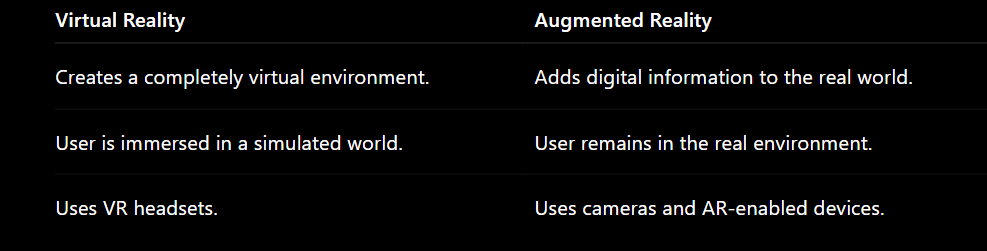
10. Differentiate between Virtual Reality and Augmented Reality.
Answer:
11. What is a Robot?
Answer: A robot is a programmable machine capable of performing one or more tasks automatically with accuracy and precision according to computer instructions.
12. What are sensors? Why are they important in robotics?
Answer: Sensors are devices that collect information from the environment. They are one of the primary components of robots and help robots observe and respond to their surroundings.
13. What is a humanoid robot?
Answer: Robots that resemble human beings in appearance and behaviour are called humanoid robots. Sophia is an example of a humanoid robot.
14. What is a drone?
Answer: A drone is an unmanned aircraft that can be remotely controlled or fly autonomously using software-controlled flight plans along with sensors and GPS.
15. Mention any five uses of drones.
Answer:
- Journalism
- Aerial photography
- Disaster management
- Search and rescue operations
- Agriculture
16. Why is Big Data difficult to process using traditional tools?
Answer: Big Data contains huge volumes of structured, semi-structured and unstructured data. Traditional data-processing tools cannot efficiently store, process and analyse such massive and complex datasets.
17. Define Data Analytics.
Answer: Data Analytics is the process of examining datasets to draw conclusions about the information they contain using specialised software and systems.
18. What is Pandas?
Answer: Pandas is a Python library used as a tool for data analysis and makes data analysis much simpler.
19. Define Smart Sensor.
Answer: A smart sensor is a device that takes input from the physical environment and uses built-in computing resources to process data before passing it on.
20. What is the role of Accelerometer and Gyroscope sensors in smartphones?
Answer: The accelerometer detects the orientation of the phone, while the gyroscope tracks rotation and twisting movements. Together they help the phone adjust screen orientation automatically.
21. What is a Smart City?
Answer: A Smart City uses computer technology, communication technology and IoT to manage resources efficiently and improve the quality of urban life.
22. How does a Smart Bridge work?
Answer: A Smart Bridge uses wireless sensors to detect loose bolts, damaged cables or cracks and sends alerts to concerned authorities through SMS.
23. How does a Smart Building help during earthquakes?
Answer: A Smart Building uses sensors to detect earthquake tremors and warns nearby buildings so that they can take precautionary measures.
24. What is SaaS? Give examples.
Answer: Software as a Service (SaaS) provides on-demand access to software applications through the cloud. Examples include Google Docs, Microsoft Office 365 and Dropbox.
25. What is PaaS?
Answer: Platform as a Service (PaaS) provides a platform for developing, testing and deploying software applications without worrying about the underlying infrastructure.
26. What is IaaS?
Answer: Infrastructure as a Service (IaaS) provides computing infrastructure such as servers, virtual machines, storage, operating systems and networking resources on demand.
27. What is a node in Grid Computing?
Answer: The individual computational resources participating in a grid are called nodes. These nodes work together to solve a common task.
28. Name the two types of Grid Computing.
Answer:
- Data Grid
- CPU (Processor) Grid
29. What is the Globus Toolkit?
Answer: Globus Toolkit is an open-source software toolkit used for building grid computing systems. It provides security, communication, resource management and fault detection facilities
30. Define Blockchain.
Answer: Blockchain is a system that allows a group of connected computers to maintain a single updated and secure ledger through a decentralised and shared database.
31. Why is Blockchain considered secure?
Answer: Blockchain is secure because every node maintains a copy of the ledger, and transactions are updated only after authentication by all nodes. Therefore, no single user can alter the data.
32. Mention any four applications of Blockchain Technology.
Answer:
- Digital currency
- Healthcare records
- Land registration
- Voting systems
NCERT Solutions for Class 11 Computer Science Chapter 3 – Emerging Trends (Home Work Question Answer)
- Explain Artificial Intelligence and its applications.
- Explain Machine Learning with examples.
- Differentiate between Virtual Reality and Augmented Reality.
- Explain the five characteristics of Big Data.
- Describe Internet of Things (IoT) with applications.
- Explain Cloud Computing and its service models (IaaS, PaaS, SaaS).
- Differentiate between Cloud Computing and Grid Computing.
- Explain Blockchain technology and its applications.
- Explain Smart Sensors and Smart Cities.
- Explain Robotics and applications of drones.