

Kaveri | CBSE | I Cannot Remember My Mother Question Answers | NCERT Solutions For Class 9 English Literature Chapter 8 | Unit 4 | Kaveri | Class IX | Best Guide 2026. It is required for Grade 9 students to build a strong foundation in the subject, and NCERT Solutions For Class 9 English Literature Chapter 8. Understanding the chapter thoroughly helps students grasp key concepts, improve comprehension, and perform well in exams.
In this article, Kaveri | CBSE | I Cannot Remember My Mother Question Answers | NCERT Solutions For Class 9 English Literature Chapter 8 | Unit 4 | Kaveri | Class IX | Best Guide 2026, we (ThinkSphereEdu.com) provide a detailed I Cannot Remember My Mother Summary by Rabindranath Tagore to make learning easier and more effective. Whether you are a student looking for well-explained solutions or a parent guiding your child, this guide will be a helpful resource for mastering the chapter with confidence.
- I Cannot Remember My Mother PDF Download: (I Cannot Remember My Mother Question Answers)
- About The Poet: (I Cannot Remember My Mother Question Answers)
- I Cannot Remember My Mother Summary in English: (I Cannot Remember My Mother Question Answers)
- I Cannot Remember My Mother Summary in Hindi: (I Cannot Remember My Mother Question Answers)
- I Cannot Remember My Mother Summary in Bengali: (I Cannot Remember My Mother Question Answers)
- Theme of The Poem: (I Cannot Remember My Mother Question Answers)
- Reflect and Respond: (I Cannot Remember My Mother Question Answers) Page – 126
- Check Your Understanding: (I Cannot Remember My Mother Question Answers) Page – 127
- Critical Reflection: (I Cannot Remember My Mother Question Answers) Page – 129
- Vocabulary in Context: (I Cannot Remember My Mother Question Answers) Page – 131
- Listen and Respond: (I Cannot Remember My Mother Question Answers) Page – 133
- Speaking Activity: (I Cannot Remember My Mother Question Answers) Page – 134
- Speaking Activity: (I Cannot Remember My Mother Question Answers) Page – 135
- Learning Beyond the Text: (I Cannot Remember My Mother Question Answers) Page – 135
- I Remember, I Remember Poem Question Answer: (I Cannot Remember My Mother Question Answers) Page – 136
CBSE | Kaveri | I Cannot Remember My Mother Question Answers Solved | Class 9 | English Literature | Must Read
I Cannot Remember My Mother PDF Download: (I Cannot Remember My Mother Question Answers)
About The Poet: (I Cannot Remember My Mother Question Answers)
Rabindranath Tagore was a famous Indian poet, writer, and philosopher. He was born in 1861 in Kolkata and became the first Asian to win the Nobel Prize in Literature in 1913. He wrote many poems, stories, and songs that express deep emotions and love for nature. His works often focus on human feelings like love, loss, and relationships. He also wrote the national anthem of India, which makes him a very important figure in Indian literature.
I Cannot Remember My Mother Summary in English: (I Cannot Remember My Mother Question Answers)
The poem “I Cannot Remember My Mother” tells the story of a young child who lost his mother when he was too young to remember her.
The child says that he does not remember his mother’s face or voice properly. Small things bring back memories of her to him at unexpected moments.While playing, a soft tune comes to his mind, like a lullaby his mother used to sing.
The early autumn morning brings him memories of his mother through the sweet smell of shiuli flowers and temple fragrances. He believes that these scents form a link to her actual presence.
His mother shows him her love when he gazes at the expansive blue sky above. Nature surrounds him with her presence although he cannot remember her actual appearance.
I Cannot Remember My Mother Summary in Hindi: (I Cannot Remember My Mother Question Answers)
कविता “I Cannot Remember My Mother” एक छोटे बच्चे की कहानी बताती है, जिसने अपनी माँ को तब खो दिया था जब वह उन्हें याद रखने के लिए बहुत छोटा था।
बच्चा कहता है कि उसे अपनी माँ का चेहरा या आवाज़ ठीक से याद नहीं है। छोटी-छोटी चीज़ें, अचानक किसी भी पल, उसे अपनी माँ की याद दिला देती हैं। खेलते समय, उसके मन में एक मीठी धुन गूंज उठती है—ठीक वैसी ही लोरी, जैसी उसकी माँ उसे सुनाया करती थी।
पतझड़ की शुरुआत वाली सुबह, शिउली के फूलों की मीठी महक और मंदिर की सुगंध के ज़रिए, उसे अपनी माँ की याद दिलाती है। उसे लगता है कि ये सुगंधें, उसकी माँ की असल मौजूदगी से उसे जोड़ती हैं।
जब वह ऊपर फैले विशाल नीले आसमान की ओर देखता है, तो उसे अपनी माँ का प्यार महसूस होता है। भले ही उसे अपनी माँ का चेहरा याद न हो, फिर भी प्रकृति हर पल अपनी मौजूदगी से उसे घेरे रहती है।
I Cannot Remember My Mother Summary in Bengali: (I Cannot Remember My Mother Question Answers)
“I Cannot Remember My Mother” (আমি আমার মাকে মনে করতে পারি না) কবিতাটি এমন এক শিশুর গল্প বলে, যে তার মাকে হারিয়েছিল তখন, যখন তার বয়স এতটাই কম ছিল যে মাকে মনে রাখার মতো স্মৃতি তার ছিল না।
শিশুটির ভাষ্যমতে, সে তার মায়ের মুখ কিংবা কণ্ঠস্বর—কোনোটাই স্পষ্টভাবে মনে করতে পারে না। তবে অপ্রত্যাশিত মুহূর্তগুলোতে অতি সাধারণ কিছু বিষয় তার মনে মায়ের স্মৃতি জাগিয়ে তোলে। খেলাধুলায় মগ্ন থাকার সময় হঠাৎই তার মনে ভেসে ওঠে এক কোমল সুর—ঠিক যেন সেই ঘুমপাড়ানি গান, যা তার মা তাকে শোনাতেন।
শরতের শুরুর দিকের সকালটি শিউলি ফুলের মিষ্টি সুবাস এবং মন্দিরের পবিত্র গন্ধের মধ্য দিয়ে তার মনে মায়ের স্মৃতি ফিরিয়ে আনে। শিশুটি বিশ্বাস করে যে, এই সুবাসগুলোই তার মায়ের প্রকৃত উপস্থিতির সাথে একটি অদৃশ্য সংযোগ স্থাপন করে।
যখন সে মাথার ওপরের বিশাল নীল আকাশের দিকে তাকিয়ে থাকে, তখন যেন তার মা নিজের ভালোবাসা দিয়ে তাকে সিক্ত করেন। যদিও সে তার মায়ের প্রকৃত রূপটি মনে করতে পারে না, তবুও প্রকৃতিই যেন মায়ের উপস্থিতির আদলে তাকে চারপাশ থেকে আগলে রাখে।
Theme of The Poem: (I Cannot Remember My Mother Question Answers)
The poem mainly talks about the deep and everlasting love of a mother. It shows that even if a child cannot clearly remember his mother, her love still remains in his heart. The child feels her presence through small things like a song, the smell of flowers, and the beauty of nature. Nature plays an important role in bringing back memories of his mother. The poem also shows feelings of loss and loneliness, but at the same time it gives a sense of comfort that a mother’s love never truly disappears.
I Cannot Remember My Mother Questions and Answers | Exam Preparation | 2026-27
Reflect and Respond: (I Cannot Remember My Mother Question Answers) Page – 126
I. Work in pairs. Discuss the memories from your childhood that you remember. List them and share with your classmates and teacher.
Answer: During my childhood, I have many happy memories. I remember playing with my friends in the evening. I also remember my mother telling me stories before going to sleep. Festivals like Durga Puja were very special because I used to wear new clothes and enjoy with my family. I also remember going to school for the first time and feeling both excited and nervous. These memories are very special to me and always make me smile.
II. Discuss how children’s relationship with their mother can in uence their emotions and memories.
Answer: A child’s relationship with their mother has a strong effect on their emotions and memories. A mother’s love and care make the child feel safe and happy. The time spent with the mother creates beautiful memories that stay for a long time. If the bond is strong, the child feels confident and emotionally secure. Even when the mother is not around, her love and teachings remain in the child’s heart.
II. Match the words given in Column 1 with their meanings in Column 2.

Answer:
| 1. Hover | (v) linger or remain near a place |
| 2. Hum | (i) sing a tune with your lips closed |
| 3. Cradle | (vi) a small bed for a baby |
| 4. Shiuli | (ii) a type of flower (coral jasmine) |
| 5. Morning Services | (iv) rituals conducted in a temple |
| 6. Gaze | (iii) look steadily for a long time |
Check Your Understanding: (I Cannot Remember My Mother Question Answers) Page – 127
I. Fill in the blanks with appropriate words.
Stanza – 1
- The poet remembers his mother while he ______
- The poet remembers the ________ but not the ________
Setting: __ (outdoor/indoor)
Answer:
- The poet remembers his mother while he is playing.
- The poet remembers the tune of a song but not the face of his mother.
Setting: Indoor
In this stanza, the poet remembers his mother while he is playing with his toys. He cannot remember her clearly, but a soft tune comes to his mind which she used to hum. This shows that even small things remind him of her.
Stanza – 2
- The poet remembers his mother in the ______ season.
- The poet remembers his mother by the smell of ________
Setting: __ (outdoor/indoor)
Answer:
- The poet remembers his mother in the early autumn season.
- The poet remembers his mother by the smell of shiuli flowers.
Setting: Outdoor
In this stanza, the poet feels his mother’s presence in the early autumn morning. The sweet smell of shiuli flowers and the temple fragrance remind him of his mother. Nature helps him connect with her memory.
Stanza – 3
- The poet feels that his mother ________ at him from the ______.
Setting: __ (outdoor/indoor)
Answer:
- The poet feels that his mother is gazing lovingly at him from the sky.
Setting: Outdoor
In this stanza, the poet looks at the blue sky from his window and feels that his mother is watching him with love. Even though he cannot remember her clearly, he feels her presence in the calm and wide sky. This shows his deep emotional connection with his mother.
II. The senses of olfactory (smell), auditory (hearing) and visual (sight), are three of the five basic senses in humans. Give examples of references to senses from the poem. Complete the table given below.

Answer:
| Stanza | Lines From the Poem | Sences |
|---|---|---|
| 1 | “only sometimes in the midst of my play a tune seems to hover over my playthings” | Auditory |
| 2 | “the smell of the shiuli flowers floats in the air the scent of the morning service in the temple” | Olfactory |
| 3 | “…the tune of some song that she used to hum while rocking my cradle” | Auditory |
II. Read the poem silently once again and complete the following.
- Two examples of alliteration from the poem are (i) _______ and (ii) _______.
- An example of onomatopoeia is ________.
- The poem uses imagery extensively. Explain.
- Although the poem does not have a rhyme scheme, it is enjoyable because _________.
- What is the tone of the poet? Why do you say so?
- What impact does the title of the poem have on the overall mood of the poem?
- The poet uses ‘I cannot remember my mother’ as a refrain because _______.
- The poet uses symbolism to indicate the memory of his mother’s presence. Identify the symbols used in the poem.
Answer:
- Two examples of alliteration from the poem are (i) “midst of my” and (ii) “blue of the distant sky”.
- An example of onomatopoeia is “hum” because it represents a soft sound.
- The poem uses imagery to create pictures in our mind. For example, the smell of shiuli flowers, the early autumn morning, and the blue sky help us imagine the scenes clearly. These images also help us feel the emotions of the poet and understand how he remembers his mother through nature.
- Although the poem does not have a rhyme scheme, it is enjoyable because it has a smooth flow and deep emotions. The simple language and repetition make it easy to read and understand.
- The tone of the poem is sad and emotional. The poet feels the absence of his mother and misses her, but at the same time, there is a soft and peaceful feeling when he remembers her through nature.
- The title creates a sad and emotional mood. It makes us feel that the poet has lost his mother at a young age and cannot remember her properly, which makes the poem touching.
- The poet uses ‘I cannot remember my mother’ as a refrain because he wants to show his deep sense of loss again and again. It also makes the poem more emotional and meaningful.
- The symbols used in the poem are the lullaby tune, the smell of shiuli flowers, the scent of the temple, and the blue sky. These things remind the poet of his mother and her love.
Critical Reflection: (I Cannot Remember My Mother Question Answers) Page – 129
I. Read the extracts given below and answer the questions that follow.
1. I cannot remember my mother
only sometimes in the midst of my play
a tune seems to hover over my playthings,
(i) Complete the following sentence appropriately
The poet is reminded of his mother during his _____
Answer: The poet is reminded of his mother during his playtime.
(ii) What is the primary emotion conveyed by the line ‘a tune seems to hover over my playthings’?
- It enhances the joy of play.
- It disrupts the playtime atmosphere.
- It activates memories of the mother.
- It symbolises the carefree nature of childhood.
Answer: C. It activates memories of the mother.
(iii) In the context of the poem, what role does the hovering tune play during the speaker’s playtime?
Answer: The hovering tune reminds the poet of his mother. It brings back memories of the lullaby she used to sing and makes him feel her presence.
(iv) State whether the following sentence is true or false.
The poet experiences the tune lingering over playthings only occasionally during playtime.
Answer: True
(v) How could the poet feel his mother’s presence, even though she isn’t there?
Answer: The poet feels his mother’s presence through small things like the tune, smells, and nature. These remind him of her love even though she is not physically present.
2. I feel that the stillness of
my mother’s gaze on my face
has spread all over the sky.
(i) What does the poet suggest about the stillness of his mother’s gaze spreading over the sky?
- The mother’s gaze is physically present in the sky.
- The sky is a symbolic extension of the mother’s presence.
- The sky mirrors the mother’s emotions.
- The stillness is eeting and unrelated to the mother.
Answer: B. The sky is a symbolic extension of the mother’s presence.
(ii) What emotion does the poet associate with the ‘stillness’ of his mother’s gaze?
- a sense of grief
- a sense of anticipation
- a sense of nostalgia
- a sense of serenity
Answer: D. a sense of serenity
(iii) State whether the following sentence is true or false.
The poet suggests that the mother’s gaze has a tangible and visual e ect on the sky.
Answer: False
(iv) What is the purpose of likening the mother’s gaze to the sky?
Answer: The poet compares his mother’s gaze to the sky to show that her love is everywhere and always around him. It also shows calmness and a feeling of comfort.
(v) Complete the sentence appropriately.
The tone of the poet in the given extract is _____ because ______.
Answer: The tone of the poet in the given extract is calm and emotional because he feels his mother’s loving presence in the peaceful sky.
II. Answer the following questions.
1. What is the emotional impact of the refrain, ‘I cannot remember my mother’?
Answer: The refrain creates a deep feeling of sadness and loss. It shows that the poet has lost his mother at a very young age and cannot remember her clearly. Repeating this line again and again makes the poem more emotional and touching.
2. Interpret the connection between the poet’s mother and the following:
- shiuli owers
- humming tune
Answer:
- shiuli flowers: The smell of shiuli flowers reminds the poet of his mother. It creates a soft and peaceful feeling, like her presence around him.
- humming tune: The humming tune reminds him of the lullaby his mother used to sing while putting him to sleep. It shows her love and care.
3. What role does nature play in the poet’s description of the memory of his mother?
Answer: Nature plays an important role in helping the poet remember his mother. Things like flowers, morning air, and the sky bring back her memory. Even though he cannot remember her face, he feels her presence through nature.
4. What can be inferred about the poet’s perception of the mother–child relationship?
Answer: The poet believes that the bond between a mother and child is very deep and strong. Even if the mother is not physically present, her love stays forever. The child can feel her love through memories and surroundings.
Vocabulary in Context: (I Cannot Remember My Mother Question Answers) Page – 131
I. Work in pairs to classify the sensory words given in the box below. One example has been done for you.


Answer:
| Visual | Auditory | Olfactory | Tactile |
|---|---|---|---|
| Glowing | Rustle | Aroma | Sticky |
| Gigantic | Hiss | Scent | Rough |
| minuscule | Sizzle | Pungent | Chilled |
| vibrant | Deafening | Fragrant | Fliffy |
| crimson | Sqeaky | Stinky | Smooth |
| Gloomy | Ear-splitting | Stale | Slimy |
| Hairy |
II. Fill in the blanks with sensory words in the box for the following passage written by Sarojini Naidu. There are two extra words.

Come and share my exquisite March morning with me:
this sumptuous blaze of gold and sapphire sky; these1. ____ lilies that adorn the sunshine; the voluptuous 2. _____ of neem and champak and serisha that beat upon the languid air with their implacable 3. _____; the thousand little gold and blue and silver breasted birds bursting with the 4. _____ ecstasy of life in nesting time. And, do you know that the scarlet lilies are woven petal by petal from my heart’s blood, these little quivering birds are my soul made incarnate music, these heavy 5. ______ are my emotions dissolved into aerial 6. _, this ____blue and gold sky is the ‘very me’…
Answer: Come and share my exquisite March morning with me: this sumptuous blaze of gold and sapphire sky; these 1. scarlet lilies that adorn the sunshine; the voluptuous 2. scents of neem and champak and serisha that beat upon the languid air with their implacable 3. essence; the thousand little gold and blue and silver breasted birds bursting with the 4. sweetness ecstasy of life in nesting time. And, do you know that the scarlet lilies are woven petal by petal from my heart’s blood, these little quivering birds are my soul made incarnate music, these heavy 5. perfumes are my emotions dissolved into aerial 6. essence, this 7. smooth blue and gold sky is the ‘very me’…
III. Write numbers against each picture with the phrases that describe them with their sensorial associations. One example has been done for you.
- beats of music echo in air
- melody of soothing scent, dancing in the air
- fragrant breeze of blooming buds
- gentle lullaby, a soft melody
- colourful sky, painting a lively sight
- attractive canvas painting the horizon

Answer: Do it by yourself and let me know in the comment section.
Listen and Respond: (I Cannot Remember My Mother Question Answers) Page – 133
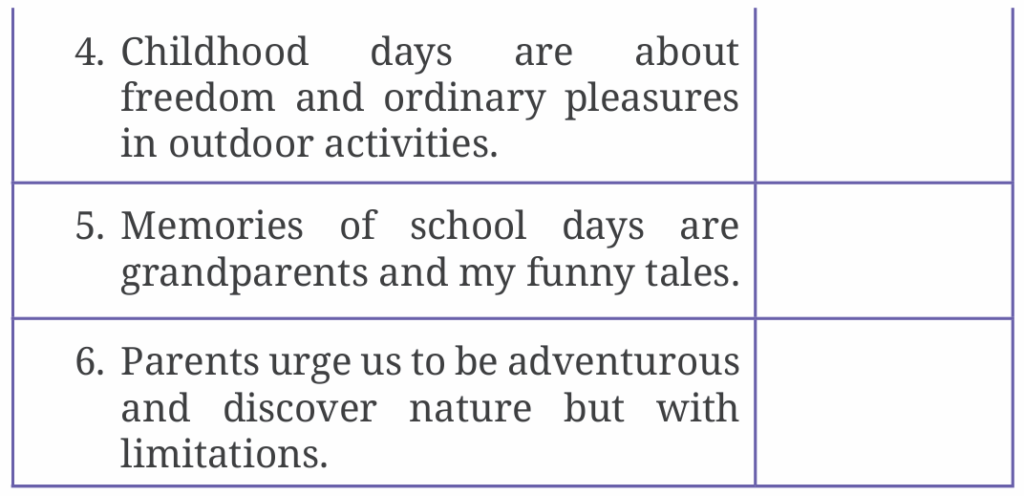
I. You will listen to four short extracts of people expressing their childhood memories. As you listen, match each statement 1–6 to each speaker (i)–(iv). There are two statements that you do not need. (Transcript for teacher on page 266)

Answer:
| Statement | Speaker |
|---|---|
| 1. The precious memories by the seaside are not the same anymore. | Speaker (iv) |
| 2. My grandfather’s encouragement influences me in moments of difficulty. | Speaker (i) |
| 3. The school days are a source of recollection to stay in touch. | Speaker (iii) |
| 4. Childhood days are about freedom and ordinary pleasures in outdoor activities. | Speaker (iv) |
| 5. Memories of school days are grandparents and my funny tales. | Speaker (iii) |
| 6. Parents urge us to be adventurous and discover nature but with limitations. | Speaker (i) |
Speaking Activity: (I Cannot Remember My Mother Question Answers) Page – 134
I. Work in pairs. Think of an object, song, or a place that is memorable for you. Take turns to speak about it using the prompts given below
- Introduce it briefly
- Describe it in detail including sensory details
- Narrate the speci c memory associated with it
- Explain how it has impacted your life
- Summarise why this memory is meaningful to you even now
You may use the following phrases.
- During my childhood…
- Growing up, I fondly remember…
- Recalling those early years, I can’t forget…
- In my younger days, I used to…
- I have a clear memory of…
- A routine activity in my childhood involved…
- A cherished part of my childhood includes…
- As a child, I was fond of…
- One of my favourite childhood moments is…
- Thinking about my early years, I recall…
- A common occurrence during my youth was…
Answer:
During my childhood, I fondly remember a song that my mother used to sing for me at night. It was a soft and soothing lullaby. The tune was very gentle, and her voice was calm and loving. Whenever she sang, I felt safe and peaceful. I can still imagine the quiet night, the dim light in the room, and her slow humming.
I have a clear memory of lying beside her while she sang that song to help me sleep. It was a routine activity in my childhood, and I always waited for that moment. Sometimes, even now, when I hear a similar tune, it reminds me of those days.
This memory has impacted my life because it makes me feel emotionally connected to my mother. It also gives me comfort when I feel sad or lonely.
Thinking about my early years, I feel that this is a very special memory for me. Even now, it is meaningful because it reminds me of my mother’s love and care.
Speaking Activity: (I Cannot Remember My Mother Question Answers) Page – 135
I. Imagine you had been on a school trip to a scenic place which appealed to all your senses. Write a diary entry describing the place and why it was a memorable experience.
Contents of the diary entry:
- begin with day, date, and time
- use only rst person (I, my)
- capture sensory details
- express emotions
- focus on signi cant moments and experiences
- conclude with re ection
Answer:
Monday, 12th October 2025
8:30 PM
Dear Diary,
Today I want to write about my recent school trip to a beautiful hill station. It was one of the most memorable days of my life. I went there with my classmates and teachers, and I really enjoyed every moment.
The place was full of natural beauty. I could see green hills all around, and the sky was clear and bright blue. The cool breeze touched my face and made me feel fresh. I could hear birds chirping and leaves rustling in the wind. The smell of fresh grass and flowers made the place even more pleasant. We also visited a small waterfall where the sound of flowing water was very soothing.
I have a clear memory of sitting with my friends near the waterfall and laughing together. We clicked many photos and shared snacks. It was a very happy and fun moment for all of us.
This trip made me feel relaxed and closer to nature. It also helped me bond better with my friends. I realised how important it is to take a break and enjoy such moments.
Thinking about this day still makes me smile. It is a very special memory for me, and I will never forget it.
Good night!
Learning Beyond the Text: (I Cannot Remember My Mother Question Answers) Page – 135
I. You read about the shiuli owers from the poem. Gather more information on unique owers of India-where they are found, how they look, what smell they emit, and what the historical signi cance is, if any. [For example, Kurinji or Neelakurinji that blooms once in twelve years.] Add more owers to this list.
Answer: India has many beautiful and unique flowers that are special in different ways.
1. Shiuli (Night-flowering Jasmine): Shiuli flowers are mostly found in eastern parts of India like West Bengal and Assam. They are small white flowers with an orange stem. They have a sweet and gentle smell, especially in the early morning. These flowers are often used in पूजा and are connected with festivals like Durga Puja.
2. Neelakurinji (Kurinji): Neelakurinji flowers are found in the hills of Kerala and Tamil Nadu. They are purple-blue in colour and bloom once every 12 years. This makes them very special. When they bloom, the hills look completely blue. It is an important natural event and attracts many tourists.
3. Lotus:The lotus is found in ponds and lakes all over India. It is usually pink or white in colour and has a mild fragrance. It is the national flower of India and is considered a symbol of purity and beauty. It also has religious importance in Hinduism and Buddhism.
4. Rhododendron: These flowers are found in the Himalayan region like Sikkim and Uttarakhand. They are bright red or pink in colour and look very attractive. They have a light fragrance and are also used to make juice and local medicines.
5. Champa (Frangipani): Champa flowers are found in many parts of India, especially in warm regions. They are white or yellow and have a strong, sweet smell. These flowers are often used in temples and for decoration.
I Remember, I Remember Poem Question Answer: (I Cannot Remember My Mother Question Answers) Page – 136
About the Poet:
Thomas Hood was an English poet and humorist. He was born in 1799 in London. He is known for writing both funny and serious poems. His poems often talk about childhood, memories, and human emotions. In this poem, he expresses his deep feelings about his past and lost childhood.
Theme of the Poem:
The main theme of the poem is childhood memories and nostalgia. The poet remembers his happy childhood days, his home, and the beauty of nature around him. But at the same time, he feels sad because those days are gone forever. The poem shows how childhood is full of joy and innocence, and how growing up brings a sense of loss.
Short Question Answer:
1. What does the poet remember about his house?
Answer: The poet remembers the house where he was born and the little window where sunlight came in the morning.
2. What flowers are mentioned in the poem?
Answer: The poet mentions roses, violets, lily cups, lilacs, and laburnum.
3. What does the robin do?
Answer: The robin builds its nest in the lilac tree.
4. What does the poet feel about his childhood now?
Answer: He feels sad because his childhood days are gone.
Long Question Answer:
1. Describe the poet’s memories of his childhood.
Answer: The poet remembers his childhood as very happy and peaceful. He recalls his house, the sunlight coming through the window, and the beautiful flowers in the garden. He also remembers trees where birds built nests and where his brother planted a laburnum tree. These memories show that his childhood was full of joy and nature.
2. How does the poet express both happiness and sadness in the poem?
Answer: The poet shows happiness by describing his beautiful childhood memories like flowers, sunshine, and his home. But he also shows sadness because those days are gone forever. He even says that he sometimes wishes he had died earlier, which shows his deep sorrow. So, the poem has both joyful memories and a feeling of loss.