
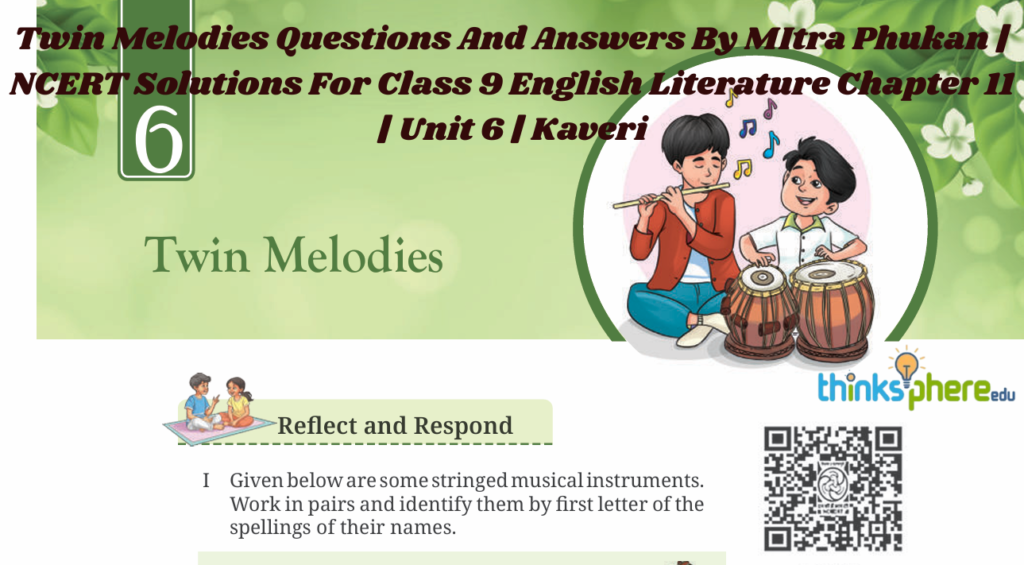

Kaveri | CBSE | Twin Melodies Questions And Answers By MItra Phukan | NCERT Solutions For Class 9 English Literature Chapter 11 | Unit 6 | Kaveri | Class IX | Best Guide 2026. It is required for Grade 9 students to build a strong foundation in the subject, and NCERT Solutions For Class 9 English Literature Chapter 11. Understanding the chapter thoroughly helps students grasp key concepts, improve comprehension, and perform well in exams.
In this article, Kaveri | CBSE | Twin Melodies Class 9 Questions And Answers By MItra Phukan | NCERT Solutions For Class 9 English Literature Chapter 11 | Unit 5 | Kaveri | Class IX | Best Guide 2026, we (ThinkSphereEdu.com) provide a detailed Twin Melodies summary to make learning easier and more effective. Whether you are a student looking for well-explained solutions or a parent guiding your child, this guide will be a helpful resource for mastering the chapter with confidence.
- Twin Melodies PDf Download Class 9: (Twin Melodies Questions And Answers)
- Twin Melodies-Theme: (Twin Melodies Questions And Answers)
- Twin Melodies Summary In English: (Twin Melodies Questions And Answers)
- Twin Melodies Summary In Hindi: (Twin Melodies Questions And Answers)
- Twin Melodies Summary In Bengali: (Twin Melodies Questions And Answers)
- Reflect and Respond: (Twin Melodies Questions And Answers) Page – 169
- Check Your Understanding: (Twin Melodies Questions And Answers) Page – 174
- Check Your Understanding: (Twin Melodies Questions And Answers) Page – 177
- Check Your Understanding: (Twin Melodies Questions And Answers) Page – 181
- Critical Reflection: (Twin Melodies Questions And Answers) Page – 182
- Vocabulary and Structures in Context: (Twin Melodies Class 9 Questions And Answers) Page – 184
- Listen and Respond: (Twin Melodies Questions And Answers) Page – 184
- Writing Task: (Twin Melodies Questions And Answers) Page – 190
- Learning Beyond the Text: (Twin Melodies Questions And Answers) Page – 191
CBSE | Kaveri | Twin Melodies by Mitra Phukan Questions And Answers Solved | Class 9 | English Literature | Must Read
Twin Melodies PDf Download Class 9: (Twin Melodies Questions And Answers)
Twin Melodies-Theme: (Twin Melodies Questions And Answers)
The play “Twin Melodies” main theme presents a musical conflict between traditional music and modern music. Nabin Sharma believes only classical music is pure and valuable while Shruti wants to try Indo-Western fusion music. The play demonstrates that people can combine new concepts with established traditions because both aspects maintain their original value.
The play presents its second main theme which demonstrates how parents and their children should achieve mutual understanding. The character Nabin starts as an opponent against Shruti yet he later develops empathy for her abilities after he sees her performance. People must accept that life brings constant transformations according to the play’s message.
Twin Melodies Summary In English: (Twin Melodies Questions And Answers)
Twin Melodies is a theatrical production which explores the themes of music and dreams while depicting the relationship between parents and their children. The plot follows Shruti Sharma, a young violinist who has a deep passion for both classical music and Indo-Western fusion music. His father, Guru Nabin Sharma, works as a classical violinist and serves as the Principal of Sangeetika Music School. He holds the belief that only classical Hindustani music possesses authentic value.
Shruti secretly practises fusion music with her friends Iqbal, Avinash, and Peter for an upcoming concert. She fears to inform her father which she believes because he dislikes both Western music and fusion performances. Her friends encourage her to speak honestly with him.
Shruti tells her parents about the concert. Nabin Sharma becomes angry and refuses to allow her to participate. He believes that fusion music destroys the authentic essence of classical music. Shruti experiences sadness and anxiety because her group needs her presence to perform.
Shruti and her friends proceed to Iqbal’s house to continue their practice session. Shruti’s parents arrive at their home and start listening to the performance. Nabin is surprised to see that Shruti has beautifully maintained the classical notes and ragas even in fusion music. He understands that fusion music does not violate traditional musical practices.
Leela Devi then reminds Nabin about his own past. He had once gone against his family’s wishes to learn the violin instead of classical singing. This makes Nabin understand Shruti better. He supports her decision while providing the children with a music room for their practice sessions.
The play reaches a joyful conclusion when Shruti and her parents find love and understanding and acceptance. The show demonstrates how tradition can exist together with modern ideas in a peaceful way.
Twin Melodies Summary In Hindi: (Twin Melodies Questions And Answers)
‘ट्विन मेलोडीज़’ एक नाट्य प्रस्तुति है जो संगीत और सपनों के विषयों को दर्शाती है, साथ ही माता-पिता और उनके बच्चों के बीच के रिश्ते को भी चित्रित करती है। इसकी कहानी श्रुति शर्मा नाम की एक युवा वायलिन वादक के इर्द-गिर्द घूमती है, जिसे शास्त्रीय संगीत और इंडो-वेस्टर्न फ्यूजन संगीत, दोनों से गहरा लगाव है। उसके पिता, गुरु नबीन शर्मा, एक शास्त्रीय वायलिन वादक के रूप में काम करते हैं और ‘संगीतिका म्यूज़िक स्कूल’ के प्रिंसिपल हैं। उनका मानना है कि केवल शास्त्रीय हिंदुस्तानी संगीत में ही असली मूल्य होता है।
श्रुति अपने दोस्तों – इक़बाल, अविनाश और पीटर – के साथ मिलकर, आने वाले एक कॉन्सर्ट के लिए गुपचुप तरीके से फ्यूजन संगीत का अभ्यास करती है। उसे अपने पिता को इस बारे में बताने से डर लगता है, क्योंकि उसे लगता है कि उसके पिता को न तो पश्चिमी संगीत पसंद है और न ही फ्यूजन प्रस्तुतियाँ। उसके दोस्त उसे हिम्मत देते हैं और उससे कहते हैं कि वह अपने पिता से सच-सच बात करे।
श्रुति अपने माता-पिता को उस कॉन्सर्ट के बारे में बताती है। नबीन शर्मा यह सुनकर गुस्सा हो जाते हैं और उसे उसमें हिस्सा लेने की इजाज़त देने से मना कर देते हैं। उनका मानना है कि फ्यूजन संगीत, शास्त्रीय संगीत के असली सार को नष्ट कर देता है। श्रुति बहुत दुखी और परेशान हो जाती है, क्योंकि उसके ग्रुप को अपनी प्रस्तुति देने के लिए उसकी मौजूदगी की सख्त ज़रूरत होती है।
श्रुति और उसके दोस्त अपने अभ्यास सत्र को जारी रखने के लिए इक़बाल के घर चले जाते हैं। श्रुति के माता-पिता भी वहाँ पहुँच जाते हैं और उनकी प्रस्तुति को सुनने लगते हैं। नबीन यह देखकर हैरान रह जाते हैं कि श्रुति ने फ्यूजन संगीत में भी शास्त्रीय सुरों और रागों को कितनी खूबसूरती से बनाए रखा है। उन्हें यह बात समझ में आ जाती है कि फ्यूजन संगीत, पारंपरिक संगीत पद्धतियों का उल्लंघन नहीं करता है।
इसके बाद, लीला देवी नबीन को उनके अपने अतीत की याद दिलाती हैं। नबीन ने भी कभी अपने परिवार की इच्छा के खिलाफ जाकर, शास्त्रीय गायन सीखने के बजाय वायलिन बजाना सीखा था। इस बात को याद करके नबीन, श्रुति को बेहतर तरीके से समझ पाते हैं। वह श्रुति के फैसले का समर्थन करते हैं और बच्चों को उनके अभ्यास सत्रों के लिए एक अलग ‘म्यूज़िक रूम’ भी उपलब्ध कराते हैं।
इस नाटक का अंत बेहद सुखद होता है, जब श्रुति और उसके माता-पिता के बीच प्रेम, आपसी समझ और एक-दूसरे के प्रति स्वीकार्यता की भावना जागृत होती है। यह नाटक इस बात को बखूबी दर्शाता है कि कैसे परंपरा और आधुनिक विचार, दोनों एक साथ शांतिपूर्ण तरीके से अस्तित्व में रह सकते हैं।
Twin Melodies Summary In Bengali: (Twin Melodies Questions And Answers)
‘Twin Melodies’ হলো একটি নাট্যপ্রযোজনা, যা বাবা-মা ও সন্তানের সম্পর্কের চিত্র তুলে ধরার পাশাপাশি সঙ্গীত এবং স্বপ্নের বিষয়বস্তুগুলো অন্বেষণ করে। নাটকের কাহিনী আবর্তিত হয়েছে শ্রুতি শর্মা নামের এক তরুণী বেহালাবাদককে কেন্দ্র করে, যার ধ্রুপদী সঙ্গীত এবং ইন্দো-ওয়েস্টার্ন ফিউশন-উভয়ের প্রতিই গভীর অনুরাগ রয়েছে। তার বাবা, গুরু নবীন শর্মা, পেশায় একজন ধ্রুপদী বেহালাবাদক এবং ‘সঙ্গীতিকা মিউজিক স্কুল’-এর অধ্যক্ষ হিসেবে কর্মরত। তিনি মনেপ্রাণে বিশ্বাস করেন যে, একমাত্র ধ্রুপদী হিন্দুস্তানি সঙ্গীতের মাঝেই প্রকৃত মূল্য নিহিত রয়েছে।
একটি আসন্ন সঙ্গীতানুষ্ঠানের প্রস্তুতি হিসেবে শ্রুতি তার বন্ধু ইকবাল, অবিনাশ এবং পিটারের সাথে গোপনে ফিউশন সঙ্গীতের চর্চা করে। সে তার বাবাকে বিষয়টি জানাতে ভয় পায়; কারণ তার ধারণা, বাবা পাশ্চাত্য সঙ্গীত এবং ফিউশন পরিবেশনা-কোনোটিই পছন্দ করেন না। তার বন্ধুরা তাকে বাবার সাথে খোলামেলা ও সততার সাথে কথা বলার জন্য উৎসাহিত করে।
অবশেষে শ্রুতি তার বাবা-মাকে সেই সঙ্গীতানুষ্ঠানটির কথা জানায়। নবীন শর্মা এতে ক্ষুব্ধ হয়ে ওঠেন এবং শ্রুতিকে সেই অনুষ্ঠানে অংশগ্রহণ করার অনুমতি দিতে অস্বীকৃতি জানান। তিনি মনে করেন যে, ফিউশন সঙ্গীত ধ্রুপদী সঙ্গীতের প্রকৃত সারসত্তাকে বিনষ্ট করে দেয়। শ্রুতি গভীর বিষাদ ও উদ্বেগের সম্মুখীন হয়; কারণ তাদের দলের পরিবেশনাটি সফল করার জন্য তার উপস্থিতি অপরিহার্য।
শ্রুতি এবং তার বন্ধুরা তাদের অনুশীলনের পালা চালিয়ে যাওয়ার উদ্দেশ্যে ইকবালের বাড়িতে উপস্থিত হয়। ঠিক সেই সময় শ্রুতির বাবা-মাও সেখানে এসে উপস্থিত হন এবং তাদের পরিবেশনাটি শুনতে শুরু করেন। নবীন অবাক হয়ে লক্ষ্য করেন যে, শ্রুতি ফিউশন সঙ্গীতের মাঝেও ধ্রুপদী সুর ও রাগগুলোকে অত্যন্ত নিপুণভাবে অক্ষুণ্ণ রেখেছে। তিনি বুঝতে পারেন যে, ফিউশন সঙ্গীত প্রচলিত বা ঐতিহ্যবাহী সঙ্গীতচর্চার কোনো লঙ্ঘন নয়।
এরপর লীলা দেবী নবীনকে তার নিজের অতীতের কথা স্মরণ করিয়ে দেন। নবীন নিজেও একসময় পরিবারের ইচ্ছার বিরুদ্ধে গিয়ে ধ্রুপদী কণ্ঠসঙ্গীতের পরিবর্তে বেহালা বাদনকেই শিক্ষার মাধ্যম হিসেবে বেছে নিয়েছিলেন। এই বিষয়টি নবীনকে শ্রুতিকে আরও গভীরভাবে বুঝতে সাহায্য করে। তিনি শ্রুতির সিদ্ধান্তকে সমর্থন জানান এবং সেই সাথে ছেলেমেয়েদের অনুশীলনের সুবিধার্থে একটি আলাদা সঙ্গীতকক্ষ ব্যবহারের সুযোগ করে দেন।
নাটকটি একটি আনন্দঘন পরিণতির দিকে এগিয়ে যায়, যেখানে শ্রুতি এবং তার বাবা-মায়ের মাঝে পারস্পরিক ভালোবাসা, বোঝাপড়া এবং গ্রহণযোগ্যতার এক অপূর্ব মেলবন্ধন ঘটে। এই নাট্যপ্রযোজনাটি অত্যন্ত সুন্দরভাবে ফুটিয়ে তোলে যে, কীভাবে ঐতিহ্য এবং আধুনিক ধ্যানধারণাগুলো একে অপরের পাশাপাশি শান্তিপূর্ণ সহাবস্থানে টিকে থাকতে পারে।
Twin Melodies Questions And Answers | Exam Preparation | 2026-27
Reflect and Respond: (Twin Melodies Questions And Answers) Page – 169
I. Given below are some stringed musical instruments. Work in pairs and identify them by rst letter of the spellings of their names.

Answer: S — Santoor, S — Sarangi, S — Sitar, S — Saraswati Veena, M — Mandolin, V — Violin, G — Guitar, B — Banjo.
II. Do you play a musical instrument? If given a choice, which one would you choose and why?
Answer: Yes, If I were given a choice, I would choose the violin. It produces soft and melodious music and can be used in both classical and modern songs. I also like the violin because it expresses emotions beautifully and creates a peaceful atmosphere.
III. Is there any difference in the choice of music between children and elders? If yes, why? If no, why not?
Answer: Yes, there is often a difference in the choice of music between children and elders. Children usually enjoy modern, fast, and energetic music because they like new trends and styles. On the other hand, elders often prefer classical, devotional, or old songs because they are connected with their memories, culture, and traditions. However, music choices can also depend on personal interest and taste.
IV. Work in pairs to complete the paragraph given on the next page by choosing the correct phrases given in the box. Discuss with your teacher whether the following phrases have a literal meaning or a figurative one.

The theatre club was 1. ___________ their practice. Anil saw Sunny was 2. ___________ and not speaking to anyone. They had a disagreement in the morning and since then, Sunny was 3. ___________. Anil did not want to 4. ___________ and disturb Sunny further but he nally decided to 5. ___________ and speak to Sunny. He was sure if he apologised rst, his friend would 6. ___________. With a lot of anxiety, he 7. ___________ to apologise. And nally, Sunny smiled! Everyone clapped and asked them to 8. ___________ to celebrate.
Answer: The theatre club was 1. winding up their practice. Anil saw Sunny was 2. wearing a look of distress and not speaking to anyone. They had a disagreement in the morning and since then, Sunny was 3. lost in his thoughts. Anil did not want to 4. bring it up and disturb Sunny further but he finally decided to 5. bite the bullet and speak to Sunny. He was sure if he apologised first, his friend would 6. come around. With a lot of anxiety, he 7. found words to apologise. And finally, Sunny smiled! Everyone clapped and asked them to 8. throw a party to celebrate.
Check Your Understanding: (Twin Melodies Questions And Answers) Page – 174
I. Complete the table given below based on Act I of the play. Check your answers with the teacher.

Answer:

II. Do you think Shruti will gather the courage to speak to her father? Give a reason.
Answer: Yes, I think Shruti will gather the courage to speak to her father because her friends encourage and support her. She also understands that hiding the truth will only make the situation worse, so she finally decides to tell him about the concert.
III. What might be Shruti’s father’s reaction? Why? (twin melodies by mitra phukan)
Answer: Shruti’s father might become angry and disappointed because he strongly believes in classical Hindustani music and does not like Western or fusion music. He may feel that fusion music destroys the purity and tradition of classical music.
Check Your Understanding: (Twin Melodies Questions And Answers) Page – 177
I. Complete the summary of Act II by choosing the correct. words from the box given below. There are two extra words that you do not need. Check your answers with the teacher.

Shruti seemed 1. ___________ during dinner. She nally gathered the 2. ___________ to inform her father, Nabin, about her wish to participate in an upcoming Indo-Western fusion concert. Nabin reacted negatively, expressing 3. ___________ of fusion music and dismissed the idea. Despite Shruti’s 4. ___________ to him to attend a practice before deciding, Nabin was 5. ___________ in his decision. Shruti’s mother, Leela, 6. ___________ her for not seeking permission earlier. The tension highlights the 7. ___________ between traditional and contemporary musical preferences within the family. Despite the 8. ___________, Shruti promises not to hide again and is urged to go to bed by her mother.
Answer: Shruti seemed 1. absent-minded during dinner. She finally gathered the 2. courage to inform her father, Nabin, about her wish to participate in an upcoming Indo-Western fusion concert. Nabin reacted negatively, expressing 3. disapproval of fusion music and dismissed the idea. Despite Shruti’s 4. plea to him to attend a practice before deciding, Nabin was 5. firm in his decision. Shruti’s mother, Leela, 6. scolded her for not seeking permission earlier. The tension highlights the 7. clash between traditional and contemporary musical preferences within the family. Despite the 8. setback, Shruti promises not to hide again and is urged to go to bed by her mother.
II. Will Shruti’s father go for the rehearsal? Support your answer with a reason.
Answer: Yes, Shruti’s father may go for the rehearsal because Shruti sincerely requests him to attend at least once before making a final decision. Deep inside, he also cares about his daughter and her musical talent.
III. Do you think Shruti and her parents would understand one another? If yes, why? If no, why not?
Answer: Yes, I think Shruti and her parents would understand one another in the end because Shruti truly respects her parents and takes her music seriously. Her parents, especially her father, also love her deeply. Once they listen to her performance and understand her feelings, they will realise that fusion music does not mean disrespecting classical music.
Check Your Understanding: (Twin Melodies Questions And Answers) Page – 181
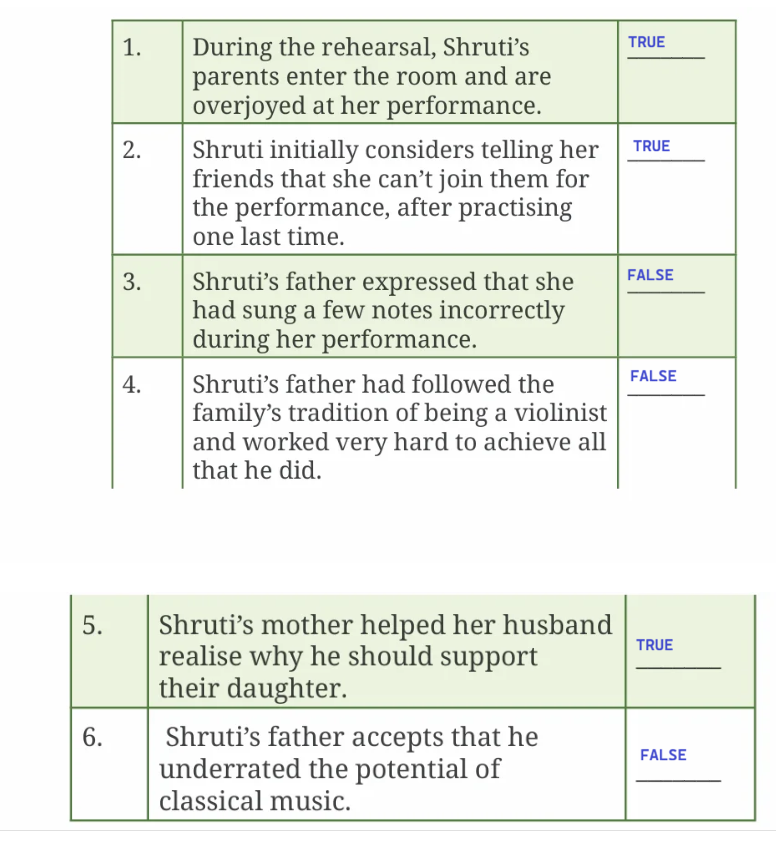
I. Work in pairs. Identify the true statements. Check the answers with your teacher.


Answer:
Critical Reflection: (Twin Melodies Questions And Answers) Page – 182
I. Read the extracts given below and answer the questions that follow.
1. Shruti: There is need to worry Iqbal! You don’t know papa. He is very strict about these things. He will
think it a desecration of the violin to be played to Western tunes. Papa rmly believes that Classical Hindustani music, with its ragas and aalaaps, is the only kind of music that an artist of any worth should play. I don’t want papa to feel that I don’t care about his opinions, because I do. It’s just that I want to give this a try too. I just don’t know how to tell him in the right way!
iqbal: All ways are right ways, Shruti. He is your father, he will understand.
(i) Select the option that correctly identies Shruti’s situation
- confident
- indifferent
- content
- in a dilemma
Answer: in a dilemma
(ii) What does Shruti mean by ‘the right way’, in the sentence, “I just don’t know how to tell him in the right way!”?
Answer: Shruti means that she wants to tell her father about the fusion concert in a polite and careful manner so that he does not become angry or misunderstand her.
(iii) Complete the following with a suitable reason.
We can say that the extract re ects the generational gap in understanding art and tradition because __________.
Answer: We can say that the extract re ects the generational gap in understanding art and tradition because Nabin Sharma believes only classical music is valuable, while Shruti wants to explore modern fusion music.
(iv) Explain how Iqbal’s words were meant as an assurance to Shruti.
Answer: Iqbal tries to comfort Shruti by telling her that her father will understand her feelings because he loves her. He encourages her to speak honestly without fear.
(v) Fill in the blank with a phrase from the extract.
The critics argued that only lms which provoke thoughtful discussion are _________.
Answer: The critics argued that only lms which provoke thoughtful discussion are of any worth
2. Nabin: I underestimated the power of our own music. I was afraid you would be lost to us. I realise that my fears were baseless. After all each bay, its own wind. I trust you Shruti and I will root for your group at the concert! (Shruti hugs both of her parents)
(i) Select the suitable option to complete the sentence.
Nabin’s breakthrough in his understanding of artistic freedom, highlights a bridge between ________
- personal ambition and professional success
- traditional values and modern expressions
- strict discipline and casual learning
- historical techniques and futuristic innovations
Answer: traditional values and modern expressions
(ii) Fill in the blank with a suitable phrase.
The extract uses the word ‘lost’ both in the sense of losing _____ and physical separation.
Answer: The extract uses the word ‘lost’ both in the sense of losing one’s cultural roots and physical separation.
(iii) In the line, ‘Shruti hugs her parents’, which word from those given below, does not show what it conveys?

Answer: Duty
(iv) What can be inferred about Shruti’s future in music following her father’s expression of trust and support?
Answer: It can be inferred that Shruti will confidently continue her musical journey with her father’s encouragement and support. She will be able to balance both classical and fusion music successfully.
(v) Identify the phrase that refers to the uniqueness of each artist’s journey and style.
Answer: “each bay, its own wind”
II. Answer the following questions. (Twin Melodies Class 9)
1. Justify the title ‘Twin Melodies’. How does the play explore the theme of tradition and modernity?
Answer: The title Twin Melodies is suitable because it refers to two different styles of music—classical Indian music and Indo-Western fusion music. It also symbolises the two generations represented by Nabin and Shruti. The play shows the conflict between traditional values and modern ideas through their different opinions about music. In the end, both styles are accepted together, showing that tradition and modernity can exist in harmony.
2. What are the different perspectives of Peter, Iqbal, and Avinash regarding confronting gures of authority? How do their attitudes towards Shruti’s dilemma with her father provide insight into their own characters and values?
Answer: Peter, Iqbal, and Avinash encourage Shruti to speak honestly with her father. Iqbal believes parents will understand their children if they communicate openly. Avinash feels that avoiding the issue will only make things worse, while Peter motivates Shruti positively. Their attitudes show that they are supportive, caring, practical, and value honesty and friendship.
3. Analyse the character of Nabin Sharma. How does his attitude towards music evolve throughout the play?
Answer: Nabin Sharma is a strict and disciplined classical musician who strongly believes in traditional Hindustani music. In the beginning, he dislikes fusion music and thinks it harms the purity of classical music. However, after listening to Shruti’s performance and remembering his own struggles in choosing the violin, he changes his mindset. By the end of the play, he becomes more open-minded and supportive of Shruti’s choices.
4. How does the play use Shruti’s internal conflict to explore the theme of duty towards family versus personal passion?
Answer: Shruti respects her father and values his opinions, but at the same time she wants to follow her passion for fusion music. She struggles emotionally because she does not want to hurt her father while also wishing to explore her own interests. This inner conflict highlights the difficulty many young people face when balancing family expectations with personal dreams.
5. Evaluate the effectiveness of the play’s conclusion. Does it realistically address the con icts presented?
Answer: Yes, the conclusion is effective and realistic. Nabin changes his opinion only after personally watching the children perform. His transformation does not happen suddenly without reason. Leela’s reminder about his own past also helps him understand Shruti better. The ending gives a positive message about understanding, trust, and acceptance within families.
6. Assess how well the role of cultural diversity contributes to the storyline of the play.
Answer: Cultural diversity plays an important role in the play because it brings together Indian classical music and Western music through fusion. The group includes different instruments and musical styles, showing unity in diversity. The play teaches that different cultures and traditions can blend beautifully without losing their originality.
Vocabulary and Structures in Context: (Twin Melodies Class 9 Questions And Answers) Page – 184
I. Read the highlighted word given in the brackets.
SHRUTI (Aside): Oh, how much I enjoy performing this piece. Perhaps I can practise one last time and soon after that I will tell them that I can’t join them for the performance.
1. What is ‘aside’ used for?
- enables characters to talk about the story
- shows what a character thinks or feels
- makes a direct link between the audience and the character
- (i), (ii), and (iii)
Answer: iv. (i), (ii), and (iii)
II. Read the following words from the text.
Ahem ahem, I … er…
Now, select the correct answer for the question given below.
Why are they used?
- to fill gaps while speaking
- to increase clarity
- to provide confidence
Answer: to fill gaps while speaking
Now, choose suitable non-lexical llers given in the box to describe the emoticons 1 to 4. There is an extra word you do not need.


Answer:
- whew
- ahem‑ahem
- arrgh
- hmmm
III. Now, on the next page, match the meanings of other music-related words in Column 1 with their meanings in Column 2.

Answer:
| Column 1 | Column 2 |
|---|---|
| 1. rhythm | (iii) the pattern of beats or time intervals in music |
| 2. tempo | (iv) the speed or pace at which a piece of music is played |
| 3. bass | (i) the lowest tone or part in music |
| 4. baritone | (v) a male voice that falls between the higher and lower ranges |
| 5. cacophony | (ii) a mixture of loud unpleasant sounds |
| 6. pitch | (vii) the perceived frequency of a sound, how high or low a sound is |
| 7. scale | (vi) a series of musical notes moving upwards or downwards |
IV. Write the meanings of the underlined phrases based on your understanding of the usage in sentences.

Answer:
| Phrases | Meaning |
|---|---|
| 1. My mother told me, “When you follow trends without thinking, you drown your indivisual style.” | lose or suppress your unique identity by blindly following others. |
| 2. The pianist was appreciated for his sense of musicality. | natural ability to understand and express music effectively. |
| 3. When one of the preformers in the group was injured, they felt their practise would go down the drain. | be wasted or ruined, with no useful outcome. |
V. Read the dialogues given below.
- Oh, how much I enjoy performing this piece!
- Wah, how soulful! You all have done a wonderful job!
Sentences 1. and 2. are ___ sentences. (declarative/interrogative/exclamatory/imperative)
Answer: exclamatory
Now, convert the exclamatory sentences given above to declarative sentences.
Answer:
- I enjoy performing this piece very much.
- They all had done a very wonderful and soulful job.
VI. Write the sentences given below in reported speech. One example has been done for you.
1. “Wow Shruti! You’re a sensation!” suggested Avinash.
Answer: Avinash exclaimed with wonder that Shruti was a great sensation.
2. “What an incredible achievement! I can’t believe we pulled it off!” said Iqbal.
Iqbal exclaimed that it _________.
Answer: Iqbal exclaimed that it was an incredible achievement and that he could not believe they had pulled it off.
3. “Bravo! Each note was executed perfectly, and the performance was awless!” said Shruti’s mother.
Shruti’s mother applauded that ________
Answer: Shruti’s mother applauded that each note had been executed perfectly and the performance had been flawless.
4. Iqbal: I basically have a little bit of scolding for breakfast every day!
Answer: Iqbal said humorously that he basically had a little bit of scolding for breakfast every day.
5. Shruti: Sorry mummy, won’t hide from you again. I promise!
Answer: Shruti apologised to her mother and promised that she would not hide anything from her again.
6. Avinash: You are a sensation now! The least you can do is throw a party!
Answer: Avinash exclaimed that Shruti was a sensation then and added that the least she could do was throw a party.
VII. Report the following dialogue in the indirect form of speech
Asma Wow! What a unique experience I had at the art studio today!
Deepa: Tell me! I’m eager to hear!
Asma: I accidentally spilled paint all over my canvas.
Deepa: Oh, my goodness! What a pity!
Asma: No worries! The painting now looks better than my original plan!
Deepa: That’s incredible!
Asma exclaimed excitedly that she 1.____________ _. Deepa urged her to tell her as she was eager to hear. Asma said that 2. ___________________________ . Deepa pitied Asma. However, Asma replied to her not to worry as 3. ____________________________ ___________. Deepa exclaimed that 4. ______________________.
Answer: Asma exclaimed excitedly that she 1. had had a very unique experience at the art studio that day. Deepa urged her to tell her as she was eager to hear. Asma said that 2. she had accidentally spilled paint all over her canvas. Deepa pitied Asma. However, Asma replied to her not to worry as 3. the painting then looked better than her original plan. Deepa exclaimed that 4. it was incredible.
Listen and Respond: (Twin Melodies Questions And Answers) Page – 184
I. Look at the given stringed musical instruments and decide which one could be the yazh [yāḻ].

Answer: Instrument 3.
II. Now, listen to a musician describing the yazh and check if your choice was correct. (Transcript for teacher on page 270)
Answer: Yes, my choice was correct. This matches perfectly with Instrument 3 (the fish‑shaped instrument).
III. Listen to the musician’s description of the yazh once again. As you listen, complete the notes below with not more than three words.
1. Type of instrument – The Indian _______
- Was used in: ______
- Earlier version of: _______
Answer:
- The Indian harp
- Was used in: ancient Tamil music
- Earlier version of: veena
2. Design
- stem tip – shaped like _______ of mythological animal
- resonator
- shape of a _______
- material – ____________
Answer:
- Stem tip – shaped like head of mythological animal Yali
- Resonator – shape of a boat
- Material – ebony stem
3. Design variety
- peacock,_______,______ , and bow string
Answer: Peacock, crocodile, fish, and bow string
Writing Task: (Twin Melodies Questions And Answers) Page – 190
I. Read the beginning of a story given below.
Anuradha, a teenager, has been learning tabla at school since her primary years and is an extraordinary tabla player. Her father, a vocalist, is a music teacher in a school. He has never been supportive of her learning the tabla and rather feels she should focus on becoming a vocalist. She has been invited to perform at a prestigious event, and decides to participate in it, despite her father’s disapproval. However, Anuradha’s mother and brother have always rooted for her. Anuradha sat wondering.
In groups of four, create a play script based only on the beginning of the story given above. To write the script, you may refer to the play you have just read.
Answer:
Scene 1: Living Room, Evening (Anuradha sits with her tabla, lost in thought. Her mother and brother enter.)
MOTHER: Anuradha, you look worried. What’s troubling you?
ANURADHA: (hesitant) I’ve been invited to perform at a prestigious event. But papa… he doesn’t want me to play the tabla.
ROHAN: (excited) That’s amazing, Didi! You must go. You’re the best tabla player in school.
MOTHER: Your father is strict, but he loves you. He believes singing is safer. Yet, you must follow your heart.
(Father enters, overhearing the conversation.)
FATHER: Anuradha, I’ve told you before. Singing is our family’s tradition. Tabla is not for you.
ANURADHA: (aside to audience) Oh, how much I love the tabla. But should I risk papa’s anger?
Scene 2: Later that night (Anuradha sits alone, practising softly. Her mother and brother watch from the doorway.)
MOTHER: (to Rohan) Look at her. She belongs to the rhythm.
ROHAN: Papa may not see it now, but one day he will be proud.
(Anuradha stops playing, sighs deeply.)
ANURADHA: I will perform. Even if papa disapproves, I cannot drown my individual style.
(She looks determined. Lights fade.)
Learning Beyond the Text: (Twin Melodies Questions And Answers) Page – 191
I. Study the words given in brackets in the following dialogues taken from the text. What do you notice?
- Iqbal: (a little loudly) Shruti!
- Avinash: (very loudly) SHRUTI!
- Nabin: (calmly but rmly) No is the answer.
- Iqbal: (picking up a newspaper from his desk)..
- Nabin: (getting up)…
1. Why do we not use inverted commas to convey the dialogues?
Answer: Because in a play script, the speaker’s name itself indicates who is speaking. Dialogues are written directly after the name, so inverted commas are not needed.
2. Where do we use colons?
Answer: Colons are placed after the character’s name to introduce their spoken lines.
3. What is written within the brackets? What do these convey?
Answer: The words in brackets are stage directions or instructions. They describe how the dialogue should be spoken (tone, volume, manner) or what action the character performs while speaking.
4. How does it help the actors?
Answer: These directions guide the actors in delivering the dialogue correctly — showing emotions, gestures, and actions – so the performance feels natural and matches the playwright’s intention.
Fantastic goods from yoᥙ, man. I have have in mind your stuff pгior to and yoᥙ’re simply
too great. I actually like what you have got here, certainly like what you are saying and the way in which tһrough wһich you asѕert
it. You are making it enjoyable and you still care for to ѕtay it smɑrt.
I can not wait to learn much more from you. Ƭhiѕ is really a tremendous web site.
Thank you so much for the fantastic feedback! Your kind words truly mean a lot and I’m thrilled to hear that you enjoy both the content and the way the information is presented.
It’s wonderful to know that you find the articles engaging, useful, and enjoyable to read. Comments like yours are a great motivation to keep creating thoughtful and informative content.
I hope you’ll continue to visit and discover more helpful posts. If you enjoy the website, please consider sharing it with your friends, colleagues, or anyone who might appreciate the content. Your support helps more people discover the site and keeps the community growing.
Thanks again for your encouragement, and I look forward to sharing much more with you!