

Kaveri | CBSE | Carrier of Words Question Answer | NCERT Solutions For Class 9 English Literature Chapter 13 | Unit 7 | Kaveri | Class IX | Best Guide 2026. It is required for Grade 9 students to build a strong foundation in the subject, and NCERT Solutions For Class 9 English Literature Chapter 13. Understanding the chapter thoroughly helps students grasp key concepts, improve comprehension, and perform well in exams.
In this article, Kaveri | CBSE | Carrier of Words Question Answer | NCERT Solutions For Class 9 English Literature Chapter 13 | Class IX | Best Guide 2026, we (ThinkSphereEdu.com) provide a detailed Carrier of Words Summary to make learning easier and more effective. Whether you are a student looking for well-explained solutions or a parent guiding your child, this guide will be a helpful resource for mastering the chapter with confidence.
- Carrier of Words PDF Download:
- Carrier of Words Summary In English: (Carrier of Words Question Answer)
- Carrier of Words Summary In Hindi: (Carrier of Words Question Answer)
- Carrier of Words Summary In Bengali:(Carrier of Words Question Answer)
- Reflect and Respond: ( Carrier of Words Question Answer) Page – 203
- Check Your Understanding: (Carrier of Words Question Answer) Page – 207
- Check Your Understanding: (Carrier of Words Question Answer) Page – 210
- Critical Reflection: (Carrier of Words Question Answer) Page – 210
- Vocabulary and Structures in Context: (Carrier of Words Question Answer) Page – 212
- Listen and Respond: (Carrier of Words Question Answer) Page – 215
- Writing Task: (Carrier of Words Question Answer) Page – 217
- Learning Beyond the Text: (Carrier of Words Questions and Answers) Page – 217
CBSE | Kaveri | Carrier of Words Question Answer Solved | Class 9 | English Literature | Must Read
Carrier of Words PDF Download:
Carrier of Words Summary In English: (Carrier of Words Question Answer)
The lesson Carrier of Words tells the inspiring story of Khetaram, a Gramin Dak Sewak (village postman) who works in the harsh desert areas of Rajasthan near the Indo-Pakistan border. He walks through extreme heat and sandstorms and other challenging conditions to deliver letters and money orders and vital news to isolated villages throughout his workday.
For more than fifteen years Khetaram has dedicated himself to serving the community. He carries his heavy mailbag on his shoulder while traveling through the Thar Desert which presents challenges that make bicycle travel unfeasible. The villagers consider him their postman who serves as a reliable companion who assists them with letter reading and reply writing while helping them maintain contact with family members who live in distant locations.
The chapter explains the importance of Gramin Dak Sewaks in India. They work in remote places like deserts and mountains and islands and river areas where communication is difficult. Through them the postal system reaches people who depend on letters and money orders for survival and emotional connection.
The story also highlights the trust and respect villagers have for Khetaram. The villagers treat him with friendship because he delivers both cheerful and sorrowful information. Khetaram takes pride in his work despite his challenging circumstances and low wages because he finds fulfillment in helping others.
The lesson demonstrates how postmen like Khetaram dedicate their lives and practice honest work because their profession provides vital social functions that connect people across distant regions.
Carrier of Words Summary In Hindi: (Carrier of Words Question Answer)
‘Carrier of Words’ (शब्दों का वाहक) पाठ खेताराम की प्रेरणादायक कहानी बताता है। खेताराम एक ‘ग्रामीण डाक सेवक’ (गाँव का डाकिया) है जो राजस्थान के कठोर रेगिस्तानी इलाकों में, भारत-पाकिस्तान सीमा के पास काम करता है। वह अपने पूरे काम के दौरान, चिट्ठियाँ, मनी ऑर्डर और ज़रूरी खबरें दूर-दराज के गाँवों तक पहुँचाने के लिए, भीषण गर्मी, रेत के तूफानों और दूसरी मुश्किल परिस्थितियों का सामना करते हुए पैदल चलता है।
पंद्रह साल से भी ज़्यादा समय से, खेताराम ने खुद को समाज की सेवा के लिए समर्पित कर दिया है। वह थार रेगिस्तान से गुज़रते समय अपने कंधे पर डाक का भारी थैला लादकर चलता है; इस रेगिस्तान की चुनौतियाँ ऐसी हैं कि यहाँ साइकिल चलाना मुमकिन नहीं है। गाँव वाले उसे अपना डाकिया मानते हैं-एक भरोसेमंद साथी-जो उन्हें चिट्ठियाँ पढ़ने और उनके जवाब लिखने में मदद करता है, और इस तरह उन्हें दूर रहने वाले अपने परिवार के सदस्यों से जुड़े रहने में सहायता देता है।
यह अध्याय भारत में ‘ग्रामीण डाक सेवकों’ के महत्व को समझाता है। वे रेगिस्तान, पहाड़, द्वीप और नदी-घाटियों जैसे दूर-दराज के इलाकों में काम करते हैं, जहाँ संचार के साधन बहुत मुश्किल से उपलब्ध होते हैं। इन्हीं डाक सेवकों के ज़रिए डाक व्यवस्था उन लोगों तक पहुँच पाती है जो अपनी गुज़र-बसर और भावनात्मक जुड़ाव के लिए चिट्ठियों और मनी ऑर्डर पर निर्भर रहते हैं।
यह कहानी इस बात पर भी रोशनी डालती है कि गाँव वाले खेताराम पर कितना भरोसा करते हैं और उसका कितना सम्मान करते हैं। गाँव वाले उसके साथ दोस्ती का व्यवहार करते हैं, क्योंकि वह उनके लिए खुशी और गम-दोनों तरह की खबरें लेकर आता है। मुश्किल हालात और कम वेतन के बावजूद, खेताराम को अपने काम पर गर्व है, क्योंकि उसे दूसरों की मदद करने में ही सच्ची संतुष्टि मिलती है।
यह पाठ दिखाता है कि खेताराम जैसे डाकिया अपना पूरा जीवन समर्पित कर देते हैं और पूरी ईमानदारी से अपना काम करते हैं; ऐसा इसलिए है, क्योंकि उनका पेशा एक बहुत ही ज़रूरी सामाजिक भूमिका निभाता है-यह दूर-दराज के इलाकों में रहने वाले लोगों को आपस में जोड़ने का काम करता है।
Carrier of Words Summary In Bengali:(Carrier of Words Question Answer)
‘Carrier of Words’ (শব্দবাহক) নামক এই পাঠটি খেতারামের এক অনুপ্রেরণাদায়ক কাহিনী তুলে ধরে—যিনি একজন ‘গ্রামীণ ডাক সেবক’ (গ্রামের ডাকপিয়ন) হিসেবে ভারত-পাকিস্তান সীমান্তের অদূরে রাজস্থানের রুক্ষ মরু অঞ্চলে কর্মরত। তীব্র গরম, বালুঝড় এবং অন্যান্য প্রতিকূল পরিস্থিতির মধ্য দিয়ে হেঁটে তিনি তাঁর পুরো কর্মদিবস জুড়ে প্রত্যন্ত গ্রামগুলোতে চিঠি, মানি অর্ডার এবং অত্যন্ত জরুরি সংবাদ পৌঁছে দেন।
পনেরো বছরেরও বেশি সময় ধরে খেতারাম নিজেকে নিঃস্বার্থভাবে জনসেবায় নিয়োজিত রেখেছেন। থর মরুভূমির দুর্গম পথ পাড়ি দেওয়ার সময় তিনি তাঁর ভারী চিঠির ব্যাগটি কাঁধে বহন করেন; এই মরুভূমির পথচলা এতটাই কঠিন যে সেখানে সাইকেলে যাতায়াত করা একেবারেই অসম্ভব। গ্রামবাসীরা তাঁকে কেবল একজন ডাকপিয়ন হিসেবেই দেখে না, বরং একজন বিশ্বস্ত সঙ্গী হিসেবেও গণ্য করে; তিনি গ্রামবাসীদের চিঠি পড়ে শোনান, চিঠির উত্তর লিখতে সহায়তা করেন এবং দূরবর্তী স্থানে বসবাসরত পরিবারের সদস্যদের সাথে তাঁদের যোগাযোগ বজায় রাখতে সাহায্য করেন।
এই অধ্যায়টি ভারতে ‘গ্রামীণ ডাক সেবক’-দের গুরুত্ব বিশদভাবে ব্যাখ্যা করে। তাঁরা মরুভূমি, পাহাড়-পর্বত, দ্বীপপুঞ্জ এবং নদীমাতৃক অঞ্চলের মতো এমন সব প্রত্যন্ত এলাকায় কাজ করেন, যেখানে যোগাযোগ ব্যবস্থা অত্যন্ত দুরূহ। তাঁদের মাধ্যমেই ডাক পরিষেবা সেইসব মানুষের দোরগোড়ায় পৌঁছে যায়, যাঁরা নিজেদের জীবনধারণ এবং মানসিক সংযোগ বজায় রাখার জন্য চিঠিপত্র ও মানি অর্ডারের ওপর নির্ভরশীল।
এই কাহিনীটি গ্রামবাসীদের মনে খেতারামের প্রতি বিদ্যমান গভীর আস্থা ও শ্রদ্ধার বিষয়টিও তুলে ধরে। গ্রামবাসীরা খেতারামের সাথে অত্যন্ত বন্ধুত্বপূর্ণ আচরণ করে, কারণ তিনি তাঁদের কাছে আনন্দ ও বিষাদ-উভয় ধরণের সংবাদই বয়ে নিয়ে আসেন। প্রতিকূল কর্মপরিবেশ এবং স্বল্প বেতন সত্ত্বেও খেতারাম তাঁর কাজ নিয়ে গর্ববোধ করেন; কারণ, অন্যদের সাহায্য করার মধ্যেই তিনি তাঁর জীবনের প্রকৃত সার্থকতা খুঁজে পান।
এই পাঠটি স্পষ্টভাবে দেখিয়ে দেয় যে, খেতারামের মতো ডাকপিয়নরা কীভাবে নিজেদের জীবন উৎসর্গ করে অত্যন্ত সততা ও নিষ্ঠার সাথে তাঁদের পেশাগত দায়িত্ব পালন করেন; কারণ তাঁদের এই পেশাটি এমন এক অত্যন্ত গুরুত্বপূর্ণ সামাজিক ভূমিকা পালন করে, যা দূর-দূরান্তের বিভিন্ন অঞ্চলের মানুষকে একে অপরের সাথে সংযুক্ত করে।
Carrier of Words Questions And Answers | Exam Preparation | 2026-27
Reflect and Respond: ( Carrier of Words Question Answer) Page – 203
I. Look at the pictures given below of persons engaged in the same profession.

Discuss in pairs and share your answers with your classmates and teacher.
1. Which profession do they belong to?
Answer: They belong to the postal service profession. They are postmen or Gramin Dak Sewaks who deliver letters, parcels, and messages to people.
2. Do they face any difficulties while doing their duty?
Answer: Yes, they face many difficulties. They travel long distances in harsh weather such as extreme heat, rain, cold, and storms. In remote areas, they may have to walk through deserts, mountains, forests, or villages with poor roads and transport facilities.
3. How does their profession a ect the people they meet?
Answer: Their profession helps people stay connected with their families and relatives. They bring important news, letters, money orders, and happiness to people. In remote areas, postmen are trusted and respected because they provide an important communication service.
II. Discuss in groups.
1. How can ‘words’ be ‘carried’?
Answer: Words can be carried through letters, messages, newspapers, phones, emails, and by people who deliver or communicate them from one place to another.
2. Who could be a carrier of words?
Answer: A postman, messenger, courier person, journalist, teacher, or even modern technology like mobile phones and the internet can be carriers of words.
3. What are the means for people to stay connected?
Answer: People stay connected through letters, telephones, mobile phones, emails, social media, video calls, and postal services.
III. Read the words given in the box below and place them in their appropriate context in the following passage.

We stepped out of the vehicle at the end of the road. Immediately, our body sent 1. ______ that our decision to visit the sand 2. ____ in the afternoon was insane. We had passed a few 3. ______ on our way to the desert. We could not nd even a single soul outdoors, 4. _______ the blazing sun. Even the camels were 5. _____ in the little shade o ered by the khejri trees. In this remote place people relied on Bharat Sanchar Nigam Limited (BSNL) to connect to the world as the area was 6. ________ of any other network service.
Answer: We stepped out of the vehicle at the end of the road. Immediately, our body sent 1. signals that our decision to visit the sand 2. dunes in the afternoon was insane. We had passed a few 3. hamlets on our way to the desert. We could not find even a single soul outdoors, 4. defying the blazing sun. Even the camels were 5. slumped in the little shade offered by the khejri trees. In this remote place people relied on Bharat Sanchar Nigam Limited (BSNL) to connect to the world as the area was 6. devoid of any other network service.
Check Your Understanding: (Carrier of Words Question Answer) Page – 207
I. Khetaram needs to submit information about himself for getting an identity card. While reading the text, fill up the following information sheet for Khetaram.

Answer:
| Name | Khetaram |
| Position | Gramin Dak Sewak(Postman) |
| Employer | India Post |
| Official address | Somarad Branch Post Office, Rajasthan |
| Mode of transport used | Mostly on foot through the desert |
| Key responsibilities | 1. Delivering letters and money orders 2. Carrying mail to remote villages 3. Reading letters and writing replies for villagers |
II. Discuss with your teacher.
1. Why do you think Khetaram has taken up this challenging job?
Answer: Khetaram has taken up this challenging job to support his family and earn a stable income. Farming alone could not feed his family because famine and poor crop production were common in his area. He also feels responsible for serving the people of remote villages by delivering their letters and money orders.
2. How do you think Khetaram would feel about taking up this challenging task every day?
Answer: Khetaram would feel proud and satisfied because his work helps many people stay connected with their families. Though the job is difficult and tiring, he performs it with dedication and a sense of duty. He also feels respected and valued by the villagers who trust him.
Check Your Understanding: (Carrier of Words Question Answer) Page – 210
I. Complete the table given below with the situations given in Column 1 and the reasons in Column 2.

Answer:
| Column 1 | Column 2 |
|---|---|
| Khetaram continued delivering letters even in extreme heat. | When the temperature is recorded as 50 degrees celsius and above, a state holiday has to be declared. |
| Khetaram can dwell on any threshold. | The villagers trust him and warmly welcome him into their homes. |
| BSF always gave Khetaram a lift. | He regularly delivered their dak (mail) and shared a good relationship with them. |
II. Why was a piece of jaggery offered in the village when he brought news of a birth or weddings?
Answer: A piece of jaggery was offered to Khetaram as a sign of happiness, gratitude, and celebration when he brought good news such as births or weddings.
III. How would phone lines help Khetaram in his job?
Answer: Phone lines would help Khetaram communicate more easily and quickly with people in remote villages. He could also become a Gramin Sanchar Sewak and carry both postal services and communication facilities from home to home.
Critical Reflection: (Carrier of Words Question Answer) Page – 210
I. Read the extracts given below and answer the questions.
1. “Akaal or famine is a way of life here. In a good year, I get one crop of bajra. That cannot feed my family of five. We would starve without this job,” he says. And for each family which resides in this arid land, survival is partly dependent on money orders remitted by a relative.
(i) Complete the sentence given below with an appropriate reason.
One crop of bajra makes a little difference for people like Khetaram because _____________.
Answer: One crop of bajra makes a little difference for people like Khetaram because it is not enough to feed the whole family for the entire year.
(ii) Why did Khetaram term famine as ‘a way of life’?
Answer: Khetaram called famine “a way of life” because drought and poor crop production were very common in his desert region, making life difficult every year.
(iii) Give one reason why Khetaram had to take up a job to help his family to survive.
Answer: Khetaram had to take up the job because farming alone could not provide enough food or income for his family.
(iv) Complete the analogy given below with a word from the extract.
Other families: Money orders:: Khetaram: ________
Answer: Other families: Money orders :: Khetaram: job
(v) What would ‘a good year’ signify?
Answer: “A good year” would signify a year with better rainfall and a successful crop harvest.
2. There is one letter delivery he dreads. The envelope with the right corner torn off, which signifies that the missive bears news of death. “Ashubh Samachar cannot be carried into the house,” says Khetaram. So, he stands outside, reads out the letter twice, then tears it to bits. “Bad news must be destroyed,” he mutters philosophically.
(i) Choose the correct option for the following question.
Who could have torn the right corner of the envelope?
- Khetaram
- Sender of the letter
- Receiver of the letter
- The postmaster
Answer: sender of the letter
(ii) Complete the sentence with an appropriate reason.
The most likely reason for Khetaram reading the letter twice is because _________
Answer: The most likely reason for Khetaram reading the letter twice is because he wanted the family members to clearly understand the sad news.
(iii) What was Khetaram’s philosophy regarding bad news, and how did he act upon it?
Answer: Khetaram believed that bad news should be destroyed after being conveyed. Therefore, after reading the letter aloud, he tore it into pieces.
(iv) State whether the following sentence is true or false.
Khetaram’s action of tearing the letter differed from his beliefs.
Answer: False
(v) Mention any one aspect of Khetaram’s temperament which is revealed through this extract.
Answer: Khetaram is sensitive and compassionate towards the feelings of others.
II. Answer the following questions.
1. Justify the statement made by Postmaster-General, Rajasthan Western Region stating that the role of GDS is ‘invaluable’.
Answer: The role of Gramin Dak Sewaks is invaluable because they deliver letters, money orders, and important messages to remote areas where transport and communication facilities are poor. They often travel on foot through deserts, mountains, and isolated villages to connect people with their families and the outside world.
2. How was the purpose of India Post different from that of the British postal system?
Answer: The British postal system in India was mainly set up to carry official company mail between administrative centres. After independence, India Post aimed to serve the entire population by connecting even the remotest villages through postal services.
3. People trusted Gramin Dak Sewaks. Support this statement with any two instances from the text.
Answer: (i) Villagers comfortably asked Khetaram to read their letters and write replies for them. (ii) People trusted the post office with their savings and depended on money orders sent through the postal system.
4. Infer the most likely reason that Khetaram was grateful to continue as GDS, even after the age of 60.
Answer: Khetaram was grateful because the job provided financial support to his family and gave him respect and purpose in life. He was also proud to continue serving the people of his village.
5. Explain why the author pays tribute to people like Khetaram.
Answer: The author pays tribute to people like Khetaram because they work with dedication and honesty under very difficult conditions to help others stay connected. They are selfless workers who serve society and support people living in remote areas.
Vocabulary and Structures in Context: (Carrier of Words Question Answer) Page – 212
I. Study the phrases given in Column 1 and match them with their meanings in Column 2.

Answer:
| Column 1 | Column 2 |
|---|---|
| 1. crumbles into sand | (iii) disappears in the desert |
| 2. give a new lease of life | (i) get a chance to continue living |
| 3. turn into a trickle before drying out | (iv) lessen gradually and then finally stop |
| 4. bearing words across this desolate geography | (ii) carrying letters to less populated areas |
Now, use the phrases from Column 1 in sentences of your own.
Answer:
- crumbles into sand – The narrow road near the desert crumbles into sand after a few kilometres.
- give a new lease of life – The new job gave the poor farmer a new lease of life.
- turn into a trickle before drying out – During summer, the village river turns into a trickle before drying out completely.
- bearing words across this desolate geography – The postman continued bearing words across this desolate geography despite the harsh weather.
II. Identify examples of alliteration and metaphor in the extract given below.
Khetaram’s khaki turban and uniform are his only protection against the desert’s furies, the scorching summer winds and swirling sandstorms which turn him into a walking sandman.
Answer:
Alliteration:
- scorching summer
- swirling sandstorms
- walking sandman
Metaphor:
- turn him into a walking sandman — Khetaram is compared to a “sandman” because he becomes covered with sand while travelling through sandstorms.
III. Match the words in Column 1 to what they suggest in Column 2 in the context of the chapter.

Answer:
Now, use the words from Column 1 in sentences of your own.
Answer:
IV. Read the underlined verbs in the sentences given in Column 1 and their functions in Column 2.

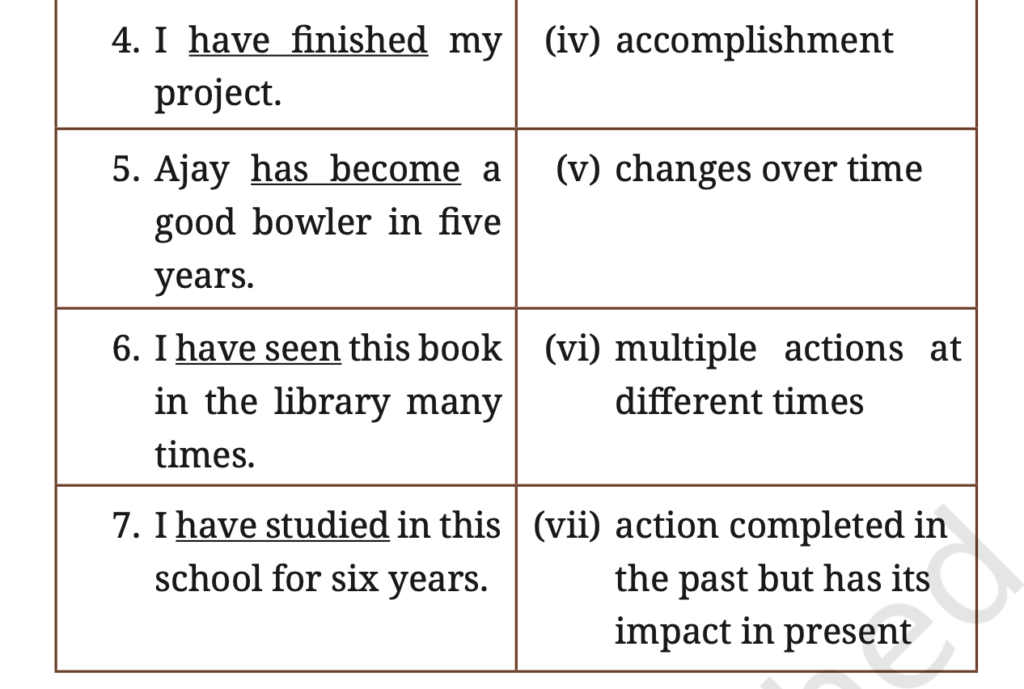
Answer:
Now, fill in the blanks by using the present perfect form of the verbs given in the brackets to complete the following paragraph.
1. I ______(has/have) just (get) a collection of postage stamps from my grandfather. He 2. ______ (collect) these stamps over a period of 20 years. I 3. _______ (study) most of the stamps in his collection and loved all of them. I 4. _______ (begin) my own collection of postage stamps. Grandfather 5. ______ truly _____ (inspire) me.
Answer: I have just got a collection of postage stamps from my grandfather. He has collected these stamps over a period of 20 years. I have studied most of the stamps in his collection and loved all of them. I have begun my own collection of postage stamps. Grandfather has truly inspired me.
V. Study the sentences given below.
Now complete the following paragraph about the advice given by Kheteram. One example has been done for you.
To begin with, a lot of stamina will be needed for this job. Next, reading clearly A. ______, as you B. ______ to read out the letters by some of the villagers. Words C. __________ neatly as you D. _______ to draft replies by some villagers. Full sleeved-shirts and trousers E. ________ to protect yourself from the heat.
Answer: To begin with, a lot of stamina will be needed for this job. Next, reading clearly will be important, as you will have to read out the letters by some of the villagers. Words will have to be written neatly as you will have to draft replies by some villagers. Full-sleeved shirts and trousers will be needed to protect yourself from the heat.
Listen and Respond: (Carrier of Words Question Answer) Page – 215
I. You will listen to a girl talking about an event. As you You will listen to a girl talking about an event. As you brackets. (Transcript for teacher on page 272)
The speaker concluded her talk with a _________. (suggestion/request/advice)
Answer:
II. You will listen to the girl talking about the event You will listen to the girl talking about the event following questions.
1. What was the occasion that the speaker was talking about?
- Letter writing carnival
- philately day
- Indian Postal Day
Answer:
2. India Post is famous for having the most extensive network _______.
- in India
- in the world
- among design institutes
Answer:
3. Letter writing is being revived as this art form has been _______.
- celebrated
- appreciated
- forgotten
Answer:
4. Which of the following will be a part of the letter writing carnival?
- calligraphy and graphology
- origami and designing
- letter posting and philately
Answer:
5. What will the postal department add to the event?
- interactive demonstrations
- theatre and dance
- workshop for letter writing
Answer:
Writing Task: (Carrier of Words Question Answer) Page – 217
A condolence message communicates your feelings to someone whose relative or a person close to them has just passed away. It mentions how sorry you feel for the loss and your prayers for strength to the family members.
I. Khetaram saw a letter with a torn corner. It had news about Bhawar Singh’s uncle passing away. Read the condolence message that Sawant Singh sent to his cousin as a reply to the letter.

Now, on behalf of your parents draft an imaginary condolence message for your aunt on the recent passing away of her father.
Answer:
Learning Beyond the Text: (Carrier of Words Questions and Answers) Page – 217
1. Study the postage stamps given below and discuss who or what they depict.

Answer: