

Kaveri | CBSE | Words Poem Class 9 Question Answer Solutions | NCERT Solutions For Class 9 English Literature Chapter 14 | Unit 7 | Kaveri | Class IX | Best Guide 2026. It is required for Grade 9 students to build a strong foundation in the subject, and NCERT Solutions For Class 9 English Literature Chapter 14. Understanding the chapter thoroughly helps students grasp key concepts, improve comprehension, and perform well in exams.
In this article, Kaveri | CBSE | Words Poem Class 9 Question Answer | NCERT Solutions For Class 9 English Literature Chapter 14 | Class IX | Best Guide 2026, we (ThinkSphereEdu.com) provide a detailed Words Poem Class 9 to make learning easier and more effective. Whether you are a student looking for well-explained solutions or a parent guiding your child, this guide will be a helpful resource for mastering the chapter with confidence.
- Words Poem Class 9 PDF Download:
- Words Poem Class 9 Summary In English: (Words Poem Class 9 Question Answer)
- Words Poem Class 9 Summary In Hindi: (Words Poem Class 9 Question Answer)
- Words Poem Class 9 Summary In Bengali: (Words Poem Class 9 Question Answer)
- Reflect and Respond: ( Words Poem Class 9 Question Answer) Page – 220
- Check Your Understanding: ( Words Poem Class 9 Question Answer) Page – 222
- Critical Reflection: ( Words Poem Class 9 Question Answer) Page – 224
- Vocabulary in Context: ( Words Poem Class 9 Question Answer) Page – 226
- Listen and Respond: ( Words Poem Class 9 Question Answer) Page – 227
- Speaking Activity: ( Words Poem Class 9 Question Answer) Page – 227
- Writing Task: ( Words Poem Class 9 Question Answer) Page – 228
CBSE | Kaveri | Words Poem Class 9 Question Answer Solutions | Class 9 | English Literature | Must Read
Words Poem Class 9 PDF Download:
Words Poem Class 9 Summary In English: (Words Poem Class 9 Question Answer)
This poem sort of tells you that words, by themselves they cant really fill up the human heart, not in the true way. A lot of folks can talk nice and kind of long, but then somehow the things they say dont end up giving much comfort, affection, or real understanding. The poet likens those empty, well said sentences to birds that lift off really fast, and also to weeds that carry hardly any worth. But then, a small number of honest, warm words they can do something big, like deep joy and emotional repair.
Affection and kindness, those things arent proved by how many lines you speak, it is more in the honesty, and in what the words actually mean. Like some plants might look lovely from the outside, with pretty flowers, yet they dont end up producing anything, so too can many impressive statements sound charming, yet still accomplish nothing. In the end it keeps pushing this idea that genuine feelings matter more than mere speech.
Words Poem Class 9 Summary In Hindi: (Words Poem Class 9 Question Answer)
यह कविता बताती है कि शब्द अकेले इंसान के दिल को सही मायनों में नहीं भर सकते। बहुत से लोग अच्छी और लंबी बातें कर सकते हैं, लेकिन उनकी बातों से अक्सर कोई खास सुकून, अपनापन या सच्ची समझ नहीं मिलती। कवि ऐसे खोखले, अच्छे-अच्छे वाक्यों की तुलना उन पक्षियों से करता है जो तेज़ी से उड़ जाते हैं, और ऐसी बेकार घास-फूस से करता है जिनकी कोई कीमत नहीं होती। लेकिन, कुछ ईमानदार और दिल को छू लेने वाले शब्द बहुत कुछ कर सकते हैं, जैसे गहरी खुशी देना और भावनाओं को ठीक करना।
अपनापन और दयालुता इस बात से साबित नहीं होती कि आप कितनी बातें करते हैं, बल्कि यह ईमानदारी और शब्दों के असली मतलब में होती है। जैसे कुछ पौधे बाहर से सुंदर दिखते हैं और उनमें प्यारे फूल भी होते हैं, लेकिन उनसे कुछ हासिल नहीं होता; वैसे ही कई प्रभावशाली बातें सुनने में तो अच्छी लगती हैं, पर उनसे कुछ नहीं होता। आखिर में, यह कविता यही संदेश देती है कि सिर्फ़ बातों से ज़्यादा सच्ची भावनाएँ मायने रखती हैं।
Words Poem Class 9 Summary In Bengali: (Words Poem Class 9 Question Answer)
এই কবিতাটি মূলত এটাই বোঝাতে চায় যে, কেবল কথার মাধ্যমে মানুষের হৃদয়কে সত্যিকার অর্থে পূর্ণ করা যায় না। অনেকেই হয়তো সুন্দর ও দীর্ঘ কথা বলতে পারেন, কিন্তু সেই কথাগুলো অনেক সময় প্রকৃত সান্ত্বনা, মমতা বা গভীর বোঝাপড়া তৈরি করতে ব্যর্থ হয়। কবি সেই অন্তঃসারশূন্য অথচ সুন্দরভাবে সাজানো কথাগুলোকে দ্রুত উড়ে যাওয়া পাখির সাথে কিংবা মূল্যহীন আগাছার সাথে তুলনা করেছেন। অন্যদিকে, অল্প কিছু আন্তরিক ও উষ্ণ কথা অনেক বড় কাজ করতে পারে—যেমন গভীর আনন্দ দেওয়া বা মনের ক্ষত সারিয়ে তোলা।
মমতা ও সহমর্মিতা কেবল কত বেশি কথা বলা হলো তার ওপর নির্ভর করে না; বরং তা নির্ভর করে আন্তরিকতা এবং কথার প্রকৃত অর্থের ওপর। যেমন -বাইরে থেকে সুন্দর ফুলশোভিত কোনো গাছকে চমৎকার মনে হলেও শেষ পর্যন্ত তা হয়তো কোনো ফল বা ফসল দেয় না, তেমনি অনেক আকর্ষণীয় ও জমকালো কথা শুনতে ভালো লাগলেও বাস্তবে কোনো সুফল বয়ে আনে না। পরিশেষে, কবিতাটি এই বার্তাই দেয় যে, কেবল কথার চেয়ে আন্তরিক অনুভূতিই অধিক গুরুত্বপূর্ণ।
Words Poem Questions And Answers | Exam Preparation | 2026-27
Reflect and Respond: ( Words Poem Class 9 Question Answer) Page – 220
I. Why are words important? Can we communicate without words? How? Share your answers with your classmates and teacher.
Answer: Words are important because they help us express our thoughts, feelings, ideas, and needs. Through words, we can share information, build relationships, and understand one another. They make communication clear and effective.
Yes, we can communicate without words. We can use facial expressions, hand gestures, body language, eye contact, pictures, signs, and actions to express our feelings and messages. For example, a smile shows happiness, and a wave of the hand can mean greeting or goodbye. These non-verbal forms of communication help people understand each other even without speaking.
II. Use the given sentences as clues to find words from the grid and fill the blanks. One example has been done for you.
My mother summoned me to introduce her friends.


Answer:
Horizontal ➡️
- We eat food to satisfy our hunger.
- The train will depart from the station at 5.00 p.m.
- The gardener was removing the weeds to clean the flower beds.
Vertical ⬇️
- The view from the top of the hill was worth the difficult climb.
- The herbs and spices add flavour to food.
- Flowers bloom in spring.
- We enjoyed a delicious feast after the ceremony.
Check Your Understanding: ( Words Poem Class 9 Question Answer) Page – 222
I. Fill in the blanks with one word from the poem One example has been done for you.
In this poem, the poet reflects that words fail to truly satisfy what the heart wants to convey. Words are compared to summer birds who 1. ____________, leaving nothing behind. The heart, is equated to a 2. ___________ who finds that words are as worthless as 3. __________ when needed. He feels that a few sincere words can bring more 4. _________ than many meaningless ones.
He adds that a voice that brings happiness to a 5. ______ place does not say much, but the few words it does, are very precious. Moreover, if words could satisfy us, the 6. _________ would celebrate but words often fail to do that. The poem ends on the note that empty words may look impressive with lots of flowers, but they cannot produce anything valuable, like a 7. _________.
Answer: In this poem, the poet reflects that words fail to truly satisfy what the heart wants to convey. Words are compared to summer birds who depart, leaving nothing behind. The heart is equated to a pilgrim who finds that words are as worthless as weeds when needed. He feels that a few sincere words can bring more joy than many meaningless ones.
He adds that a voice that brings happiness to a lonely place does not say much, but the few words it does, are very precious. Moreover, if words could satisfy us, the world would celebrate but words often fail to do that. The poem ends on the note that empty words may look impressive with lots of flowers, but they cannot produce anything valuable, like a fruit.
II. Let us appreciate the poem.
1. Read the poem again. Find any four sets of rhyming words and also write the rhyme scheme of the poem.
Answer:
Four Sets of Rhyming Words
- care – air
- earth – worth
- said – head
- cheer – dear
Rhyme Scheme of the Poem
- The poem follows the rhyme scheme ABAB in each stanza.
2. Read the following phrases and sentences taken from the poem. Identify the poetic device in each of them and explain what the poet wants to communicate through their usage.
- But words, like summer birds, depart…
- heart, a pilgrim upon earth…
- words are of as little worth
As just so many weeds - If words could satisfy the chest … Oft satisfy
the least! - The world might hold a feast…
- Like plants that make a gaudy show
All blossom to the root - But whose poor nature cannot grow
One particle of fruit!
Answer:
(i) “But words, like summer birds, depart…”
Poetic Device: Simile
Explanation: The poet compares words to summer birds using the word “like.” Just as birds fly away quickly, words are often temporary and disappear without leaving a lasting effect.
(ii) “heart, a pilgrim upon earth…”
Poetic Device: Metaphor
Explanation: The heart is compared to a pilgrim without using “like” or “as.” The poet suggests that the human heart is always searching for love, peace, and happiness during its journey through life.
(iii) “words are of as little worth / As just so many weeds”
Poetic Device: Simile
Explanation: Words are compared to weeds using the word “as.” Weeds are generally unwanted and of little value.
(iv) “If words could satisfy the chest … Oft satisfy the least!”
Poetic Device: Irony
Explanation: The poet ironically states that if words could truly satisfy people’s feelings, they would be very powerful.
(v) “The world might hold a feast…”
Poetic Device: Hyperbole
Explanation: The poet exaggerates by saying that the whole world would celebrate with a feast if words could truly satisfy people.
(vi) “Like plants that make a gaudy show / All blossom to the root”
Poetic Device: Simile
Explanation: Empty words are compared to plants full of attractive blossoms. The poet wants to show that some words may sound beautiful and impressive on the surface but lack real value or sincerity.
(vii) “But whose poor nature cannot grow / One particle of fruit!”
Poetic Device: Symbolism
Explanation: Empty words are compared to plants full of attractive blossoms. The poet wants to show that some words may sound beautiful and impressive on the surface but lack real value or sincerity.
3. Which words are repeated in the poem? Why does the poet use repetition?
Answer: The repeated words are “words,” “heart,” and “satisfy.” The poet uses repetition to stress the central message that words without sincerity have little value and cannot truly satisfy the heart.
4. The stanzas 4, 5, and 6 end with exclamation marks Choose the option that displays the emotions being expressed through them.

Answer: The correct answer is (ii)
- frustration
- admiration
- disillusionment
Explanation:
- Stanza 4 – “But, oh! those few, how dear!” – The poet expresses admiration for the few sincere and heartfelt words. However, in the given options, admiration is associated with stanza 5, so we look at the overall pattern.
- Stanza 5 – “Oft satisfy the least!” – The poet is disappointed that words often fail to satisfy people, showing frustration.
- Stanza 6 – “One particle of fruit!” — The poet realizes that many attractive words are ultimately fruitless, expressing disillusionment.
III. Identify examples of hyperbole from the given lines
If words could satisfy the chest,
The world might hold a feast.
Work in pairs. Complete the sentences given below with hyperboles. Use the hints given in the brackets.
- I have ______ things to do on this weekend. (lots of/tonnes of)
- The player missed the basket by _______. (a mile/ an inch)
- My mother is so tired that she can sleep for a ___________. (night/decade)
- I will be back in _______. (five minutes/two seconds)
Answer:
- I have tonnes of things to do on this weekend.
- The player missed the basket by a mile.
- My mother is so tired that she can sleep for a decade.
- I will be back in two seconds.
Critical Reflection: ( Words Poem Class 9 Question Answer) Page – 224
I. Read the following lines and answer the questions.
- The heart, a pilgrim upon earth,
Finds often, when it needs,
That words are of as little worth
As just so many weeds.
(i) Why has the poet referred to the heart as ‘a pilgrim’?
Answer: The poet refers to the heart as “a pilgrim” because, like a pilgrim on a journey, the human heart is always searching for love, happiness, comfort, and understanding throughout life.
(ii) When would a heart ‘need’ words?
Answer: A heart would need words during times of sadness, loneliness, pain, or emotional difficulty, when it seeks comfort, support, and understanding from others.
(iii) Complete the sentence with an appropriate reason.
The words are like weeds because ___________
Answer: The words are like weeds because they are often useless and have little value when genuine feelings are needed.
(iv) Mention two emotions the heart might be experiencing when it nds words to be of ‘little worth’.
Answer: The heart might be experiencing:
- Disappointment
- Frustration
(v) What do these lines suggest about the nature of communication?
Answer: These lines suggest that communication is meaningful only when it is sincere and heartfelt. Mere words are not enough; genuine feelings and honesty are needed to truly connect with and comfort others.
- If words could satisfy the chest,
The world might hold a feast;
But words, when summoned to the test,
Oft satisfy the least!
(i) How can words ‘satisfy the chest’?
Answer: Words can satisfy the chest (heart) by bringing comfort, happiness, peace, and emotional support to a person.
(ii) How can words be ‘summoned to the test’?
Answer: Words are summoned to the test when they are judged by their ability to comfort, help, or express genuine feelings in difficult situations.
(iii) What does ‘the world’ holding ‘a feast’ imply?
Answer: It implies that everyone in the world would celebrate with great joy if words could truly satisfy people’s hearts and emotional needs.
(iv) Complete the sentence with an appropriate reason.
The poet mentions that words satisfy the least because ____________
Answer: The poet mentions that words satisfy the least because they often fail to express true feelings and cannot fully meet the emotional needs of the heart.
(iv) Select the word that does not mean the same as ‘oft’.
- always
- usually
- frequently
- often
Answer: A. always
II. Answer the following questions.
1. What is the comparison that the poet draws between words and ‘empty air’?
Answer: The poet compares words to empty air because they often disappear quickly and leave no lasting effect. Just as empty air cannot satisfy a person’s needs, mere words without sincerity cannot satisfy the heart.
2. According to the poet meaningful words are more precious than a lot of them. Explain.
Answer: The poet believes that a few sincere and heartfelt words are more valuable than many meaningless ones. Honest words can bring comfort, joy, and understanding, whereas a large number of empty words may sound impressive but fail to touch the heart.
3. Do you agree that the poet presents contrasting ideas related to ‘words’ in the poem? If yes, why? If no, why not?
Answer: Yes, I agree. The poet presents two contrasting ideas about words. On one hand, he says that many words are often empty and worthless. On the other hand, he shows that a few genuine and heartfelt words can bring great happiness and comfort. This contrast highlights the importance of sincerity in communication.
4. The theme of loneliness hovers over the poem. Support this statement with examples from the text.
Answer: The theme of loneliness is evident in the poem through phrases such as “The heart, a pilgrim upon earth” and “A lonely home to cheer.” These expressions suggest a sense of emotional isolation and a longing for comfort and companionship. The poet emphasizes that sincere words can bring happiness and warmth to lonely hearts.
5. How does the poet convey the super cial nature of words? What ought to be done to address this?
Answer: The poet conveys the superficial nature of words by comparing them to summer birds, weeds, and plants with many blossoms but no fruit. These images show that words may appear attractive but often lack real value or lasting impact. To address this, people should speak honestly and sincerely, ensuring that their words are supported by genuine feelings and meaningful actions.
Vocabulary in Context: ( Words Poem Class 9 Question Answer) Page – 226
I. The poet has used some gurative phrases. Match the phrases in Column 1 with their correct meanings in Column 2. Use each phrase in a sentence of your own.

Answer:

Sentences of My Own:
- Satisfy the heart – A few kind words from my friend were enough to satisfy the heart.
- Depart and leave but empty air – His promises departed and left but empty air, as he never kept them.
- Hosts of words – The speaker used hosts of words but failed to explain the topic clearly.
- Never touch the heart – A speech without sincerity can never touch the heart.
- Wins its sunny way – Her cheerful smile wins its sunny way into everyone’s life.
- Plants that cannot grow fruit – Efforts without dedication are like plants that cannot grow fruit.
II. Create a ‘Word Map’ for each of the words from the poem given in the box.

To complete the word map include:
- Meaning (in your own words)
- Synonyms of the word
- Antonyms of the word
- Sentence using the word
- A quick sketch or symbol that represents the word
One example has been done for you.
Word: cheer
Meaning: to give a loud shout of approval or encouragement
Synonym: comfort
Antonym: sadden
Sentence: The audience cheered her for great performance.
Sketch: Picture of sunshine, sun ower, or a smiling face
Answer:
1. Depart
- Meaning: To leave a place or go away.
- Synonyms: Leave, go, exit
- Antonyms: Arrive, stay, remain
- Sentence: The train will depart from the station at 5 p.m.
2. Pilgrim
- Meaning: A person who travels to a holy place or on a meaningful journey.
- Synonyms: Traveller, wanderer, voyager
- Antonyms: Resident, local
- Sentence: The pilgrim walked a long distance to visit the temple.
3. Cheer
- Meaning: To make someone happy or encourage them.
- Synonyms: Encourage, comfort, inspire
- Antonyms: Discourage, depress, upset
- Sentence: My friends tried to cheer me up when I was sad.
4. Word
- Meaning: A unit of language used to express ideas or feelings.
- Synonyms: Term, expression, statement
- Antonyms: Silence, quietness
- Sentence: A kind word can brighten someone’s day.
5. Sunny
- Meaning: Bright and full of sunshine; cheerful.
- Synonyms: Bright, cheerful, radiant
- Antonyms: Cloudy, gloomy, dark
- Sentence: We enjoyed a sunny afternoon in the park.
6. Satisfy
- Meaning: To fulfill a need or make someone content.
- Synonyms: Fulfill, please, content
- Antonyms: Disappoint, dissatisfy, frustrate
- Sentence: A good meal can satisfy hunger.
7. Heart
- Meaning: The centre of feelings and emotions.
- Synonyms: Mind, spirit, soul
- Antonyms: Indifference, coldness
- Sentence: Her kind words touched my heart.
Listen and Respond: ( Words Poem Class 9 Question Answer) Page – 227
I. You will listen to a conversation between a girl and a boy. As you listen, mark four statements from 1–6 that are true. (Transcript for teacher on page 273)
1. The girl was excited to participate in the declamation contest.
Answer: True ✅
2. The boy was doubtful about the suitability of the topic chosen for the contest.
Answer: False ❌
3. The girl explained that people prefer to keep their personal experiences to themselves.
Answer: False ❌
4. The boy was unaware of the role played by body language in re ecting the speaker’s con dence.
Answer: True ✅
5. According to the girl, body language had an insigni cant role to play in communication.
Answer: False ❌
6. The girl had issued the book on body language earlier from the library.
Answer: True ✅
Speaking Activity: ( Words Poem Class 9 Question Answer) Page – 227
I. Read the following quotations and select the one you like the most. Explain the quotation and share the reason for your choice with your classmates and teacher. You may talk about a connected personal experience too.

You may use the cues given below to state your choice
and the reason.
- I chose _____ because ……
- I Selected _____ since ……
- I decided on _______ due to …..
- I picked ______ as ……
- I Settled for ______ because ……
Answer: I picked the quote “The path from dreams to success does exist. May you have the vision to find it, the courage to get on to it, and the perseverance to follow it!” by Kalpana Chawla because it shows us how to achieve our goals.
This quote means that dreaming is not enough-we need the vision to set a goal, courage to take the first step, and hard work to keep going.
I selected this quote since it helped me during my school science exhibition last year. I was scared to participate, but keeping her words in mind gave me the courage to join. Even when my project failed the first time, perseverance helped me fix it and win a prize.
It reminds me to never give up on my goals. Thank you!
Writing Task: ( Words Poem Class 9 Question Answer) Page – 228
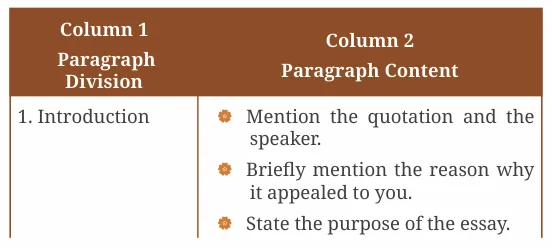
I. Write an essay on any one quotation from speaking activity. Follow the guidelines given below while drafting the essay.

Answer:
Selected Quotation: “Whatever words we utter should be chosen with care for people will hear them and be influenced by them for good or ill.” – Gautama Buddha
1. Introduction
Gautama Buddha once said, “Whatever words we utter should be chosen with care for people will hear them and be influenced by them for good or ill.” I picked this line because it reminds us how powerful our everyday words really are. A few spoken words can easily hurt someone or lift their spirits. The goal of this essay is to explain why we must always think before we speak.
2. Body Paragraph 1: Words have the power to heal or hurt
To start with, what we say directly affects the feelings of people around us. Kind words can give hope to a friend who is feeling down, while rude words can ruin someone’s entire day. For instance, encouraging a classmate before an exam can boost their confidence, but making fun of their mistakes can make them lose faith in themselves. Therefore, choosing gentle words helps create a happy and supportive environment.
3. Body Paragraph 2: Spoken words cannot be taken back
In addition, once a word leaves our mouth, we can never take it back. In anger, we often say harsh things that we regret later. Even if we say sorry, the emotional pain caused by those words often remains in the other person’s mind. Consequently, learning to control our tongue and remaining quiet when we are angry saves us from destroying important relationships.
4. Counterargument
On the other hand, some people argue that being completely honest is more important than choosing words carefully. They believe that sugarcoating the truth hides reality. While telling the truth is necessary, there is always a polite way to say it without being cruel or insulting. So, honesty and care must go hand in hand.
5. Conclusion
To sum up, Buddha’s quotation teaches us a vital life lesson about self-control and empathy. Words are like arrows; once shot, they cannot be recalled. By thinking before we speak, we can make sure our words spread peace and happiness instead of conflict. Ultimately, speaking with care makes us better human beings.