
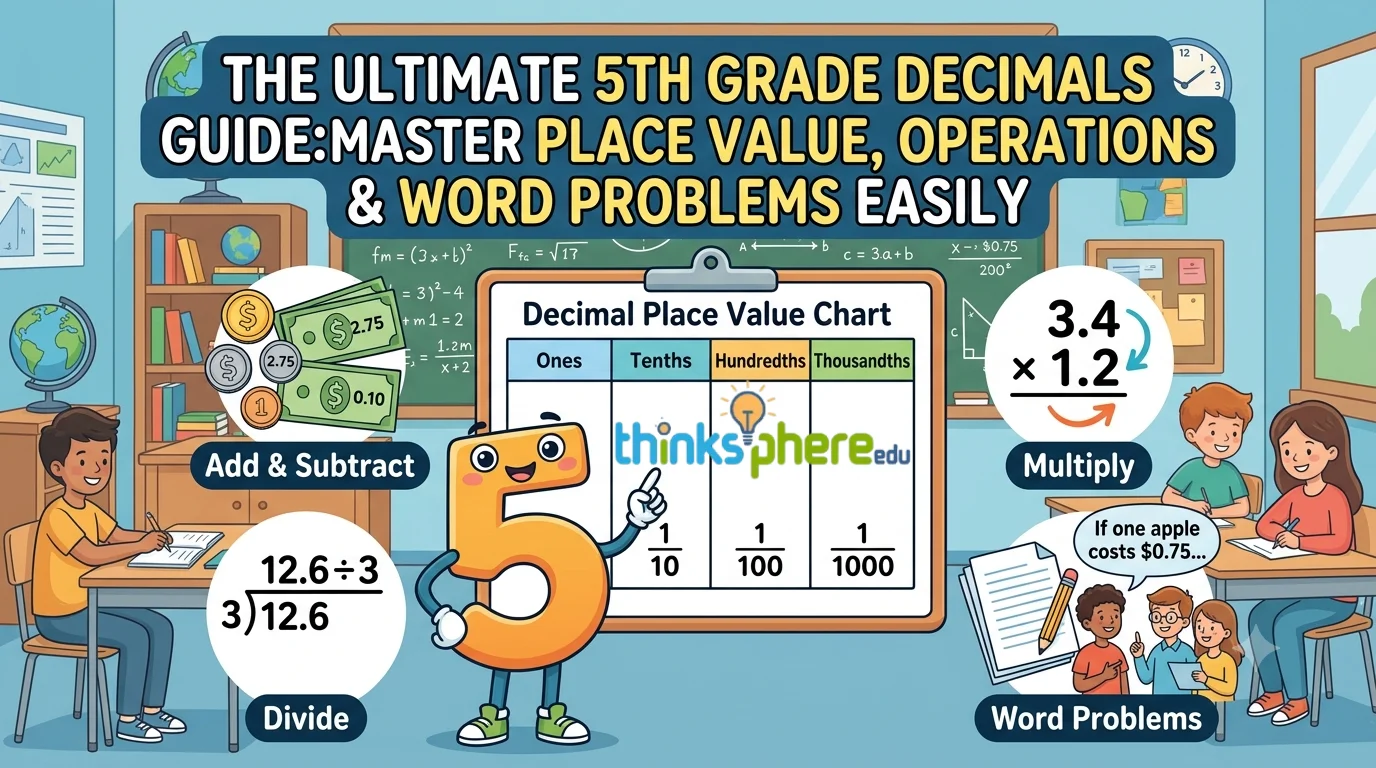

Welcome to your complete, friendly 5th grade decimals guide! Whether you are a student looking to conquer math class, a parent helping with homework, or a teacher searching for clear explanations, you have landed in the right spot.
Decimals can feel tricky at first because they introduce numbers smaller than 1. But here is the secret: if you can count money, you already know how decimals work!
In this comprehensive guide, we will break down every single 5th-grade decimal topic step by step – from basic place value all the way to multiplying, dividing, and solving real-world story problems. Let’s jump in!
Welcome to 5th-grade math on ThinkSphereEdu.com!
Understanding decimals is a core milestone in the Common Core State Standards for 5th Grade Math, as it bridges simple whole-number arithmetic with real-world applications.
- 1. Introduction to Decimals (5th Grade Decimals Guide)
- 2. Decimal Place Value (5th Grade Decimals Guide)
- Tenths (1/10 or 0.1)
- Hundredths (1/100 or 0.01)
- Thousandths (1/1000 or 0.001)
- Quick Summary
- Standard Form
- Word Form
- Expanded Form
- 3. Compare Decimals (Grade 5 Decimal Place Value)
- Example: Compare 0.45 and 0.409
- 4. Order Decimals (Grade 5 Decimal Place Value)
- 5. Round Decimals
- 6. Add Decimals (How to Add and Subtract Decimals 5th Grade)
- 7. Subtract Decimals (Grade 5 Decimal Place Value)
- 8. Multiply Decimals (Grade 5 Decimal Place Value)
- 9. Divide Decimals
- Bonus Skill: Converting Fractions to Decimals (3/8 as a Decimal)
- 10. Decimal Word Problems
K-5 | The Ultimate 5th Grade Decimals Guide
Welcome to your complete, friendly guide to 5th grade decimals! Whether you are a student looking to conquer math class, a parent helping with homework, or a teacher searching for clear explanations, you have landed in the right spot.
Decimals can feel tricky at first because they introduce numbers smaller than 1. But here is the secret: if you can count money, you already know how decimals work!
In this comprehensive guide, we will break down every single 5th-grade decimal topic step by step-from basic place value all the way to multiplying, dividing, and solving real-world story problems. Let’s jump in!
1. Introduction to Decimals (5th Grade Decimals Guide)
What exactly is a decimal?
In simple terms, a decimal is a way of showing a part of a whole number. It represents a fraction whose denominator is a power of 10 (like 10, 100, or 1,000).
Think about a whole dollar bill. If you cut that dollar bill into 100 equal pieces, each tiny piece is worth 1 cent. In math terms, 1 cent is written as $0.01. That tiny point between the 0 and the 01 is called the decimal point.

Introduction to Decimals (5th Grade Decimals Guide)
The decimal point acts like a sturdy fence separating two worlds:
- To the LEFT of the decimal point: Whole numbers ($1, 10, 100$). These represent complete objects or whole dollars.
- To the RIGHT of the decimal point: Fractional parts (tenths, hundredths, thousandths). These represent pieces that are smaller than 1 whole.
Real-World Examples You See Every Day (5th Grade Decimals Guide)
- Money: A slice of pizza costs $2.75. (2 whole dollars and 75 cents out of a hundred).
- Sports: A track runner completes a dash in 12.4 seconds.
- Body Temperature: A normal body temperature reading is around 98.6°F.
2. Decimal Place Value (5th Grade Decimals Guide)
When you learned whole numbers in earlier grades, you learned about ones, tens, hundreds, and thousands. As you move left, each position becomes 10 times larger.
Decimals work the exact same way, but in reverse! As you move right past the decimal point, each position becomes 10 times smaller.

Understanding the Decimal Positions (Grade 5 Decimal Place Value)
Notice how all the decimal place names end with “-ths”. That “-ths” is your clue that you are dealing with parts of a whole!
Tenths (1/10 or 0.1)
The tenths place is the first digit to the right of the decimal point. It represents one part out of ten equal parts of a whole.
Example: If a pizza is divided into 10 equal slices, one slice represents 1 tenth, which can be written as 0.1.
Hundredths (1/100 or 0.01)
The hundredths place is the second digit to the right of the decimal point. It represents one part out of 100 equal parts of a whole.
Example: If a pizza is divided into 100 equal pieces, one piece represents 1 hundredth, which can be written as 0.01.
Thousandths (1/1000 or 0.001)
The thousandths place is the third digit to the right of the decimal point. It represents one part out of 1,000 equal parts of a whole.
Example: If a pizza is divided into 1,000 tiny pieces, one piece represents 1 thousandth, which can be written as 0.001.
Quick Summary
| Place Value | Fraction | Decimal |
|---|---|---|
| Tenths | 1/10 | 0.1 |
| Hundredths | 1/100 | 0.01 |
| Thousandths | 1/1000 | 0.001 |
Three Ways to Write Decimals (Grade 5 Decimal Place Value)
In 5th grade, you will need to read and write decimals in three distinct forms. Let’s use the decimal 3.425 as our example:
Standard Form
Written using digits.
Standard Form = 3.425
Word Form
Written using words. Always read the decimal point as “and”.
Word Form = “Three and four hundred twenty-five thousandths”
Expanded Form
Shows the value of each digit separately.
Expanded Form =
(3 × 1) + (4 × 1/10) + (2 × 1/100) + (5 × 1/1000)
Or in decimal notation:
3 + 0.4 + 0.02 + 0.005
3. Compare Decimals (Grade 5 Decimal Place Value)
Comparing decimals means figuring out which number is larger, which is smaller, or if they are equal. We use three main mathematical symbols:
- > (Greater Than)
- < (Less Than)
- = (Equal To)
Step-by-Step Rule for Comparing Decimals
- Line up the decimal points vertically.
- Compare digits from left to right, starting with the highest place value (whole numbers).
- Find the first place value where the digits are different. The number with the larger digit in that spot is the greater decimal.
- Fill in empty trailing spots with zeros (placeholder zeros) so both numbers have the same number of digits.
Example: Compare 0.45 and 0.409
At first glance, 409 looks bigger than 45. But remember: we must look at place value, not length!
- Step 1: Line them up vertically.
0.450
0.409
(Notice we added a trailing 0 to 0.45 so both numbers have three decimal places).
- Step 2: Compare starting from the left.
- Ones place: Both have 0. Move right.
- Tenths place: Both have 4. Move right.
- Hundredths place: 0.450 has a 5, while 0.409 has a 0.
Since 5 is greater than 0, 0.450 is larger! 0.45>0.409
4. Order Decimals (Grade 5 Decimal Place Value)
Ordering decimals is simply comparing three or more numbers and arranging them in a specific sequence:
- Least to Greatest (Ascending order / Smallest to Largest)
- Greatest to Least (Descending order / Largest to Smallest)
Example: Order these numbers from Least to Greatest
1.2, 1.08, 1.25, 1.009
- Step 1: Add placeholder zeros so all numbers have three decimal places.
- 1.200
- 1.080
- 1.250
- 1.009
- Step 2: Line them up vertically and compare from left to right.
All four numbers start with $1$ in the ones place. Look at the tenths place:
- 1.080 has 0 tenths
- 1.009 has 0 tenths
- 1.200 has 2 tenths
- 1.250 has 2 tenths
The two numbers with 0 in the tenths place (1.080 and 1.009) are smaller than the ones with 2 in the tenths place. Compare 1.080 and 1.009 at the hundredths place:
- 1.009 has 0 hundredths –> Smallest (1st)
- 1.080 has 8 hundredths –> 2nd Smallest
Final Answer (Least to Greatest): 1.009, 1.08, 1.2, 1.25
5. Round Decimals
Rounding makes numbers simpler to work with while keeping their value close to what it was. In 5th grade, you will round decimals to the nearest whole number, tenth, or hundredth.
The Universal Rounding Poem
Underline the digit, look next door.
5 or higher, add one more!
4 or lower, keep the score (stays the same)!
Everything behind turns into a zero… or disappears!
Example 1: Round 4.378 to the nearest tenth.
- Underline the digit in the tenths place: 4.378
- Look next door to the right (hundredths place): the digit is 7.
- Apply the rule: Since 7 ≥ 5, round the underlined 3 UP to 4.
- Drop all digits to the right.
Result – 4.4
6. Add Decimals (How to Add and Subtract Decimals 5th Grade)
Adding decimals is almost identical to adding whole numbers. The most important golden rule to remember is: ALWAYS LINE UP THE DECIMAL POINTS!

Steps to Add Decimals
- Write the numbers vertically so their decimal points align straight down like buttons on a shirt.
- Fill in empty spaces with placeholder zeros so both numbers have the same number of columns.
- Bring the decimal point straight down into your answer line.
- Add from right to left, regrouping (carrying over) just like normal addition.
Example: Solve 14.85 + 6.3

Walkthrough
- 5 + 0 = 5
- 8 + 3 = 11 (Write 1, Carrry 1)
- 1 + 4 + 6 = 11 (write 1, carry 1)
- 1 + 1 = 2
- Final Sum: 21.15
7. Subtract Decimals (Grade 5 Decimal Place Value)
Just like addition, subtraction relies entirely on aligning your decimal points!
Steps to Subtract Decimals
- Line up the decimal points vertically.
- Add placeholder zeros to the top or bottom number if needed. (This step is essential in subtraction!)
- Bring the decimal point straight down into your answer.
- Subtract from right to left, borrowing (regrouping) when the top digit is smaller than the bottom digit.
Example: Solve 15.4 – 8.26
Notice that 15.4 has only one decimal place, while 8.26 has two. We must attach a placeholder zero to 15.4 to make it 15.40.

Walkthrough:
- In the hundredths column, we cannot do 0 – 6. Borrow 1 from the 4 (tenths), turning 4 into 3 and 0 into 10.
- 10-6 = 4
- 3-2= 1
- 15-8 = 7
Final Difference: 7.14
8. Multiply Decimals (Grade 5 Decimal Place Value)
Here is a big surprise: When multiplying decimals, you do NOT line up the decimal points!
Instead, pretend the decimal points don’t exist, multiply the numbers as if they were regular whole numbers, and then count up place values to place the decimal point in your final answer.
Steps to Multiply Decimals
- Ignore the decimal points and rewrite the problem as whole-number multiplication.
- Multiply using standard algorithm methods.
- Count the total number of digits behind (to the right of) the decimal points in both original factors.
- Starting from the far right of your final answer, jump to the left that exact number of places and drop your decimal point!
Example: Solve 3.24 X 1.5
Step 1: Count decimal places in the factors.
- 3.24 –> 2 decimal places
- 1.5 –> decimal Place
- Total decimal places required in answer: 2 + 1 = 3 decimal places.
Step 2: Multiply as whole numbers (324 X 15).

Step 3: Move the decimal point 3 places to the left in 4860.
4860. –> 486.0 –> 48.60 –> 4.860 or 4.86
Final Product: 4.86
9. Divide Decimals
Division with decimals can feel intimidating, but we can make it simple with one key trick: always turn your divisor into a whole number first!
Terms to Know
Dividend / Divisor = Quotient
- Dividend (inside the house): 12.6
- Divisor (outside the house): 0.3
Part 1: Dividing a Decimal by a Whole Number
If your divisor is already a digit, you do not need to shift anything! Just drag the decimal point right up to the roof of the division bar and divide as usual.
Example: 14.4 ÷ 6

Part 2: Dividing a Decimal by Another Decimal (decimal to fraction)
If your divisor has a decimal point, follow the “Shift and Slide” rule:
- Shift the decimal point in the divisor all the way to the right to make it a whole number.
- Slide the decimal point in the dividend to the right by the exact same number of hops.
- Bring that new decimal point straight up onto the quotient roof.
- Divide as usual!
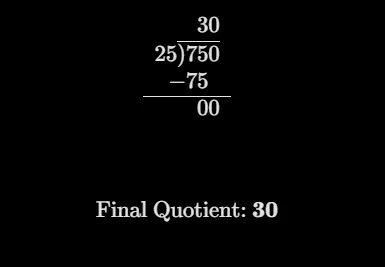
Example: Solve 7.5 ÷ 0.25
- Divisor is 0.25. Shift the decimal 2 places to the right to make it 25.
- Dividend is 7.5. Slide its decimal 2 places to the right (add a trailing zero) to make it 750.
- Now solve the updated problem: 750 ÷ 25.
Bonus Skill: Converting Fractions to Decimals (3/8 as a Decimal)
Sometimes in 5th grade math, you will come across fractions that need to be rewritten as decimals. Here is a secret trick: every fraction bar is secretly a division sign!
To convert any fraction into a decimal, simply divide the top number (numerator) by the bottom number (denominator).
Let’s look at a common example you will see on math tests: finding 3/8 as a decimal.
- Fraction: 3/8
- Division Problem: 3 ÷ 8
Step-by-Step Long Division:
- Set up the division: Since 8 cannot go into 3, write a 0 above the 3 and add a decimal point after it (3.0).
- Move the decimal point: Bring the decimal point straight up to your answer line.
- First division step: Ask yourself, how many times does 8 go into 30? It goes in 3 times (8 X 3 = 24). Subtract 24 from 30 to get a remainder of 6.
- Second division step: Add another zero (3.00) and bring it down to make 60. Ask, how many times does 8 go into 60? It goes in 7 times (8 X 7 = 56). Subtract 56 from 60 to get 4.
- Final division step: Add one last zero (3.000) and bring it down to make 40. Ask, how many times does 8 go into 40? It goes in exactly 5 times (8 X 5 = 40). No remainder is left!
Result: 3/8 as a decimal is equal to 0.375 (three hundred seventy-five thousandths).
10. Decimal Word Problems
Math in the real world is almost always delivered as a story! Solving decimal word problems is all about reading carefully and picking out key operator words.
Common Keyword Clues
- Addition Keywords: in all, total, combined, altogether, sum, spent in total.
- Subtraction Keywords: how much more, difference, remaining, left over, change back, heavier than.
- Multiplication Keywords: each (when finding a total), per, area of, times as many.
- Division Keywords: split equally, shared evenly, per (when finding unit price), cut into equal pieces.
Practice Problem 1: Money & Subtraction
Problem: Maya went to the school book fair with a $20.00 bill. She bought a journal for $6.45 and a pack of gel pens for $3.80. How much change should Maya receive?

Answer: Maya should receive $9.75 in change.
K-5 | 5th Grade Decimals Practice Worksheet & Answer Key
Test your skills with this complete review worksheet! Grab a piece of paper and pencil before checking the answers below.
Part A: Place Value & Forms
- Write 5.063 in word form.
- Write “Fourteen and seven hundredths” in standard form.
- What is the place value of the underlined digit in 8.391?
Part B: Comparing & Rounding
- Insert >, >, =: 3.208 _____ 3.28
- Round 18.462 to the nearest tenth.
- Round 0.897 to the nearest hundredth.
Part C: Operations
- 19.4 + 5.82 = ________
- 42.1 – 8.35 = ________
- 6.3 X 0.4 = ________
- 15.6 ÷ 3 = ________
- 3.75 ÷ 0.5 = ________
Part D: Word Problem
Liam bought 3.5 pounds of apples at $1.60 per pound. How much did he pay in total?
K-5 | Answer Key & Step-by-Step Solutions
1. Five and sixty-three thousandths (Note: “and” represents the decimal point).
2. 14.07 (Notice the zero in the tenths spot so the 7 is in the hundredths spot).
3. Hundredths place (The digit is 9, which represents 0.09).
4. 3.208 < 3.28 (Comparing hundredths: 0 is less than 8).
5. 18.5 (Look at 6 in hundredths spot; round 4 up to 5).
6. 0.90 (Look at 7 in thousandths spot; 9 rounds up to 10, carrying over to make 0.90).
7. 25.22
8. 33.75
9. 2.52 (63 X 4 = 252. Count 2 total decimal places –> 2.52.)
10. 5.2 (15.6 ÷ 3 = 5.2 (decimal moves straight up)}.
11. 7.5 ($$\text{Shift decimal 1 place right: } 37.5 ÷ 5 = 7.5)
12. $5.60 (3.5 X 1.60 = 5.600 –> $5.60