

Kaveri | CBSE | Canvas of Soil Questions And Answers | NCERT Solutions For Class 9 English Literature Chapter 6 | Unit 3 | Kaveri | Class IX | Best Guide 2026. It is required for Grade 9 students to build a strong foundation in the subject, and NCERT Solutions For Class 9 English Literature Chapter 6. Understanding the chapter thoroughly helps students grasp key concepts, improve comprehension, and perform well in exams.
In this article, Kaveri | CBSE | Canvas of Soil Poem Questions And Answers | NCERT Solutions For Class 9 English Literature Chapter 6 | Kaveri | Class IX | Best Guide 2026, we (ThinkSphereEdu.com) provide a detailed Canvas of Soil Summary by Maya Anthony to make learning easier and more effective. Whether you are a student looking for well-explained solutions or a parent guiding your child, this guide will be a helpful resource for mastering the chapter with confidence.
- Canvas of Soil PDF Download: (Canvas of Soil Questions And Answers)
- Canvas of Soil Summary in English: (Canvas of Soil Questions And Answers)
- Canvas of Soil Summary in Hindi: (Canvas of Soil Questions And Answers)
- Canvas of Soil Summary in Bengali: (Canvas of Soil Questions And Answers)
- Reflect and Respond: (Canvas of Soil Questions And Answers) Page – 86
- Check Your Understanding: (Canvas of Soil Questions And Answers) Page – 87
- Critical Reflection: (Canvas of Soil Poem Questions And Answers) Page – 89
- Vocabulary in Context: (Canvas of Soil Questions And Answers) Page – 92
- Listen and Respond: (Canvas of Soil Questions And Answers) Page – 93
- Speaking Activity: (Canvas of Soil Questions And Answers) Page – 94
- Writing Task: (Canvas of Soil Questions And Answers) Page – 94
- Learning Beyond the Text: (Canvas of Soil Question Answer) Page – 95
- A Sea of Foliage Girds Our Garden Round Poem Question Answer | Toru Dutt Page – 95
CBSE | Kaveri | Canvas of Soil Questions And Answers Solved | Class 9 | English Literature | Must Read
Canvas of Soil PDF Download: (Canvas of Soil Questions And Answers)
Canvas of Soil Summary in English: (Canvas of Soil Questions And Answers)
The poem “Canvas of Soil” shows how a garden is like a beautiful painting. The poet compares soil to a canvas and seeds to brushstrokes. Gardeners are shown as artists who carefully plant seeds and wait for them to grow. When spring comes, the garden becomes full of colorful flowers and greenery, just like a painting full of life.
This poem also tells us that gardening is not just work, but a creative activity. With care and patience, people can turn simple land into something beautiful. In this way, the poem connects art with nature and shows how life and creativity come together in a garden.
Canvas of Soil Summary in Hindi: (Canvas of Soil Questions And Answers)
कविता “कैनवस ऑफ़ सॉयल” (Canvas of Soil) दिखाती है कि एक बगीचा किस तरह एक खूबसूरत पेंटिंग जैसा होता है। कवि मिट्टी की तुलना एक कैनवस से और बीजों की तुलना ब्रश के स्ट्रोक्स से करता है। बागवानों को कलाकारों के रूप में दिखाया गया है, जो बड़ी सावधानी से बीज बोते हैं और उनके बढ़ने का इंतज़ार करते हैं। जब वसंत आता है, तो बगीचा रंग-बिरंगे फूलों और हरियाली से भर जाता है—ठीक वैसे ही, जैसे कोई पेंटिंग जीवन से लबालब हो।
यह कविता हमें यह भी बताती है कि बागवानी महज़ एक काम नहीं, बल्कि एक रचनात्मक गतिविधि है। देखभाल और धैर्य के साथ, लोग ज़मीन के एक साधारण से टुकड़े को किसी खूबसूरत चीज़ में बदल सकते हैं। इस तरह, यह कविता कला को प्रकृति से जोड़ती है और दिखाती है कि एक बगीचे में जीवन और रचनात्मकता किस तरह एक साथ आते हैं।
Canvas of Soil Summary in Bengali: (Canvas of Soil Questions And Answers)
“ক্যানভাস অফ সয়েল” (Canvas of Soil) কবিতাটি তুলে ধরে যে, একটি বাগান কীভাবে একটি সুন্দর চিত্রকর্মের মতো হয়ে ওঠে। কবি মাটিকে তুলনা করেছেন একটি ক্যানভাসের সাথে এবং বীজগুলোকে তুলনা করেছেন তুলির আঁচড়ের সাথে। এখানে মালিদের চিত্রিত করা হয়েছে শিল্পী হিসেবে—যারা অত্যন্ত যত্নসহকারে বীজ রোপণ করেন এবং সেগুলোর বেড়ে ওঠার অপেক্ষায় থাকেন। যখন বসন্ত সমাগত হয়, তখন বাগানটি রঙিন ফুল ও সবুজে পরিপূর্ণ হয়ে ওঠে; ঠিক যেন প্রাণবন্ত এক চিত্রকর্ম।
এই কবিতাটি আমাদের এও জানায় যে, বাগান করা কেবলই একটি কাজ নয়, বরং এটি একটি সৃজনশীল কর্ম। সঠিক যত্ন ও ধৈর্যের মাধ্যমে মানুষ সাধারণ একখণ্ড জমিকে অসাধারণ সৌন্দর্যে রূপান্তরিত করতে পারে। এভাবেই কবিতাটি শিল্পকে প্রকৃতির সাথে সংযুক্ত করে এবং দেখিয়ে দেয় যে, একটি বাগানের মাঝে জীবন ও সৃজনশীলতা কীভাবে একে অপরের সাথে একাকার হয়ে যায়।
Canvas Of Soil Question Answer | Exam Preparation | 2026-27
Reflect and Respond: (Canvas of Soil Questions And Answers) Page – 86
I. Work in pairs. Discuss what all you see in a garden. Think of the colours you see and where you see them. Share your responses with your teacher.
Answer: In a garden, I see many beautiful things like flowers, trees, grass, butterflies, birds, and benches. There are many colours in the garden. I see green in the leaves and grass, red in roses, yellow in sunflowers, pink in different flowers, and blue in the sky above. The garden looks very colourful and peaceful.
II. Look at the picture of a garden and a painting given below. Speak about any similarities between the garden and the painting.
Speak Using the following:
- Just as a garden ______, similarly, a painting _________.
- A garden and a painting, both __________.
- ___________ is common to both a garden and a painting.
- Like a garden, a painting too ___________

Answer:
- Just as a garden has many colourful flowers and plants, similarly, a painting has many bright colours and designs.
- A garden and a painting, both look beautiful and attractive.
- Colours is common to both a garden and a painting.
- Like a garden, a painting too gives us joy and peace.
Check Your Understanding: (Canvas of Soil Questions And Answers) Page – 87
I. Read the poem again and complete the summary of each stanza by filling in the blanks.
1. The ________ is portrayed as a rich palette where gardeners’ _ _ _ a _ s flourish in the form of ____ , awaiting spring.
Answer: The soil is portrayed as a rich palette where gardeners’ dreams flourish in the form of seeds, awaiting spring.
2. The garden flowers ______ into a beautiful display of di࠵erent b _ _ _ _ _ m s, resembling a ___ by Mother Nature, in the light of morning.
Answer: The garden flowers bloom into a beautiful display of different blossoms, resembling a painting by Mother Nature, in the light of morning.
3. Each garden is likened to a wide _ _ n _ _ s, integrating art and _. Through the efforts of gardeners, gardens transform into still-life _____.
Answer: Each garden is likened to a wide canvas, integrating art and life. Through the efforts of gardeners, gardens transform into still-life paintings.
II. Match the poetic devices in Column 1 to the examples in Column 2. Discuss your responses in pairs. Then share the responses with your classmates and teacher.


Answer:
| 1. Imagery | (iv) colours, brushstrokes, blossoms, shades of green |
| 2. Metaphor | (vi) garden as a painting, plot as canvas, seeds as brushstrokes |
| 3. Rhyme Scheme | (ii) AABB |
| 4. Tone | (i) appreciative |
| 5. Mood | (vii) joyful |
| 6. Speaker | (v) a gardener |
| 7. Alliteration | (iii) “Blossoms bloom” |
Critical Reflection: (Canvas of Soil Poem Questions And Answers) Page – 89
I. Read the given extracts from the poem and answer the questions that follow.
1. Brushstrokes of seeds, planted true,
Awaiting spring’s vibrant hue.
(i) The poet has used a metaphor in ‘Brushstrokes of seeds’. Which option from those given below
uses a metaphor?
- Her mother’s heart heard her heartfelt request with kindness.
- She has a heart of gold.
- Her heart did a dance of joy on seeing the new doll.
- She has a very kind heart.
Answer: She has a heart of gold.
(ii) Complete the sentence appropriately.
The phrase ‘planted true’ is significant because it implies _____.
Answer: The phrase ‘planted true’ is significant because it implies the seeds are planted with care, honesty, and hope for proper growth.
(iii) Why has the poet used the word ‘hue’ instead of ‘colours’ in the extract?
Answer: The poet has used the word ‘hue’ instead of ‘colours’ to make the line more poetic and musical, and also to fit the rhyme with the word “true”.
(iv) Complete the following analogy correctly with a word from the extract.
Summer: hot :: Spring : _______
Answer: hue
(iv) Read the Assertion (A) and the Reason (R) and select the option that is correctly suited.
(A): Gardeners wait for Spring.
(R): Gardens are worth painting in Spring.
- Both (A) and (R) are true and (R) is the correct explanation of (A).
- Both (A) and (R) are true but (R) is not the correct explanation of (A).
- (A) is true but (R) is false.
- (A) is false but (R) is true.
Answer: B. Both (A) and (R) are true but (R) is not the correct explanation of (A).
2. Each plot, a canvas wide,
Where art and life coincide.
(i) What does ‘Each plot’ refer to in this extract?
Answer: ‘Each plot’ refers to each small piece of land or garden where plants are grown.
(ii) Select which option imitates the rhyme scheme of the extract.
- beautiful and clear
laughter and cheer - beautiful and clear
laughter and tears
Answer: A
(iii) Select the line from the extract that conveys that gardening blends aesthetic beauty with natural growth.
Answer: “Where art and life coincide.”
(iv) Complete the following sentence appropriately.
The plot is likened to a canvas suggesting that ___________
Answer: The plot is likened to a canvas suggesting that the garden is like a place where creativity is expressed like a painting.
(v) Why has the poet most likely used the word ‘wide’ instead of ‘long’ in ‘canvas wide’?
Answer: The poet has used the word ‘wide’ instead of ‘long’ to show the vastness and openness of the garden, making it feel like a large canvas for creativity.
II. Give reasons for the comparisons made by the poet in the poem.
- A painter is compared to a gardener because _________.
- A palette is like earth as _________.
- The brushstrokes are like seeds because ________.
- A canvas is similar to a garden plot as _________.
Answer:
- A painter is compared to a gardener because both create something beautiful with care, skill, and imagination.
- A palette is like earth as it holds different colours just like the earth holds different plants and flowers.
- The brushstrokes are like seeds because both are the starting points of creation that later grow into something beautiful.
- A canvas is similar to a garden plot as both are spaces where creativity is expressed and transformed into art.
III. Answer the following questions.
1. How does the metaphor ‘Brushstrokes of seeds’, enhance the understanding of gardening as an art form?
Answer: The metaphor ‘Brushstrokes of seeds’ shows that planting seeds is like painting. Just as a painter uses brushstrokes to create art, a gardener uses seeds to create a beautiful garden. This helps us understand that gardening is also a creative and artistic activity.
2. What can you infer about the poet’s perspective on the relationship between nature and creativity from the following lines?
‘Each plot, a canvas wide,/Where art and life coincide.’
Answer: From these lines, we can understand that the poet believes nature and creativity are closely connected. A garden is not just a natural space, but also a place where human creativity and natural growth come together to create beauty.
3. Do you think the imagery in the poem successfully paints a vivid picture in the reader’s mind? If yes, why? If no, why not?
Answer: Yes, the imagery in the poem successfully paints a vivid picture. The use of words like colours, blossoms, and canvas helps the reader clearly imagine a bright and lively garden, just like a beautiful painting.
4. Support the view that the poet’s mention of the colour yellow, besides red, blue and green, would have lent effectively to the imagery.
Answer: The mention of yellow along with red, blue, and green would make the imagery more colourful and complete. Yellow represents brightness and sunlight, so it would make the picture of the garden even more lively and attractive.
5. Considering the line ‘Gardens become paintings still’, what can you interpret about the poet’s view on the timelessness of nature’s beauty?
Answer: The line ‘Gardens become paintings still’ suggests that the beauty of nature is timeless. Like a painting that stays beautiful forever, the garden’s beauty can be remembered and appreciated for a long time.
6. Justify the title of the poem, ‘Canvas of Soil’.
Answer: The title ‘Canvas of Soil’ is appropriate because the soil is compared to a canvas where gardeners create beauty by planting seeds. Just like artists paint on a canvas, gardeners create colourful and lively gardens on the soil.
Vocabulary in Context: (Canvas of Soil Questions And Answers) Page – 92
I. The poet refers to the shades of green, red, and blue in the poem. Let us read some of the names of different shades of these colours.

Now, Discuss in pairs, any two things that you can associate with these colours.
Answer: Any two for each colour
- Green: Grass, Tree
- Red: Rose, Blood
- Blue: Sky, Ocean
Listen and Respond: (Canvas of Soil Questions And Answers) Page – 93
I. You will listen to a young girl describe her school garden. As you listen identify which of the following 1–3, she does not talk about. (Transcript for teacher on page 264)

Answer: she does not mention anything about a tap or water pipe
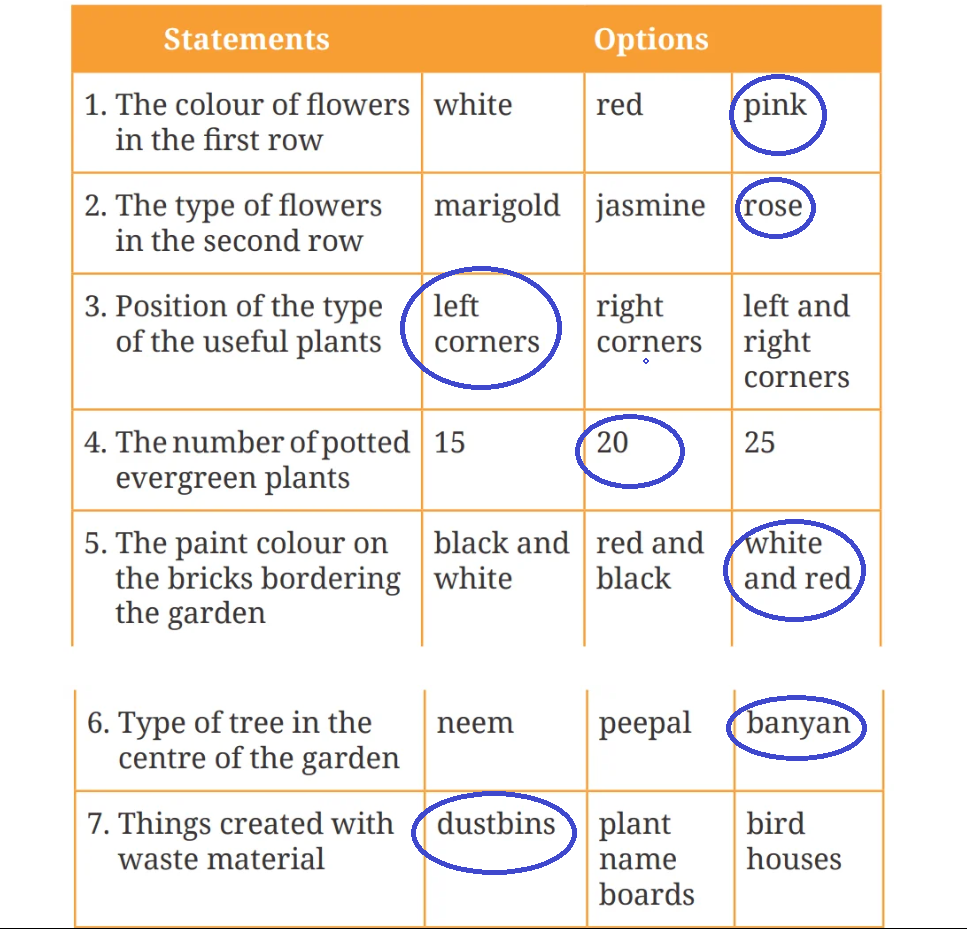
II. You will once again listen to the young girl. As you listen, circle the correct answer from the options given below.


Answer:
Speaking Activity: (Canvas of Soil Questions And Answers) Page – 94
I. People wish to have a garden at home. Some like a flower garden and some a vegetable garden. Think and note some advantages of both these types, as gardens for homes.
Answer:
Advantage of a Flower Garden:
- It makes the home look beautiful and colourful.
- Flowers give a pleasant smell.
- It creates a peaceful and happy environment.
- It attracts butterflies and birds.
Advantages of a Vegetable Garden:
- It provides fresh and healthy vegetables.
- It saves money on buying vegetables.
- Vegetables grown at home are safe and chemical-free.
- It is useful for daily cooking.
II. Would you like to have a flower garden or a vegetable garden at home? Why?
Take turns with your partner and speak your points aloud, one by one, by using the given sentence prompts to express your preference, with reasons.
- I prefer _ to _ because …
- For me , it is a _ instead of a _ due to….
- If I had a choice I’d rather have a ________than a _______ as….
- I would prefer _ rather than _ since ______
Answer:
- I prefer a vegetable garden to a flower garden because it gives fresh vegetables for daily use.
- For me, it is a vegetable garden instead of a flower garden due to its usefulness.
- If I had a choice I’d rather have a vegetable garden than a flower garden as it is healthy and saves
- I would prefer a vegetable garden rather than a flower garden since it is more practical and helpful for my family.
Writing Task: (Canvas of Soil Questions And Answers) Page – 94
I. Write a descriptive piece of two to three paragraphs describing the details and colours in the garden you have visited.
- Focus on how different shades of blue, red, and green interact, create contrast, and bring the garden to life.
- Pay attention to details like the texture of petals, the varying greens of leaves, and the way light affects the colours.
Answer: I once visited a beautiful garden filled with bright and soothing colours. The different shades of green were the first thing I noticed. Some leaves were light green and fresh, while others were dark and thick, giving a sense of depth. The grass looked soft and smooth, like a green carpet spread across the ground. Sunlight falling on the leaves made them shine, creating a mix of light and shadow that made the garden look alive.
Among the greenery, red and blue flowers stood out brightly. The red flowers were bold and eye-catching, with soft and velvety petals that looked rich and warm. In contrast, the blue flowers gave a calm and cool feeling, almost like the sky had come down to rest in the garden. The mix of red and blue with the green background created a beautiful contrast, making each colour look more vibrant.
Learning Beyond the Text: (Canvas of Soil Question Answer) Page – 95
I. Mini-Project (Canvas of Soil Questions And Answers)
Objective: Explore the multifaceted world of gardens-their design, cultural significance, artistic inspiration,
and the art of gardening itself.
Duration: This project can span over a few weeks, allowing students adequate time for research and
creative processes.
Select any TWO assignments. Any one from 1 or 2, and any one from 3 or 4
(1)
- Do research and collect information on any FIVE famous gardens of India, such as Amrit Udyan, Brindavan Gardens, and many others.
- Focus on history, design elements, and cultural significance.
- Prepare a short report and make a presentation.
Answer: India has many beautiful and historic gardens that show art, culture, and nature together.
- Amrit Udyan (Rashtrapati Bhavan, Delhi): This garden was designed during the British period. It has Mughal-style design with lawns, fountains, and many types of flowers. It shows a mix of Indian and European styles.
- Brindavan Gardens (Mysuru): Built near the Krishnarajasagar Dam, it is famous for its musical fountains and terrace design. It is a popular tourist place and looks very beautiful at night.
- Shalimar Bagh (Srinagar): This Mughal garden was built by Emperor Jahangir. It has flowing water channels, fountains, and terraces. It shows the beauty of Mughal architecture and love for nature.
- Lalbagh Botanical Garden (Bengaluru): It was started by Hyder Ali and later developed by Tipu Sultan. It has a large variety of plants and a famous glass house. It is important for plant study and conservation.
- Rock Garden (Chandig: Created by Nek Chand, this garden is made from waste materials like stones, tiles, and broken items. It shows creativity and recycling ideas.
(2)
- Explore various art forms (painting, sculpture) inspired by gardens. Select an art piece and analyse how the garden is represented.
- Create a visual or written response inspired by the garden.
Answer: Many artists have created beautiful artworks inspired by gardens. One famous painting is “The Garden at Sainte-Adresse” by Claude Monet.
In this painting, the garden is shown with bright flowers, green grass, and people enjoying nature. The colours are soft and natural, and the sunlight makes the scene look lively. The artist has used light and colour to show peace and beauty.
The garden in the painting looks like a perfect place for relaxation. It shows how nature can inspire art and bring happiness. The mix of colours and the calm environment make the painting very attractive.
Inspired by this, I would draw a garden with colourful flowers, green trees, and a bright sky. I would use different shades to show light and shadow, making it look like a real and peaceful place.
(3)
Design your own garden
- Design a garden on paper or using digital tools.
- Incorporate elements and artistic inspirations learned from parts (1)/(2).
- Present your choices in design and artistic influences to the class.
Answer: I have designed a small but beautiful garden that combines both beauty and usefulness. The garden has a central green lawn with soft grass, which looks like a natural carpet. Around the lawn, I have added colourful flower beds with red, blue, yellow, and pink flowers to create a bright and attractive look. There is also a small pathway made of stones that goes through the garden, making it easy to walk and enjoy the view.
My design is inspired by Mughal gardens with symmetry and water features, and also by modern gardens that mix beauty with usefulness. I chose these elements to make the garden both relaxing and practical. The combination of colours, greenery, and simple design makes it look like a living painting.
(4)
Interview with a Gardener or Landscaping Expert
- Approach a local gardener or a landscaping expert for an interview.
- Prepare questions focussed on understanding the practical aspects of gardening/landscapping.
- Write a summary of your experience.
Answer: I interviewed a local gardener to understand the practical aspects of gardening. I asked questions about how to take care of plants, how often to water them, and which plants grow best in our area. The gardener explained that regular watering, proper sunlight, and good soil are very important for healthy plants. He also told me that different plants need different care, and we should choose plants according to the season.
He shared that removing weeds and adding natural fertilizers like compost helps plants grow better. He also said that patience is very important in gardening because plants take time to grow. According to him, gardening is not only work but also a relaxing and enjoyable activity.
Overall, this experience was very interesting and useful for me. I learned that gardening needs care, time, and knowledge. It also made me respect the hard work of gardeners and understand how they help in making our surroundings green and beautiful.
A Sea of Foliage Girds Our Garden Round Poem Question Answer | Toru Dutt Page – 95
I. Short Answer Questions (Canvas of Soil Questions And Answers)
1. What does the phrase “a sea of foliage” mean?
Answer: It means a large area full of trees and plants, looking like a green sea.
2. Why does the poet say it is not a “dull unvaried green”?
Answer: Because the garden has many different colours and shades, not just one type of green.
3. Name the trees mentioned in the poem.
Answer: Tamarind, mango, palm, seemul, and bamboo trees.
4. How are the seemul flowers described?
Answer: They are described as bright red and eye-catching, like the sound of a trumpet.
5. What comparison is made about the palm trees?
Answer: Palm trees are compared to grey pillars.
6. What happens to the lotus in the moonlight?
Answer: The white lotus looks like a silver cup in the moonlight.
7. Which part of the garden does the poet find most beautiful?
Answer: The bamboo grove in the moonlight.
II. Reference to Context
1. “And palms arise, like pillars gray, between;”
(i) What figure of speech is used here?
Answer: Simile
(ii) What is compared?
Answer: Palm trees are compared to grey pillars.
2. “Red-red, and startling like a trumpet’s sound.”
(i) What does ‘red-red’ suggest?
Answer: Brightness and intensity of colour.
(ii) What figure of speech is used?
Answer: Simile
III. Long Answer Questions
1. Describe the beauty of the garden in your own words.
Answer: The garden is full of different trees and colours. There are light green tamarinds, dark green mango trees, tall palms, and bright red seemul flowers. The bamboo grove looks especially beautiful in the moonlight, and the lotus appears like a silver cup. The whole garden looks peaceful and magical.
2. How does the poet use imagery in the poem?
Answer: The poet uses vivid images of colours, trees, and light to create a clear picture in the reader’s mind. Words like “light-green,” “red-red,” and “silver” help us imagine the beauty of the garden.
3. What feelings does the poem create in the reader?
Answer: The poem creates feelings of peace, wonder, and admiration for nature’s beauty.
IV. Extra Important Questions
1. What is the central idea of the poem?
Answer: The poem shows the beauty and variety of nature in a garden and how it fills the poet with joy and amazement.
2. Why does the poet compare the garden to Eden?
Answer: Because the garden looks pure, natural, and heavenly, like the paradise of Eden.
3. Explain the line “One might swoon / Drunken with beauty then.”
Answer: It means the beauty of the garden is so overwhelming that a person may feel lost or amazed by it.